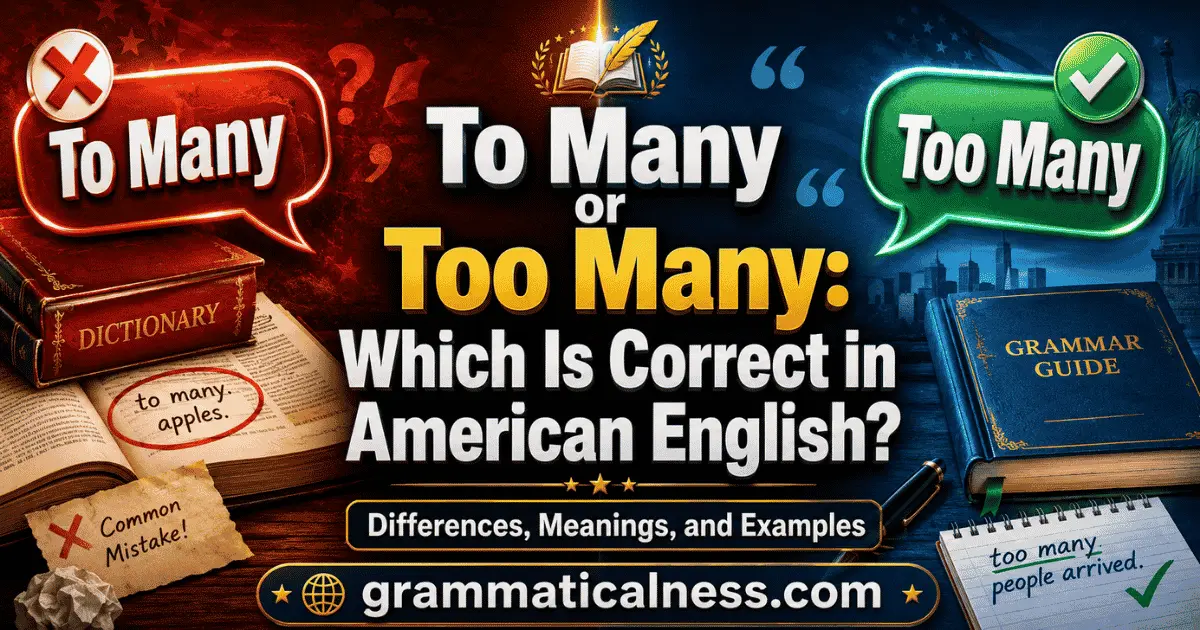
When you mean an excessive number, too many is correct.
For example:
There are too many cars in the parking lot.
However, to many is not always an error. The two words can appear together when to works as a preposition:
The survey was sent to many customers.
The real difference is therefore not simply “correct versus incorrect.” The choice depends on what to or too is doing in the sentence.
Quick Answer
Use too many when you mean more people or things than are needed, wanted, suitable, or manageable.
We received too many applications for the available positions.
Use to many only when to has its own grammatical job, usually introducing people or things connected with an action:
We sent invitations to many neighbors.
A simple test helps: if you mean an excessive number, choose too many.
Why People Confuse Them
The confusion comes mainly from to and too sounding alike, especially when spoken clearly or with emphasis.
In everyday speech, to is also often pronounced more weakly, almost like “tuh.” Still, pronunciation does not always make the spelling obvious.
The meanings are different.
Too can express excess.
To usually shows a relationship such as direction, connection, or who receives an action.
That single extra o changes the grammatical job of the word.
Key Differences At A Glance
| Context | Best Choice | Why |
| More emails than you can handle | too many | Expresses an excessive number |
| An update was sent to numerous employees | to many | To introduces the recipients |
| More mistakes than acceptable | too many | Shows that a number exceeds a limit |
| A rule is familiar to numerous people | to many | To connects the description with a group |
| More appointments than your schedule allows | too many | Describes excess |
The key contrast is simple:
- too many = an excessive number
- to many = to performing its normal prepositional role before many
They are not interchangeable.
Meaning and Usage Difference
Too many combines too, meaning more than is appropriate or needed, with many, a quantity word used with countable people or things.
You can say:
too many emails
too many cars
too many meetings
too many mistakes
It can also stand without a following noun when the missing noun is obvious:
We ordered eight pizzas, but that was too many.
To many works differently. It is not a quantity expression meaning excess.
Here, to is normally a preposition, while many refers to a large number of people or things:
The message was forwarded to many employees.
The problem is familiar to many.
In both examples, removing or changing to would change the sentence structure.
Recommended outbound source: Merriam-Webster — Too Definition & Meaning
https://www.merriam-webster.com/dictionary/too
Tone, Context, and Formality
Too many usually carries the idea that a number has crossed some limit. Because of that, it often sounds negative, critical, inconvenient, or cautionary.
There are too many errors in this report.
The exact limit depends on context. Ten guests may be too many for a small table but not for a large event.
To many has no built-in sense of excess or criticism.
The new policy was explained to many employees.
Both constructions can appear naturally in casual conversation, school writing, business communication, and formal prose. The difference is not mainly formality. It is meaning and sentence structure.
Which One Should You Use?
Ask one question:
Do I mean more than is needed, wanted, or suitable?
If yes, use too many.
I have too many tabs open.
We scheduled too many meetings this week.
If no, check whether to is needed to show a recipient, connection, direction, or relationship.
The company donated supplies to many schools.
That concern is important to many parents.
Another useful test is to replace too many with an excessive number of.
There are an excessive number of complaints.
If that keeps your intended meaning, too many is probably the right choice.
When One Choice Sounds Wrong
Using to many for excess is incorrect:
Incorrect: There are to many people in the room.
Correct: There are too many people in the room.
The sentence describes an excessive number, so it needs too.
The reverse mistake also occurs:
Incorrect: We sent the announcement too many customers.
Correct: We sent the announcement to many customers.
Here, the customers receive the announcement. The sentence needs the preposition to, not the excess word too.
Context controls the spelling.
Common Mistakes (and Quick Fixes)
A common error is dropping the second o when describing excess.
Wrong: I made to many mistakes.
Right: I made too many mistakes.
Another error is adding an extra o before a recipient.
Wrong: The company gave refunds too many customers.
Right: The company gave refunds to many customers.
Also remember that too many normally refers to things that can be counted individually.
Correct: too many messages
Correct: too many chairs
Correct: too many delays
For an uncountable quantity, English normally uses too much instead:
too much information
A useful memory trick is that too has an extra o, and too many describes an extra or excessive number.
Everyday Examples
Too many:
There are too many cars on this street during rush hour.
I signed up for too many classes this semester.
We bought too many snacks for the road trip.
She has too many unread emails to answer tonight.
The report contains too many small errors.
To many:
The teacher gave extra practice sheets to many students.
That restaurant is familiar to many people in the neighborhood.
We emailed the updated schedule to many clients.
The decision came as a surprise to many.
The program provides free meals to many families.
Notice that to many normally belongs inside a larger structure. It does not replace too many when the meaning is excess.
Dictionary-Style Word Details
Verb
To many: The expression is not a verb. In valid uses, to is usually a preposition before many. Although to can also mark an infinitive elsewhere, that is not its role in a sequence such as “to many customers.”
Too many: The expression is not a verb. It describes or refers to an excessive number.
Noun
To many: The full expression is not a noun. However, many can stand independently after the preposition when the people or things are understood: “The issue matters to many.”
Too many: The full expression is not a noun. It can stand alone when an understood plural count noun has been omitted: “We ordered ten, but that was too many.”
Synonyms
To many: There is no exact synonym for the whole sequence because its meaning depends on the surrounding sentence. In some contexts, phrases such as for many may be close, but they are not automatically interchangeable.
Too many: Closest plain alternatives include an excessive number of, more than needed, more than wanted, and more than can be handled, depending on context.
A useful opposite for too many is too few when contrasting excessive and insufficient numbers. To many has no fixed antonym as a whole expression.
Example Sentences
To many:
- The change was unexpected to many residents.
- We distributed the instructions to many volunteers.
- The problem is already known to many.
Too many:
- There are too many boxes in the hallway.
- I have too many appointments this afternoon.
- Three desserts would be too many for me.
Word History
To many: This sequence combines to with many. To comes from an old English function word used for relationships such as direction and connection, while many has long expressed a large indefinite number.
Too many: Too is historically related to to, but modern English gives the spellings different grammatical functions. In too many, too expresses excess. Many also has an old history in English.
Neither two-word combination needs to be treated as a single word with its own separate origin.
Phrases Containing
To many:
- known to many
- important to many
- available to many
- sent to many people
- familiar to many of us
These are normal sentence combinations rather than one fixed idiom.
Too many:
- too many to count
- one too many
- have a few too many
- too many cooks
- far too many
These expressions keep the core idea of an excessive or greater-than-desired number.
FAQs
Use too many when you mean an excessive number of people or things. For example, “There are too many cars on the road.” However, to many can also be correct when to works as a preposition, as in “The message was sent to many customers.”
Too many means more than is needed, wanted, suitable, or manageable. It is normally used with plural countable nouns. Examples include “too many emails,” “too many mistakes,” and “too many meetings.”
Yes. To many is correct when the word to has its normal grammatical role before many. For example, “The new policy was explained to many employees.” In this sentence, to introduces the people who received the explanation.
Both can be correct, but they mean different things. “There are too many people here” means the number is excessive. “We spoke to many people” means we spoke with a large number of people.
The correct form is too many times when you mean something happened more often than desired. For example, “I have reminded him too many times.” To many times is not correct for that meaning.
Think of the extra o in too as suggesting something extra or excessive. Use too many for more than needed. Use to many only when to belongs naturally to the sentence structure, such as “important to many people.”
Conclusion
Use too many when you mean an excessive number:
There are too many people waiting.
Use to many only when to has its own grammatical role:
The notice was sent to many people.
The fastest test is to look for the idea of excess. If the sentence means more than needed, wanted, or suitable, the correct choice is too many. If to introduces a recipient, connection, or relationship before many, then to many can be completely correct.