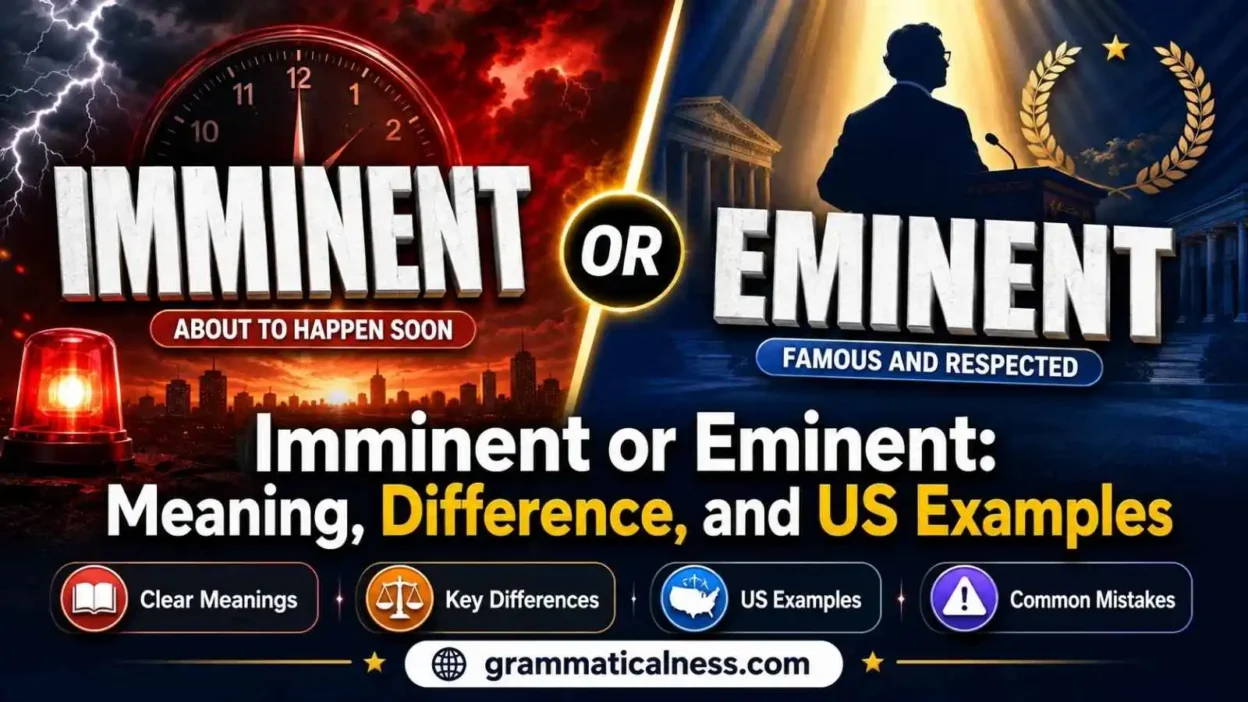
Imminent and eminent look and sound similar, but they express different ideas. One tells readers that something will happen very soon. The other describes a person or thing that stands out because of importance, skill, or respect.
Choosing the wrong word can completely change your sentence. An imminent storm is approaching, while an eminent scientist is highly respected.
Quick Answer
Use imminent for something that is about to happen, such as an imminent storm, deadline, arrival, or decision. Use eminent for someone or something distinguished, respected, or prominent, such as an eminent professor or author. They are both adjectives, but they are not interchangeable.
Why People Confuse Them
The words have nearly identical spellings. Each contains three syllables and ends in -minent.
Their pronunciations are also close. Imminent sounds like IM-uh-nent, while eminent sounds like EM-uh-nent. The first vowel is the main difference in careful speech.
Because the sound difference is small, writers may remember the correct meaning but type the wrong first letter.
Key Differences At A Glance
| Context | Best Choice | Why |
| Something will happen very soon | Imminent | It expresses closeness in time |
| A danger or threat is approaching | Imminent | It signals urgency or nearness |
| An arrival or announcement is expected shortly | Imminent | The event is close to happening |
| A professional is highly respected | Eminent | It describes distinction or reputation |
| A person or institution stands out in a field | Eminent | It indicates recognized importance |
| The legal expression about government acquisition of property | Eminent | Eminent domain is the established phrase |
| Feature | Imminent | Eminent |
| Core idea | Happening soon | Distinguished or prominent |
| Main question answered | When will it happen? | How respected or important is it? |
| Common partners | Danger, arrival, threat, decision | Scholar, professor, expert, author |
| Typical tone | Urgent or anticipatory | Formal and approving |
Meaning and Usage Difference
Imminent means that an event is close to happening. It describes timing rather than importance.
Examples include an imminent deadline, an imminent storm, or an imminent announcement. The event does not have to be negative. However, the word frequently appears with danger, threats, crises, and other serious situations.
Eminent means distinguished, prominent, or highly respected. It commonly describes people who have earned recognition in a profession or field.
An eminent surgeon is not merely a surgeon who is well known. The wording suggests recognized skill, standing, or achievement.
The basic distinction is therefore nearness in time versus distinction in status.
Tone, Context, and Formality
Imminent has a serious, anticipatory tone. It often creates urgency because it suggests that little time remains before something happens.
For example, “The bridge is in imminent danger of collapse” sounds more urgent than saying the bridge may collapse someday.
Still, imminent can appear in neutral contexts:
“The company’s announcement is imminent.”
Eminent sounds formal and approving. It is common in professional, academic, historical, medical, and cultural writing.
In casual conversation, people may use respected, leading, or well-known instead. In formal writing, eminent gives stronger emphasis to recognized distinction.
Which One Should You Use?
Ask what your sentence is describing.
Choose imminent when the main idea is that an event is very close:
“The vote is imminent.”
Choose eminent when the main idea is that someone or something has high standing:
“She is an eminent legal scholar.”
A simple memory aid can help:
- Imminent begins like immediate. Both relate to something close in time.
- Eminent begins with the same letter as esteemed. Both can relate to respect.
These associations are memory aids, not explanations of the words’ origins.
When One Choice Sounds Wrong
Eminent deadline sounds wrong because a deadline is not respected or distinguished. The deadline is approaching, so imminent deadline is the logical choice.
Imminent professor also sounds wrong in an ordinary sentence. A professor is a person, not an approaching event. A highly respected professor is eminent.
However, the professor’s arrival may be imminent:
“The eminent professor’s arrival is imminent.”
Here, each word performs a different job. Eminent describes the professor’s standing, while imminent describes the timing of the arrival.
Common Mistakes (and Quick Fixes)
Mistake: The town faced eminent danger.
Fix: The town faced imminent danger.
Danger can approach, so the timing word is required.
Mistake: We invited an imminent historian.
Fix: We invited an eminent historian.
The historian is respected, not about to occur.
Mistake: The product update next year is imminent.
Fix: Use imminent only when the update is genuinely close in the relevant context.
Mistake: He became eminent after one popular video.
Fix: Use eminent when the context supports recognized distinction, not simply brief attention.
Mistake: The city used imminent domain.
Fix: The established legal expression is eminent domain.
Everyday Examples
- Meteorologists warned residents that severe flooding was imminent.
- With the deadline imminent, the team completed the final review.
- The hospital consulted an eminent heart specialist.
- She studied under an eminent professor of constitutional law.
- Officials said a final decision was imminent.
- The imminent arrival of the guests sent everyone into the kitchen.
- Several eminent authors attended the literary event.
- The building was closed because inspectors found an imminent safety risk.
- His work made him an eminent figure in modern architecture.
- Although the scientist was eminent, her retirement was not imminent.
Dictionary-Style Word Details
Verb
- Imminent: Not commonly used as a verb in standard US English. It functions as an adjective.
- Eminent: Not commonly used as a verb in standard US English. It functions as an adjective.
Noun
- Imminent: The exact word is not normally used as a noun.
- Eminent: The exact word is not normally used as a noun.
Synonyms
- Imminent: Impending, looming, approaching, near at hand.
- Eminent: Distinguished, prominent, renowned, notable, respected.
Closest opposites for imminent include distant and remote. Closest opposites for eminent include obscure and undistinguished.
The alternatives are not interchangeable in every sentence, so the surrounding meaning still matters.
Example Sentences
- Imminent: The evacuation order suggested that danger was imminent.
- Imminent: An announcement about the new office is imminent.
- Imminent: With graduation imminent, Maya began applying for jobs.
- Eminent: An eminent physician reviewed the difficult case.
- Eminent: The museum displayed work by several eminent photographers.
- Eminent: He became one of the field’s most eminent researchers.
Word History
Both words developed from closely related Latin forms connected with projecting or standing out.
Eminent developed from a form carrying the idea of standing out. That physical idea later supported the meaning of being prominent or distinguished.
Imminent developed from a form associated with projecting over or threatening. This background helps explain its modern sense of something hanging close or about to happen.
Their related histories help explain the similar spellings, but their present meanings remain clearly separate.
Phrases Containing
- Imminent danger: Danger that is close and may occur at any moment.
- Imminent threat: A threat that is approaching or requires prompt attention.
- Imminent arrival: An arrival expected very soon.
- Eminent scholar: A highly respected academic expert.
- Eminent authority: A person recognized as a leading expert.
- Eminent domain: A fixed legal expression concerning government authority to acquire private property for public use under applicable law. It is never imminent domain.
FAQs
Is it imminent danger or eminent danger?
The correct phrase is imminent danger. It means that the danger is close and may happen very soon. Eminent danger is incorrect because eminent describes someone or something distinguished, respected, or prominent rather than an approaching threat.
What is the main difference between imminent and eminent?
Imminent relates to time and means “about to happen.” Eminent relates to reputation or importance and means “highly respected or distinguished.” For example, a storm may be imminent, while a well-known and respected scientist may be eminent.
Can imminent describe positive events?
Yes. Although imminent often appears with serious words such as danger, threat, and collapse, it can also describe positive or neutral events. You can refer to an imminent promotion, an imminent arrival, an imminent celebration, or an imminent announcement.
Can eminent describe something other than a person?
Yes. Eminent most often describes respected people, such as an eminent professor, doctor, or writer. However, it may also describe a distinguished position, institution, achievement, or quality when the context clearly shows importance, excellence, or prominence.
How can I remember imminent versus eminent?
Connect imminent with immediate because both relate to something close in time. Connect eminent with esteemed because both may describe respect or high standing. These simple associations can help you remember which spelling matches your intended meaning.
Is imminent domain correct?
No. The correct legal phrase is eminent domain. It refers to the government’s legal authority to acquire private property for public use under applicable laws and compensation requirements. Imminent domain is incorrect because the phrase concerns authority, not something about to happen.
Conclusion
Use imminent when something is close to happening. Use eminent when a person or thing stands out because of reputation, importance, or achievement.
Remember the central contrast: imminent deals with time, while eminent deals with distinction. A storm may be imminent, and a scientist may be eminent. Once you identify whether the sentence concerns an approaching event or respected status, the correct choice becomes clear.
The correct phrase is imminent danger. It means that the danger is close and may happen very soon. Eminent danger is incorrect because eminent describes someone or something distinguished, respected, or prominent rather than an approaching threat.
Imminent relates to time and means “about to happen.” Eminent relates to reputation or importance and means “highly respected or distinguished.” For example, a storm may be imminent, while a well-known and respected scientist may be eminent.
Yes. Although imminent often appears with serious words such as danger, threat, and collapse, it can also describe positive or neutral events. You can refer to an imminent promotion, an imminent arrival, an imminent celebration, or an imminent announcement.
Yes. Eminent most often describes respected people, such as an eminent professor, doctor, or writer. However, it may also describe a distinguished position, institution, achievement, or quality when the context clearly shows importance, excellence, or prominence.
Connect imminent with immediate because both relate to something close in time. Connect eminent with esteemed because both may describe respect or high standing. These simple associations can help you remember which spelling matches your intended meaning.
No. The correct legal phrase is eminent domain. It refers to the government’s legal authority to acquire private property for public use under applicable laws and compensation requirements. Imminent domain is incorrect because the phrase concerns authority, not something about to happen.