
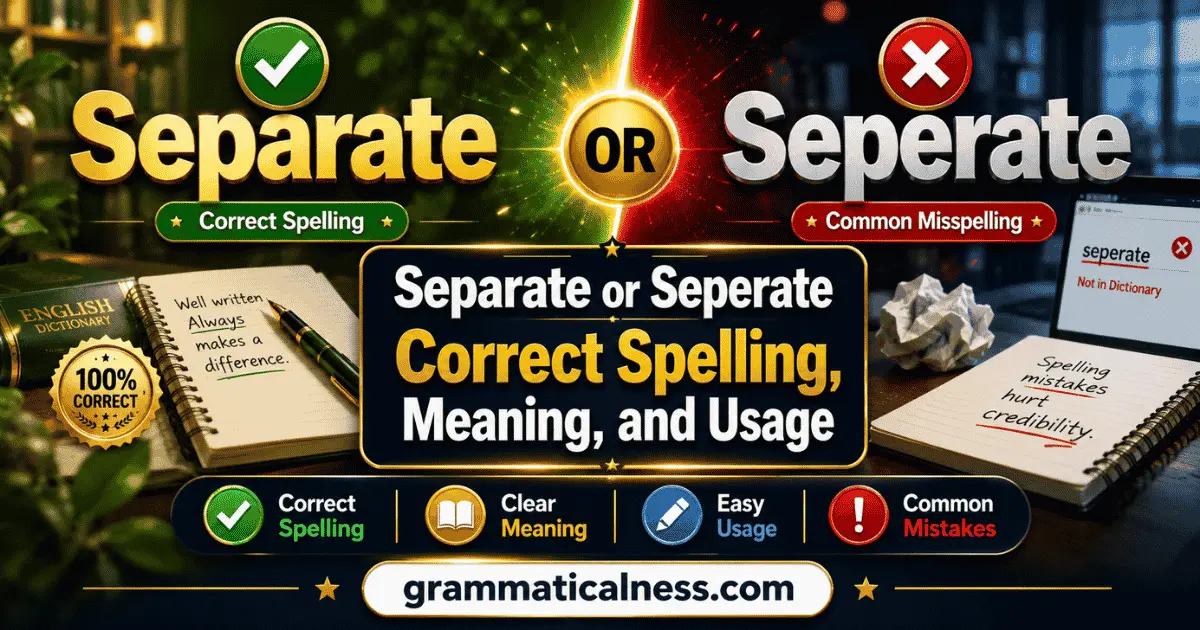
The choice between separate or seperate has one clear answer: separate is the correct spelling in standard English. Seperate is a misspelling.
This is not a case where two accepted words have different meanings. It is also not an American-versus-British spelling difference. The real challenge is remembering the correct vowel in the middle of separate and knowing how the standard word works in different sentences.
Quick Answer
Use separate whenever you mean to divide things, keep them apart, or describe things as distinct or independent.
Seperate is not an accepted spelling of that word in standard English.
Correct:
- Please separate the recycling from the trash.
- The teams work in separate offices.
Incorrect:
- Please seperate the recycling.
- The teams work in seperate offices.
One easy reminder is to break the correct word into sep + a + rate. That keeps the important a after the p.
Why People Confuse Them
The confusion comes largely from pronunciation. In normal speech, the middle vowel in separate may sound weak, so writers do not always hear a clear a.
The word also has two common pronunciations depending on its grammatical role.
As a verb, separate is commonly pronounced roughly SEP-uh-rate.
As an adjective, it is commonly pronounced more like SEP-uh-rut or SEP-rut.
That sound difference can make the spelling seem less predictable. However, the written form stays separate in both uses.
Key Differences At A Glance
| Feature | separate | seperate |
| Standard English word | Yes | No |
| Correct spelling | Yes | No |
| Main grammar roles | Verb, adjective, less-common noun | None as a standard word |
| Meaning | Divide, keep apart, distinct, independent | No separate standard meaning |
| Formal and informal writing | Correct | Misspelling |
| US and UK standard spelling | Separate | Not a standard alternative |
The key point is simple: these are not two competing standard words. Separate carries all the valid meanings and grammatical uses.
Meaning and Usage Difference
As a verb, separate means to divide, disconnect, distinguish, sort, or move things apart.
Separate the white shirts from the dark clothes.
A fence separates the two properties.
You should separate fact from opinion.
As an adjective, separate describes people or things that are distinct, independent, or not joined together.
Please use separate folders for each client.
Each group arrived in separate cars.
That is a completely separate issue.
As a noun, separate is less common. Its plural form, separates, is often used in clothing to describe individual garments that can be mixed and matched with other pieces.
The store carries jackets, skirts, and other separates.
By contrast, seperate has no standard meaning or grammatical function in English. When it appears in place of separate, it is simply a spelling error.
Tone, Context, and Formality
Separate is neutral standard English. It works naturally in conversation, school assignments, business communication, journalism, legal contexts, and everyday writing.
There is no special formality rule that makes seperate acceptable in casual writing. A text message may be informal, but the standard spelling is still separate.
There is also no normal US-versus-UK distinction here. The accepted spelling is separate.
Pronunciation changes with grammatical role, but spelling does not. The verb in “Please separate the files” and the adjective in “Use separate files” are spelled exactly the same way.
Which One Should You Use?
| Context | Best Choice | Why |
| Dividing items into groups | separate | It is the standard verb |
| Describing distinct items | separate | It is the standard adjective |
| Keeping two things apart | separate | It expresses division or lack of connection |
| Business or academic writing | separate | It is the accepted spelling |
| Casual messages | separate | Informality does not change the spelling |
| Clothing sold as individual pieces | separate or separates | The word has a recognized noun use |
| Discussing the spelling error itself | seperate | Use it only when showing or quoting the incorrect form |
For ordinary writing, choose separate every time you intend this English word.
When One Choice Sounds Wrong
Seperate may look believable because it resembles the way some people hear the word. On the page, however, it is the wrong spelling when the intended word is separate.
Wrong:
- The manager asked us to seperate the files.
Correct:
- The manager asked us to separate the files.
The correct spelling can still be used incorrectly if the sentence structure is wrong. Common patterns include:
- separate A from B: Separate personal expenses from business expenses.
- separate into: The students separated into four groups.
- separate from: The garage is separate from the house.
The spelling remains the same across these patterns.
Common Mistakes (and Quick Fixes)
A frequent mistake is replacing the first a in separate with e.
Incorrect: seperate
Correct: separate
The same spelling pattern should be remembered in closely related forms:
- separated, not seperated
- separating, not seperating
- separately, not seperately
- separation, not seperation
A practical memory method is to see sep-a-rate inside separate. The chunk a + rate helps keep the correct vowel in place.
Another useful check is to look at the word before sending an email or submitting a document. If you wrote sep-e-rate, change that middle e to a.
Everyday Examples
Here are natural examples of separate in modern American English:
- We keep personal and business expenses in separate accounts.
- Please separate the signed forms from the blank ones.
- The kids sleep in separate rooms.
- The app stores customer and payment information in separate records.
- Let’s separate the urgent requests from the ones that can wait.
- The two departments have separate budgets.
- Oil may separate from the other ingredients after the bottle sits.
- They decided to separate after several years of marriage.
Examples with the misspelling should be corrected:
- Incorrect: Put the receipts in seperate folders.
- Correct: Put the receipts in separate folders.
- Incorrect: We need to seperate these two issues.
- Correct: We need to separate these two issues.
Dictionary-Style Word Details
Verb
Separate: A standard verb meaning to divide, disconnect, distinguish, sort, move apart, or become divided.
Example: Please separate the applications by department.
It can be transitive, as in “separate the files,” or intransitive, as in “the mixture began to separate.”
Seperate: Not a standard verb. When used with the intended meaning of dividing or moving apart, the correct spelling is separate.
Noun
Separate: An uncommon noun in some contexts. The plural separates commonly refers to individual clothing pieces designed to be worn in different combinations. A specialized noun use can also refer to an individually issued printed item.
Seperate: Not a standard noun and has no independent noun meaning.
Synonyms
Separate: Suitable alternatives depend on the grammatical role and context.
As a verb, close alternatives include:
- divide
- split
- disconnect
- detach
- distinguish
- sort
As an adjective, close alternatives may include:
- distinct
- detached
- independent
- individual
Useful opposites in suitable contexts include:
- join
- unite
- combine
- connect
Seperate: It has no true synonyms or antonyms because it is not a separate standard word. The correct spelling intended in normal use is separate.
Example Sentences
Separate:
- The company maintains separate accounts for each location.
- Can you separate the invoices by month?
- These are two separate questions.
- The group separated after the meeting.
- She bought several separates for her work wardrobe.
Seperate:
- Incorrect: Please seperate the documents.
- Correct: Please separate the documents.
- Incorrect: We booked seperate rooms.
- Correct: We booked separate rooms.
Word History
Separate: The word traces through Middle English to Latin separare, meaning to pull, set, or keep apart. Its history supports the established spelling with a in the middle.
The word developed several closely connected uses: physically dividing things, distinguishing one thing from another, and describing things that exist apart or independently.
Seperate: It has no separate standard word history in modern English for these meanings. It is generally encountered as a misspelling of separate. It should not be treated as a historical, regional, or stylistic alternative in ordinary modern writing.
Phrases Containing
Separate:
- separate from
- separate ways
- separate issue
- separate account
- separate room
- separate entity
- separate category
- separate property
- separate out
- keep separate
Examples:
- The two friends eventually went their separate ways.
- Keep raw food separate from ready-to-eat food.
- That is a separate issue.
Seperate: There are no standard phrases that require this spelling. Forms such as seperate ways, seperate rooms, or seperate from should normally be corrected to separate ways, separate rooms, and separate from.
FAQs
Separate is the correct spelling in standard English. Seperate is a common misspelling and should be avoided in formal, academic, business, and everyday writing. The correct word always uses an a after the p: sep-a-rate.
Many people write seperate because the middle vowel in separate is not always pronounced clearly in natural speech. The word may sound as though it contains an e, but the correct spelling remains separate.
No. Seperate is not an accepted standard spelling of separate in American or British English. It is not a regional variant or an informal alternative. When you mean divided, distinct, or kept apart, use separate.
Yes. As a verb, separate means to divide or move things apart, as in “Separate the papers by color.” As an adjective, it means distinct or independent, as in “We booked separate rooms.”
A simple memory trick is to break the word into sep-a-rate. Focus on the a in the middle. You can also remember that separate contains a rat, which helps many writers recall the correct vowel order.
Yes. Related forms keep the same basic spelling pattern: separately, separated, separating, and separation. Misspellings such as seperately, seperated, and seperation should be corrected. Keeping the base spelling separate in mind makes these related forms easier to write correctly.
Conclusion
For separate or seperate, the correct choice is separate.
Use separate as a verb when something is divided or kept apart, as an adjective for things that are distinct or independent, and occasionally as a noun, especially in the plural separates.
Seperate is not an alternative spelling, regional preference, or informal version. When you mean the standard English word, write separate with an a after the p.