
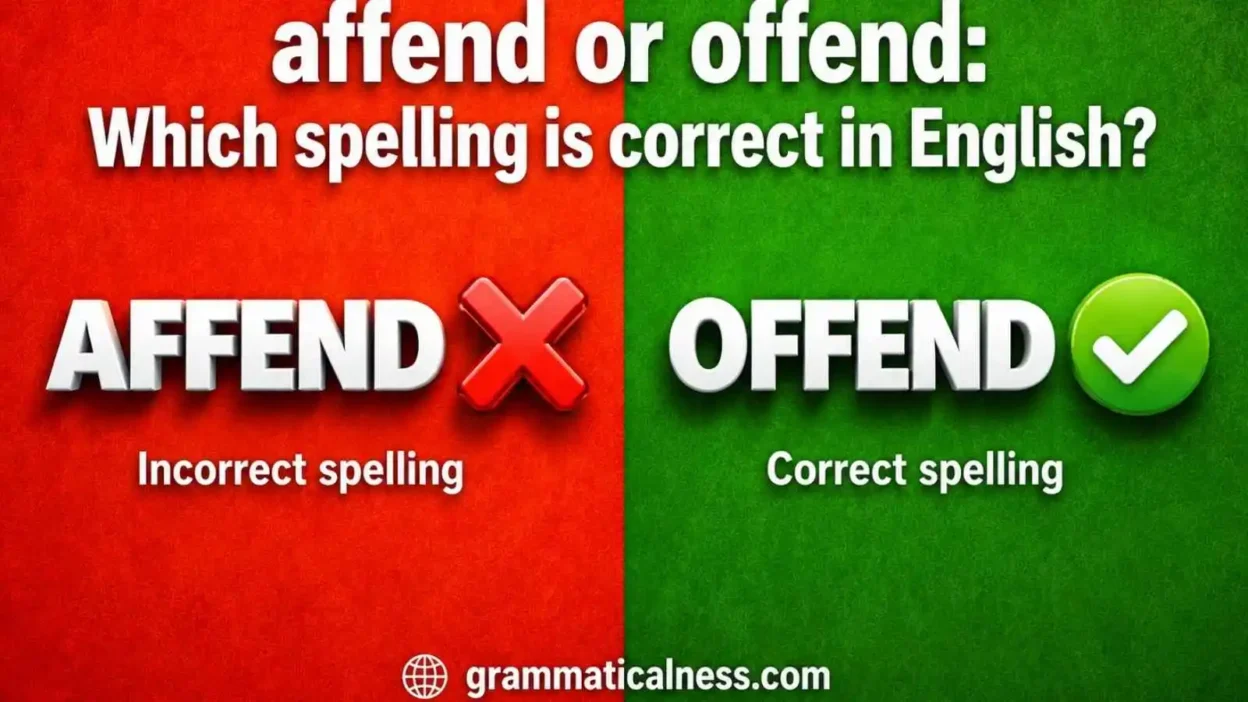
The correct choice is offend.
affend is not a standard word in US English. It is usually a misspelling of offend.
Use offend when you mean to upset, insult, annoy, or hurt someone’s feelings. It can also mean to break a rule, law, or moral standard.
Write: “I didn’t mean to offend you.”
Do not write: “I didn’t mean to affend you.”
Quick Answer
Use offend every time.
affend should not be used in standard writing, schoolwork, work emails, articles, messages, or formal documents.
The word offend is a verb. It can be used with a person, group, rule, law, or standard.
Examples:
• “That joke might offend some people.”
• “The company changed the ad after viewers said it offended them.”
• “The action offended basic workplace rules.”
Why People Confuse Them
People often write affend because offend is pronounced like “uh-FEND.” The first sound is soft, so some writers guess that the word begins with a.
That guess is understandable, but it is still wrong.
The spelling stays offend in the main forms:
• offend
• offends
• offended
• offending
• offender
• offensive
• offense
The first letters stay off-, not aff-.
Key Differences At A Glance
| Feature | affend | offend |
| Standard US English | No | Yes |
| Main role | Not a standard word | Verb |
| Meaning | No accepted standard meaning | To upset, insult, annoy, or violate a rule |
| Use in formal writing | Avoid | Correct |
| Example | “That may affend them” is wrong | “That may offend them” is correct |
The main difference is simple: offend is the correct word. affend is a spelling mistake.
Meaning and Usage Difference
Offend means to make someone feel hurt, upset, angry, insulted, or disrespected.
It can describe something said or done:
• “Her comment offended several coworkers.”
• “The post offended some readers.”
• “I hope my question doesn’t offend you.”
It can also refer to breaking a rule, law, or accepted standard:
• “The conduct offended company policy.”
• “The act offended public decency.”
affend has no standard meaning. If readers see it, they will usually assume you meant offend.
Pronunciation matters here because it explains the mistake. Offend is commonly said like uh-FEND. The spelling, though, is offend, not affend.
Tone, Context, and Formality
Offend works in casual, professional, and formal writing.
In casual speech, it often means “hurt someone’s feelings”:
• “I didn’t want to offend him.”
In workplace writing, it can sound careful and respectful:
• “Please let me know if anything in the draft could offend clients.”
In legal, policy, or formal contexts, it can mean “violate” or “go against”:
• “The behavior may offend local rules.”
affend does not fit any tone or setting in standard US English. It looks like a typo in a text message and an error in polished writing.
Which One Should You Use?
| Context | Best Choice | Why |
| Texting a friend | offend | It is still the correct spelling |
| Work email | offend | It looks professional and clear |
| School essay | offend | It is the standard verb |
| Apology message | offend | It clearly means hurt or upset |
| Policy or rules discussion | offend | It can mean violate or go against |
| Any formal document | offend | affend is not standard |
Choose offend in every normal sentence.
Use affend only if you are pointing out the misspelling itself, as in: “affend is not the correct spelling.”
When One Choice Sounds Wrong
affend sounds wrong when it appears as a normal word because readers expect offend.
Wrong: “I hope this does not affend anyone.”
Correct: “I hope this does not offend anyone.”
Wrong: “She was affended by the comment.”
Correct: “She was offended by the comment.”
Wrong: “The joke was affensive.”
Correct: “The joke was offensive.”
The wrong forms often happen because writers change the first letters from off- to aff-. Do not change them.
Common Mistakes (and Quick Fixes)
Mistake: “I didn’t mean to affend you.”
Fix: “I didn’t mean to offend you.”
Mistake: “He was affended by the email.”
Fix: “He was offended by the email.”
Mistake: “That word is affensive.”
Fix: “That word is offensive.”
Mistake: “No affense, but I disagree.”
Fix: “No offense, but I disagree.”
For US English, use offense as the noun. The verb is still offend.
Everyday Examples
• “I didn’t mean to offend you with my question.”
• “That headline could offend some readers.”
• “Please remove anything that might offend customers.”
• “She was offended when her name was left off the invite.”
• “The comedian’s joke offended part of the audience.”
• “His tone offended me more than his actual words.”
• “The rule was meant to stop conduct that might offend guests.”
• “I’m not offended; I just think the comment was unfair.”
Each sentence uses offend or one of its correct forms. None should use affend.
Dictionary-Style Word Details
Verb
• affend: Not commonly used as a verb in standard US English. Treat it as a misspelling of offend.
• offend: A standard verb. It means to upset, insult, annoy, hurt someone’s feelings, or violate a rule, law, or standard.
Examples:
• “That remark may offend people.”
• “The decision offended many fans.”
• “The conduct offended basic rules of fairness.”
Noun
• affend: Not commonly used as a noun in standard US English.
• offend: Not commonly used as a noun. The related US noun is offense.
Examples:
• “No offense, but I disagree.”
• “She took offense at the comment.”
• “The player committed an offense.”
Synonyms
• affend: No true synonyms, because it is not a standard word.
• offend: Closest plain alternatives include upset, insult, hurt, annoy, anger, and disrespect, depending on the sentence.
Possible antonyms for offend include please, comfort, respect, and reassure, but the best opposite depends on the exact meaning.
Examples:
• “The joke offended her.”
• “The joke upset her.”
• “The apology reassured her.”
Example Sentences
• affend: “Please do not write ‘affend’ when you mean ‘offend.’”
• offend: “I hope this feedback does not offend you.”
• affend: “The spelling ‘affend’ is an error in standard writing.”
• offend: “The ad offended some viewers, so the company pulled it.”
• affend: “If you typed ‘affended,’ change it to ‘offended.’”
• offend: “Some comments offend people even when that was not the speaker’s goal.”
Word History
• affend: No clear standard word history applies, because affend is not a standard English word.
• offend: The word has a long English history connected with the idea of striking against, doing wrong, or causing displeasure. For this article, the useful point is current usage: modern US English uses offend, not affend.
Phrases Containing
• affend: No standard phrases use affend.
• offend: Common phrases and related forms include:
• “not mean to offend”
• “easily offended”
• “take offense”
• “no offense”
• “offend someone’s sense of fairness”
• “offend against a rule”
• “offensive comment”
• “repeat offender”
FAQs
The correct spelling is offend. Affend is not a standard English word and is considered a spelling mistake. Use offend when referring to upsetting someone, causing insult, or breaking a rule or law.
Offend means to cause someone to feel hurt, insulted, annoyed, or disrespected. It can also refer to committing an illegal or unacceptable act. For example, “I did not mean to offend you with my comment.”
People may write affend because the pronunciation of certain English vowels can sound unclear in normal speech. However, the standard spelling always begins with o: offend.
You can use offend when talking about causing emotional discomfort or violating rules. For example, “Her joke might offend some people.” Another example is, “The advertisement was removed because it could offend viewers.”
The past tense and past participle of offend are both offended. For example, “He offended his coworker with an insensitive remark” and “She was offended by the rude response.”
Offend is the base form of the verb, while offended is its past-tense form and can also function as an adjective. For example, “Do not offend your guests” uses the verb, while “She felt offended by the comment” describes how someone felt.
Conclusion
For affend or offend, the answer is clear: offend is correct.
affend is not a standard word in US English. Use offend when you mean to upset, insult, annoy, hurt someone’s feelings, or violate a rule or standard.
Best sentence to remember:
“I didn’t mean to offend you.”
That one sentence shows the correct spelling, meaning, and everyday use.