
Both whom and who are correct English words, but they do not traditionally perform the same grammatical job.
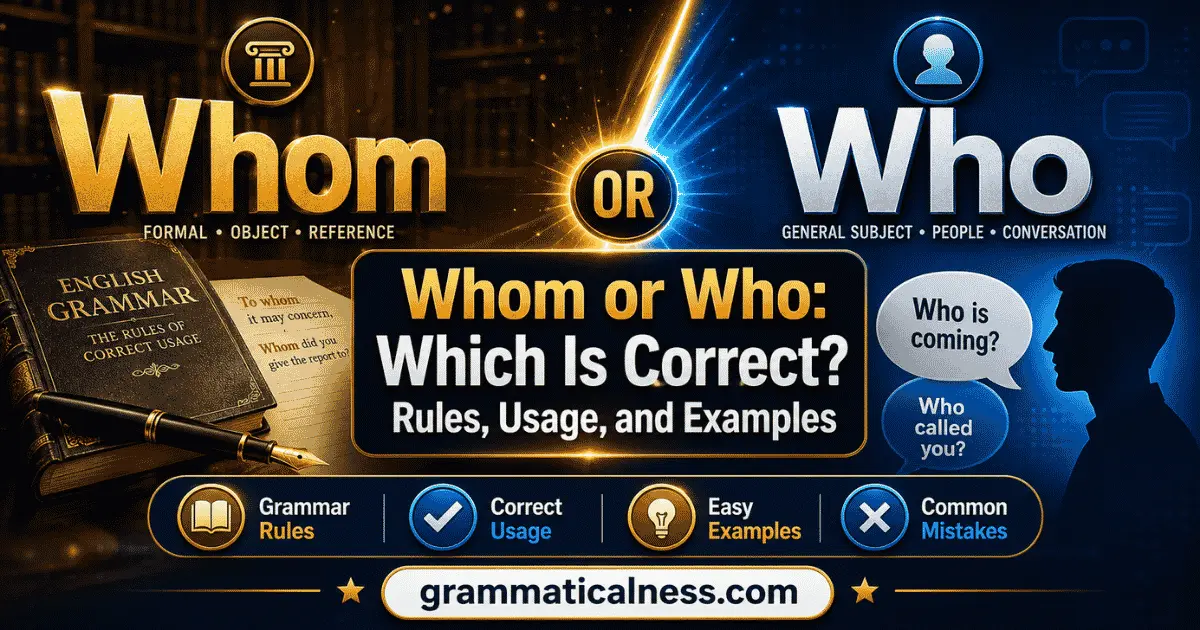
The basic distinction is simple: who is the subject form, while whom is the object form. Compare “Who called you?” with “Whom did you call?” In the first sentence, the person performs the action. In the second, the person receives the action.
However, real modern American English adds an important qualification. In ordinary conversation and much everyday writing, speakers often use who where traditional formal grammar would use whom.
That means choosing correctly requires more than memorizing one rigid rule. You need to consider grammar, sentence structure, and level of formality.
Quick Answer
Use who when the pronoun is the subject of a verb: “Who sent the email?” Use whom when it is the object of a verb or preposition in formal English: “Whom did you invite?” or “To whom should I respond?”
In everyday American English, who commonly replaces object-form whom, especially in sentences such as “Who did you invite?” and “Who were you talking to?” Those forms sound natural and are widely accepted.
One distinction remains especially useful: when a preposition comes immediately before the pronoun, whom is normally the natural formal choice: “to whom,” “for whom,” and “with whom.”
Why People Confuse Them
The confusion exists partly because English no longer marks case on most nouns. We say “the teacher called Jordan” and “Jordan called the teacher” without changing either name.
A few pronouns still change form. We use he/him, she/her, they/them, and traditionally who/whom.
The problem is that whom is much less common in ordinary American conversation than it once was. Many speakers naturally use who for both subject and object roles.
Sentence structure can create another problem. Consider:
“Who do you think will win?”
Some writers choose whom because they see “do you think” and assume the pronoun is the object of think. It is not. The important clause is “who will win.” Since who is the subject of will win, who is correct.
So the safest approach is to examine the pronoun’s role inside its own clause.
Key Differences At A Glance
| Context | Best Choice | Why |
| Person performing an action | who | It functions as the subject |
| Person receiving an action in formal writing | whom | It functions as the object |
| Immediately after a preposition | whom | It is the object of the preposition |
| Everyday question with a preposition at the end | who is often natural | Modern conversational English commonly uses who |
| Formal relative clause with an object | whom | It preserves the traditional object form |
| Subject inside an embedded clause | who | Its role inside that clause controls the choice |
A compact way to remember the grammatical contrast:
- Who → he, she, they: subject forms. “Who called?” → “She called.”
- Whom → him, her, them: object forms. “Whom did you call?” → “You called her.”
The substitution test is useful, but test the correct clause rather than simply looking at the nearest verb.
Meaning and Usage Difference
Who and whom both ask about or refer to people. Their main difference is grammatical case, not basic reference.
Use who when the person represented by the pronoun acts as the subject.
“Who wants coffee?”
The answer could be “He wants coffee” or “They want coffee.” Because a subject pronoun fits, who is correct.
The same rule applies in a relative clause:
“The neighbor who helped us was very kind.”
Here, who performs the action helped.
Traditionally, use whom when the person is the object of a verb.
“Whom did the committee select?”
Rearrange the idea: “The committee selected him.” Since him is an object form, traditional formal grammar calls for whom.
The same pattern appears in a relative clause:
“The candidate whom we selected starts Monday.”
“We selected her” shows that the pronoun is the object of selected.
However, everyday US English commonly allows:
“The candidate who we selected starts Monday.”
Many speakers would also simply omit the object relative pronoun:
“The candidate we selected starts Monday.”
Prepositions create the clearest formal environment for whom:
“To whom did you send the file?”
“With whom are you meeting?”
“For whom was the reservation made?”
When the preposition moves to the end, ordinary American English strongly favors more conversational wording:
“Who did you send the file to?”
“Who are you meeting with?”
“Who was the reservation made for?”
For a detailed explanation of the rule, see Merriam-Webster’s guide to who vs. whom, which explains how who is generally used as a subject and whom as an object.
Tone, Context, and Formality
Who sounds neutral and natural across nearly every level of modern English. It belongs comfortably in conversation, business communication, journalism, school writing, and formal prose whenever it functions as a subject.
Whom has a narrower modern role. It is most natural in formal writing and in constructions where a preposition appears directly before it.
For example:
“To whom it may concern” sounds established and formal.
“Who should I address this letter to?” sounds more conversational.
Neither sentence communicates a different basic idea. The difference is mainly grammatical structure and register.
Using whom correctly can sound polished in formal contexts. Still, forcing it into casual sentences may sound stiff.
“Whom are you going to lunch with?” is traditionally grammatical because the person is the object of with, but many Americans would naturally say:
“Who are you going to lunch with?”
A useful principle is to preserve whom where formal sentence structure naturally supports it, especially directly after a preposition. Do not insert it merely because a sentence sounds sophisticated.
Which One Should You Use?
First, determine what job the pronoun performs inside the relevant clause.
When it performs the action or serves as the subject, choose who.
“Who approved the request?”
“He approved the request.”
Therefore, who is correct.
When it receives the action, traditional formal grammar uses whom.
“Whom did Maria recommend?”
“Maria recommended him.”
Therefore, formal English favors whom.
The same method works with relative clauses.
“She is the consultant whom we hired.”
Test the clause by replacing the disputed word: “We hired her.” Because her is an object form, whom fits formal grammar.
Now consider:
“She is the consultant who we believe can solve the problem.”
Do not test “we believe her.” The pronoun belongs grammatically with can solve: “We believe she can solve the problem.” Since she is the subject of can solve, the correct choice is who.
For everyday conversation, you usually do not need to force whom into an object position when who sounds more natural. Formal documents may call for a stricter distinction.
When One Choice Sounds Wrong
Whom sounds clearly wrong when it is used as the subject of a verb.
Incorrect:
“Whom wants to join us?”
Correct:
“Who wants to join us?”
You would say “She wants to join us,” not “Her wants to join us.”
Overcorrection also causes problems in more complex sentences.
Incorrect:
“Whom do you think is responsible?”
Correct:
“Who do you think is responsible?”
The relevant idea is “he is responsible,” so who is the subject form.
By contrast, this sentence correctly uses whom in formal English:
“Whom do you think they hired?”
The underlying clause is “they hired him.” Since the pronoun is the object of hired, whom fits.
Some constructions make who sound awkward because a preposition comes immediately before it.
“To who should I send this?”
In careful formal writing, “To whom should I send this?” is the established choice.
In casual speech, the smoother alternative is usually “Who should I send this to?”
Common Mistakes (and Quick Fixes)
One common mistake is assuming whom is simply a more educated version of who. It is not. Using whom as a subject is still a case error in standard formal grammar.
“Whom called?” should be “Who called?”
Another mistake is choosing based on the first verb you notice.
“Who do you believe deserves the promotion?” is correct because who is the subject of deserves. The phrase “do you believe” does not turn it into whom.
Writers also sometimes assume that any preposition anywhere in the sentence automatically requires whom.
Compare:
“Who are you waiting for?”
“For whom are you waiting?”
The first is natural conversational English. The second is formal. Moving the preposition changes the structure and the expected register.
Finally, do not use whom merely to make a sentence sound formal. Check whether an object form actually belongs there.
Everyday Examples
At work:
“Who is leading the meeting?”
“Who should I send the updated report to?”
“To whom should the formal request be addressed?”
In conversation:
“Who called last night?”
“Who did you go with?”
“Who are they waiting for?”
In more formal writing:
“The applicants whom we interviewed were well prepared.”
“The department to whom the complaint was submitted responded promptly.”
In relative clauses:
“I know the neighbor who organized the event.”
“That is the doctor whom my parents recommended.”
In modern everyday English, the second sentence may naturally become:
“That is the doctor who my parents recommended.”
It may also become:
“That is the doctor my parents recommended.”
Consider an embedded clause:
“Who did you say was coming?”
Who is correct because the underlying idea is “she was coming.”
Now compare:
“Whom did you say they invited?”
In formal grammar, whom is correct because the underlying idea is “they invited her.”
These examples show why sentence structure matters more than simply counting nearby verbs.
Dictionary-Style Word Details
Verb
Whom: Not used as a verb in standard US English. In this comparison, whom is a pronoun functioning as an object.
Who: Not used as a verb in standard US English. In this comparison, who is a pronoun, traditionally functioning as a subject and also commonly appearing in object positions in modern informal usage.
Noun
Whom: Not commonly used as an ordinary noun. It is the traditional objective form of the pronoun who.
Who: Not commonly used as an ordinary noun in the grammatical sense discussed here. It functions primarily as an interrogative or relative pronoun when asking about or referring to people.
Synonyms
Whom: There is no exact one-word synonym that preserves the same grammatical function in every sentence. The closest plain alternative in a question may be which person, although the sentence often needs to be rewritten. In many conversational sentences, who can replace whom without changing the intended person.
Who: No exact one-word synonym works in every context. In direct questions, which person or what person may sometimes express a similar idea, although they do not always sound equally natural.
Neither word has a useful direct antonym because the distinction concerns grammatical case rather than opposite meanings.
Example Sentences
Whom: “Whom did the manager choose?” Here, whom is the object of choose.
“Taylor, whom I met at the conference, works in Denver.” Here, whom is the object of met.
“With whom did you discuss the proposal?” Here, whom follows the preposition with.
Who: “Who made this decision?” Here, who is the subject of made.
“The student who answered first won the prize.” Here, who is the subject of answered.
“Who did you speak to?” Here, who appears naturally in an object position in everyday American English.
Word History
Whom: Whom comes through Middle English from Old English hwām, an inflected form related to who. Historically, it marked an object-related grammatical case. The form has existed in English since before the 12th century.
Who: Who comes through Middle English from Old English hwā. It has deep roots in the Germanic history of English and has been recorded since before the 12th century.
The historical relationship explains why the two words refer to the same general kind of person while traditionally marking different grammatical roles.
Phrases Containing
Whom: Common formal constructions include “to whom it may concern,” “for whom,” “with whom,” “of whom,” and “to whom.”
Example: “To whom it may concern, I am writing to confirm my employment.”
Who: Common constructions include “who knows?”, “who is responsible?”, “who are you?”, “who said that?”, and “who do you think?”
Example: “Who knows what the weather will be like tomorrow?”
These patterns also reveal the modern difference in register. Who appears freely in everyday questions, while whom survives most strongly in formal object constructions and established expressions.
FAQs
Who is traditionally used as a subject, while whom is used as an object. For example, “Who called you?” uses who because the person performs the action. “Whom did you call?” uses whom because the person receives the action.
Yes, in many everyday American English sentences, who commonly replaces whom, especially in conversation. “Who did you invite?” sounds natural and is widely accepted. In formal writing, “Whom did you invite?” follows the traditional object rule.
When the preposition comes directly before the pronoun, whom is normally the formal choice. Write “to whom,” “for whom,” or “with whom.” In casual English, speakers often move the preposition to the end and use who, as in “Who did you speak with?”
Yes. Whom is still correct, especially in formal writing, professional communication, and expressions such as “To whom it may concern.” However, it is less common in everyday conversation, where who often appears instead.
Try replacing the word with another pronoun. If he, she, or they fits, use who. If him, her, or them fits, formal grammar favors whom.
Yes. Who is correct because it is the subject of “will win.” The phrase “do you think” does not make it an object. The underlying structure is similar to “Do you think he will win?” so the subject form who is required.
Conclusion
Choosing between whom or who becomes easier once you separate the grammar rule from modern usage.
Use who when the pronoun is the subject: “Who called?” Use whom as the traditional formal object form: “Whom did you call?” and especially after a preceding preposition: “To whom did you speak?”
At the same time, modern American English commonly uses who in object positions such as “Who did you call?” or “Who were you speaking to?” These sentences are natural in ordinary communication.
The most important mistake to avoid is unnecessary whom in a subject position. When unsure, identify the pronoun’s role inside its own clause. If he, she, or they fits, choose who. If him, her, or them fits, formal grammar favors whom.