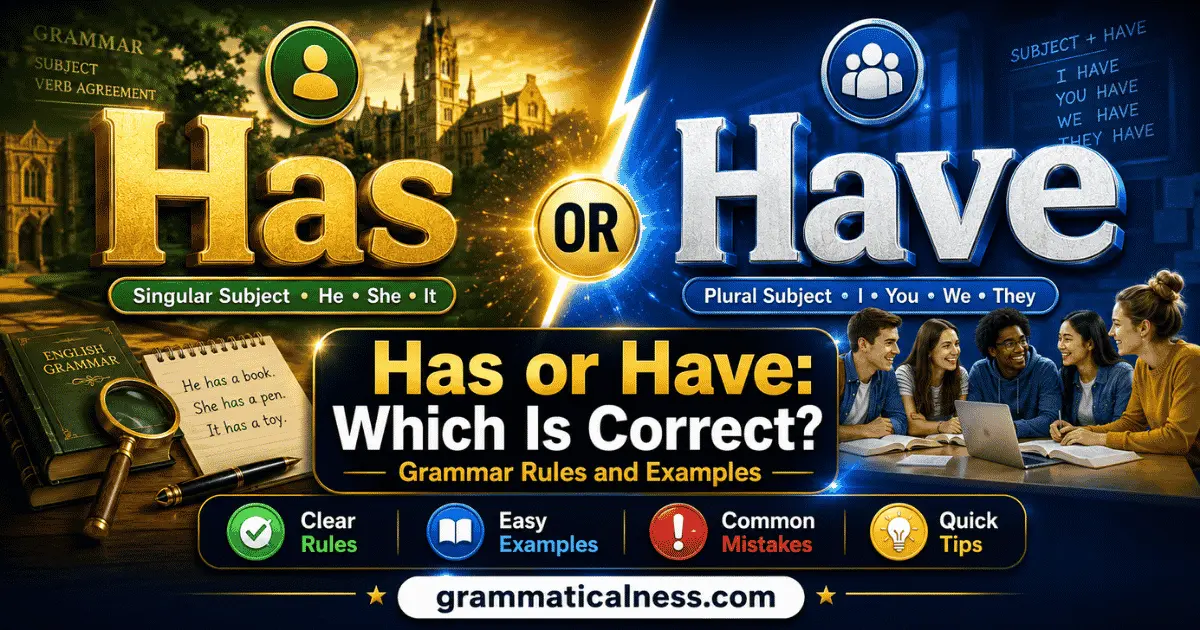
Both has and have are correct. They are present-tense forms of the same irregular verb, have, but they match different subjects.
Use has with third-person singular subjects such as he, she, it, Maria, the dog, or the company. Use have with I, you, we, they, and plural nouns such as students or cars.
The choice is mainly grammatical, not a difference in meaning. Compare:
- She has a new laptop.
- They have new laptops.
The verb still expresses possession. Only its form changes to agree with the subject.
Quick Answer
Use has with he, she, it, or one third-person person or thing:
- He has a meeting.
- Olivia has two brothers.
- The phone has a cracked screen.
Use have with I, you, we, they, and plural subjects:
- I have a question.
- You have plenty of time.
- We have tickets.
- The neighbors have a new car.
A useful rule is:
He, she, it → has
I, you, we, they → have
However, sentence structure also matters. Say Does she have time?, not Does she has time? After does, English uses the base form have. Likewise, modal verbs take the base form: can have, should have, may have.
Why People Confuse Them
The confusion happens because has and have are not separate verbs with different basic meanings. Has is simply the third-person singular present form of have.
A common shortcut says, “Use has for singular and have for plural.” That works in many sentences, but it is incomplete.
I is singular, yet we say:
- I have a car.
You can refer to one person, yet we still say:
- You have a car.
That is why third-person singular is more accurate than simply saying “singular.”
Both forms can also work as helping verbs:
- She has finished the report.
- They have finished the report.
Here again, the subject controls whether the helping verb is has or have.
Key Differences At A Glance
| Context | Best Choice | Why |
| He, she, it | has | Third-person singular |
| One named person or thing | has | Third-person singular |
| I | have | First-person singular uses have |
| You | have | Second person uses have |
| We, they | have | Plural agreement |
| Plural nouns | have | Plural agreement |
| She ___ finished | has | Present-perfect auxiliary with third-person singular |
| They ___ finished | have | Present-perfect auxiliary with a plural subject |
| Does she ___ time? | have | Does requires the base form |
| She can ___ another | have | Modal verbs take the base form |
Compact comparison:
- Has: limited mainly to third-person singular present constructions.
- Have: used with all other present-tense persons and numbers and as the base form after words such as do, does, can, may, should, and will.
Meaning and Usage Difference
In most comparisons, has and have do not express different meanings. They are different grammatical forms of the same verb.
As a main verb, they can express possession:
- Ava has a bicycle.
- Her parents have two cars.
They can describe characteristics, relationships, experiences, or things included within something:
- The apartment has two bedrooms.
- We have a busy week ahead.
- Daniel has three sisters.
- The students have several options.
The verb have also works as an auxiliary. In the present perfect, use has with third-person singular subjects and have with the other standard subject forms:
- She has completed the application.
- I have completed the application.
- They have completed the application.
The present-perfect structure is has/have + past participle.
Another common construction is have to, meaning that something is necessary:
- Marcus has to leave early.
- We have to leave early.
The meaning stays essentially the same. The subject changes the verb form.
Tone, Context, and Formality
Neither has nor have is inherently more formal. Both are standard forms required by normal English grammar.
You can use them naturally in casual conversation, school assignments, workplace writing, news, and formal documents.
Compare:
- The company has announced a new policy.
- The companies have announced new policies.
Collective nouns can require more care. In American English, a noun such as team, family, company, or group is commonly treated as singular when the group acts as one unit:
- The team has a new coach.
- Our family has a reunion every summer.
Collective agreement can vary when writers emphasize individual members, so the intended meaning and sentence structure may matter.
Which One Should You Use?
Start by finding the true subject.
Use has when the subject is third-person singular:
- My brother has a motorcycle.
- Elena has an interview tomorrow.
- This restaurant has outdoor seating.
Use have with I, you, we, they, or a plural subject:
- I have an appointment.
- You have a message.
- We have enough chairs.
- My coworkers have flexible schedules.
Words such as everyone, everybody, someone, somebody, anyone, and each are grammatically singular in standard constructions:
- Everyone has a chance.
- Someone has left a jacket here.
- Each student has an ID card.
A compound subject joined by and normally takes have:
- Maya and Jordan have tickets.
- The teacher and the principal have arrived.
Subject-verb agreement depends on the grammatical subject, not simply on the noun closest to the verb.
When One Choice Sounds Wrong
Some errors are straightforward:
Incorrect: She have a new job.
Correct: She has a new job.
Incorrect: They has two children.
Correct: They have two children.
Other mistakes happen because another verb changes the structure.
Incorrect: Does he has a reservation?
Correct: Does he have a reservation?
In a simple-present question with does, the third-person marking is already carried by does, so the following verb stays in its base form.
Compare that with a present-perfect question:
- Has he made a reservation?
Here has is the auxiliary that forms the present perfect, so it is correct before he.
The same base-form rule applies after modal verbs:
Incorrect: She can has another chance.
Correct: She can have another chance.
Incorrect: He should has more time.
Correct: He should have more time.
Modal verbs are followed by a base-form verb.
Common Mistakes (and Quick Fixes)
Mistake: Using has with I
Wrong: I has an idea.
Right: I have an idea.
Fix: Remember that I always pairs with have in the present tense.
Mistake: Using has after does
Wrong: Does Maria has the file?
Right: Does Maria have the file?
Fix: After do, does, or did, use the base form have.
Mistake: Letting a nearby plural noun control the verb
Wrong: The list of appointments have changed.
Right: The list of appointments has changed.
The subject is list, not appointments. A phrase beginning with of does not automatically control the verb.
Mistake: Treating everyone as plural
Wrong: Everyone have a ticket.
Right: Everyone has a ticket.
Mistake: Confusing two types of questions
- Does she have the package?
- Has she received the package?
The first is a simple-present question using does + have. The second uses has + past participle to form the present perfect.
Everyday Examples
Here are natural examples from everyday American English:
- My sister has class at nine.
- I have an early meeting tomorrow.
- The grocery store has a pharmacy inside.
- Our neighbors have two dogs.
- She has already sent the email.
- We have already checked the schedule.
- Everyone has a seat.
- The students have enough time to finish.
- Does your phone have enough storage?
- Has your phone received the update?
- He may have another option.
- The manager and assistant have reviewed the request.
Notice that meaning alone does not determine the choice. The subject and grammatical structure do.
Dictionary-Style Word Details
Verb
Has: The third-person singular present-tense form of have. It is used as both a main verb and an auxiliary.
Examples:
- She has a new apartment.
- The store has closed for the night.
Have: The base and present-tense form used with I, you, we, they, and plural subjects. It also appears after modal verbs and after do/does/did when those words function as auxiliaries.
Examples:
- We have enough food.
- Does she have a key?
- He might have a key.
Noun
Has: Not commonly used as a noun in standard modern English.
Have: It has a rare noun use referring to a person or group possessing wealth or advantages, most familiar in the expression the haves and the have-nots. This noun use is separate from the everyday verb comparison discussed in this guide.
Synonyms
Because has and have are forms of the same verb, they do not need separate synonym sets.
Depending on the intended meaning, closest plain alternatives can include:
- possess
- own
- hold
- contain
- experience
For example:
- She has a cabin. → She owns a cabin.
- They have several properties. → They own several properties.
These alternatives are meaning-dependent. They cannot replace has or have mechanically in every construction, especially when the words function as auxiliaries.
For possession, lack can function as an opposite in some contexts, but there is no single antonym that fits every use of has/have. Merriam-Webster lists possession-related synonyms such as possess and own for the verb.
Example Sentences
Has:
- The hotel has free parking.
- Jordan has an appointment at noon.
- She has finished her homework.
- Everyone has a different opinion.
Have:
- I have a dentist appointment Friday.
- You have a good point.
- The kids have soccer practice tonight.
- We have already made a reservation.
Word History
Have has a long history in English and traces back to Old English habban. Has belongs to the same verb; in modern English, it functions as the third-person singular present form rather than as a separate word with an unrelated origin.
The historical background does not create a modern meaning difference between has and have. For everyday use, subject agreement and sentence structure determine the correct choice.
Phrases Containing
Common constructions with has include:
- has to
- has been
- has got
- has had
- has something to do with
Common constructions with have include:
- have to
- have been
- have got
- have a look
- have a good time
- have something in common
The same agreement principle remains visible:
- She has to work.
- They have to work.
- He has been waiting.
- We have been waiting.
FAQs
Both has and have are correct forms of the verb have. Use has with third-person singular subjects such as he, she, it, or one person or thing. Use have with I, you, we, they, and plural subjects.
She has is correct in the simple present tense. For example, “She has a new job.” However, after does, use the base form have: “Does she have a new job?” Do not say “Does she has.”
Everyone has is correct. Although everyone refers to multiple people, it is grammatically singular. Therefore, write “Everyone has a ticket” and “Everyone has finished the assignment.”
Always use have with I in the present tense. For example, “I have a question” and “I have finished my work.” Never write “I has,” even though I refers to one person.
In standard American English, team has is usually preferred when the team is treated as one unit: “The team has a new coach.” In some contexts, writers may emphasize individual members, but singular agreement is the normal American choice.
When a sentence uses does, the main verb stays in its base form. Therefore, “Does she have time?” is correct. The same rule applies to other verbs: “Does he work?” rather than “Does he works?” By contrast, has is correct when it acts as the helping verb in the present perfect: “Has she finished?”
Conclusion
Both has and have are correct forms of the verb have. The right choice normally depends on the subject.
Use has with he, she, it, and third-person singular nouns:
- She has time.
- The building has an elevator.
Use have with I, you, we, they, and plural nouns:
- I have time.
- They have time.
Do not rely only on “singular versus plural,” because I and singular you still take have. Also remember that does and modal verbs require the base form: Does she have?, can have, and should have.
The safest method is simple: identify the subject, check the sentence structure, and then choose the form that fits.