

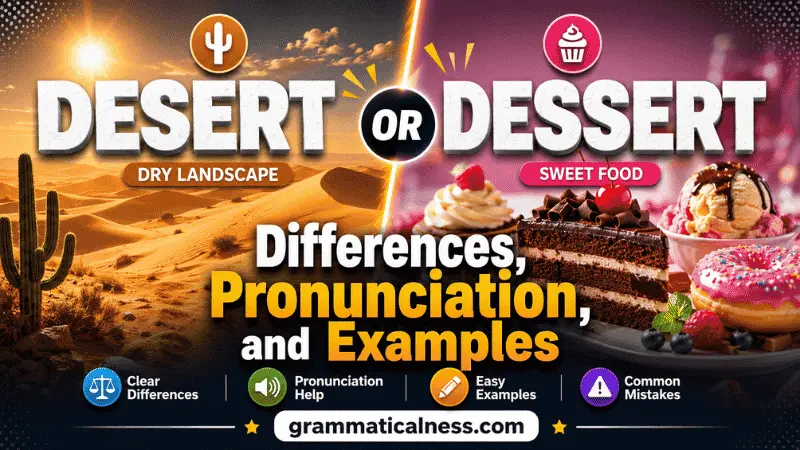
Both desert and dessert are correct English words, but they do not have the same meaning.
Use desert for a dry region or for the act of abandoning someone, something, or a duty. Use dessert for food commonly served at the end of a meal.
Their similar spellings cause confusion, but meaning and pronunciation usually reveal the correct choice.
Quick Answer
Use desert when you mean dry land:
“The road crosses the desert.”
You can also use desert as a verb meaning “leave” or “abandon”:
“Good friends do not desert each other.”
Use dessert when referring to cake, pie, ice cream, fruit, or another final course:
“We ordered cheesecake for dessert.”
A helpful spelling reminder is that dessert has two s letters because you may want a second serving. That is only a memory aid, not a language rule.
Why People Confuse Them
The words differ by only one letter. Both contain two syllables, and one pronunciation of desert sounds exactly like dessert.
The dry-land noun desert is pronounced DEZ-ert, with stress on the first syllable.
The verb desert is pronounced dih-ZURT, with stress on the second syllable. Dessert has the same second-syllable stress: dih-ZURT.
Because the verb and the food noun sound alike, writers must rely on meaning and spelling rather than sound alone.
Key Differences At A Glance
- Desert: One s; a dry region, an uninhabited place, or the act of abandoning someone or something.
- Dessert: Two s letters; a usually sweet course or dish served at or near the end of a meal.
- Pronunciation: Dry-land desert is DEZ-ert. Verb desert and food dessert are both dih-ZURT.
Meaning and Usage Difference
As a noun, desert commonly describes a region with very little rainfall and limited plant life. A desert does not have to be covered in sand or located in a hot climate. Some deserts are rocky or cold.
The word can also describe a place that lacks something important. For example, a neighborhood with few fresh-food options may be called a “food desert.”
As a verb, desert means to leave, abandon, or stop supporting a person, group, place, cause, or responsibility. It can be transitive, as in “desert a friend,” or intransitive, as when a soldier deserts.
Standard dictionaries also recognize an adjective use in expressions such as “desert climate” and “desert island.”
Dessert is a noun. It refers to a course or dish commonly eaten after the main part of a meal. In American use, desserts are usually sweet, such as pie, cake, cookies, pudding, or ice cream.
Although dessert can appear before another noun in phrases such as “dessert menu,” it still identifies the type or purpose of the following noun.
Tone, Context, and Formality
Both words are standard and neutral. The correct choice depends on meaning rather than formality.
Desert appears in geography, climate discussions, travel writing, military contexts, and serious descriptions of abandonment. The verb can sound emotionally strong because deserting someone often suggests disloyalty or neglect.
Dessert belongs mainly to food, restaurant, recipe, and everyday dining contexts. It usually carries a pleasant or neutral tone.
The basic distinction remains the same in formal reports, casual conversations, school assignments, menus, and social posts.
Which One Should You Use?
| Context | Best Choice | Why |
| A dry region with little rain | desert | It names a type of landscape or climate region. |
| Leaving a person, group, cause, or duty | desert | It functions as a verb meaning “abandon.” |
| A sweet course after a meal | dessert | It names food served at the end of a meal. |
| A menu, spoon, table, or course for sweets | dessert | It identifies something connected with the final food course. |
| A remote, uninhabited island | desert | “Desert island” uses the sense of remote or uninhabited. |
| A deserved punishment in a fixed expression | deserts | The standard expression is “just deserts.” |
Use the surrounding sentence as your guide. Sand, climate, abandonment, or duty points to desert. Cake, pie, ice cream, restaurants, or meals points to dessert.
When One Choice Sounds Wrong
“I ate chocolate desert after dinner” is incorrect because food served after dinner is dessert.
“The hikers became lost in the dessert” suggests that the hikers became lost inside a food course. The intended word is desert.
“The officer desserted his post” is also incorrect. The verb is desert, and its past-tense form is deserted.
A “dessert island” would normally be an intentional joke about an island filled with sweets. The established expression for a remote island is desert island.
However, not every unusual sentence is automatically wrong. “We served dessert in the desert” correctly uses both words.
Common Mistakes (and Quick Fixes)
Mistake: Using desert for sweet food.
Write dessert when the sentence concerns something eaten after a meal. Remember that the food word contains two s letters.
Mistake: Pronouncing every use of desert the same way.
Stress the first syllable in the dry-land noun: DEZ-ert. Stress the second syllable in the verb: dih-ZURT.
Mistake: Writing just desserts.
The traditional expression is just deserts, meaning the consequences or punishment someone deserves. In this expression, deserts is pronounced like desserts.
Mistake: Assuming every desert is sandy and hot.
A desert is defined mainly by its dry conditions, not by sand or high temperature alone.
Everyday Examples
“The family drove through the desert on its way to Arizona.”
“Very little rain falls in that desert region.”
“The abandoned building stood in what felt like a cultural desert.”
“Please do not desert the team during a difficult week.”
“Several soldiers were accused of deserting their posts.”
“The restaurant offers three desserts each evening.”
“We shared a warm brownie for dessert.”
“After crossing the desert, the travelers celebrated with dessert.”
Dictionary-Style Word Details
Verb
Desert: Used as a verb meaning to abandon, leave, forsake, or withdraw support. It may refer to a person, place, organization, cause, responsibility, or military post. Example: “She refused to desert her colleagues.”
Dessert: Not commonly used as a verb in standard US English. Use verbs such as serve, eat, order, prepare, or finish when discussing dessert.
Noun
Desert: A dry region with very little rainfall and limited vegetation. It may be countable in “a vast desert” or used more generally in “miles of desert.” A separate, uncommon noun appears mainly in the expression “just deserts.”
Dessert: A food course or dish served at the end of a meal. It can be used generally in “We had dessert” or countably in “The bakery sells twelve desserts.”
Synonyms
Desert: Closest plain alternatives for the landscape meaning include arid region, wilderness, and, in some contexts, wasteland. Verb alternatives include abandon, forsake, leave, and withdraw from. No single antonym fits every meaning.
Dessert: Closest plain alternatives include sweet course, final course, and after-dinner treat. These alternatives are not exact in every dining tradition. The word has no clear general antonym.
Example Sentences
Desert: “The research team studied plants that survive in the desert.” As a verb: “A responsible leader will not desert the group during a crisis.”
Dessert: “Fresh berries and ice cream made a simple dessert.” Another example is, “Would you like to see the dessert menu?”
Word History
Desert: The dry-land noun and the verb entered English through French forms connected with a Latin source meaning to leave, forsake, or make uninhabited. This history helps explain the connection between a deserted place and a desert.
Dessert: The food word came through French from a term associated with clearing what had been served from the table. It developed into the name of the course presented after the main dishes were removed.
The similar spellings do not make the modern words interchangeable.
Phrases Containing
Desert: Common phrases include desert climate, desert landscape, desert island, food desert, desert a friend, desert one’s post, and just deserts. In just deserts, the word refers to something deserved and is pronounced like desserts.
Dessert: Common phrases include dessert menu, dessert course, dessert table, dessert spoon, dessert wine, frozen dessert, and save room for dessert.
FAQs
Desert usually refers to a dry region with little rainfall. It can also be a verb meaning to abandon someone, something, or a duty. Dessert is a noun for food commonly served after the main part of a meal, such as cake, pie, pudding, or ice cream.
Both spellings are correct, but the right choice depends on meaning. Use desert for dry land or abandonment. Use dessert for a sweet course or after-meal treat. The extra s in dessert can help you remember that it refers to something sweet.
The dry-land noun desert is pronounced DEZ-ert, with stress on the first syllable. The verb desert and the food noun dessert are pronounced dih-ZURT, with stress on the second syllable. Context helps listeners identify the intended meaning.
The correct word is dessert. For example, “We ordered chocolate cake for dessert.” Writing desert would incorrectly refer to dry land or the act of abandoning someone or something.
The traditional expression is just deserts, even though deserts is pronounced like desserts. It means a deserved reward or punishment, though it is often used for negative consequences. For example, “The dishonest manager finally received his just deserts.”
Remember that dessert has two s letters because you may want a second serving of something sweet. Desert has one s and commonly refers to a dry place. This is a memory trick, not a grammar rule, but it can help prevent spelling mistakes.
Conclusion
Choose desert for dry land, an uninhabited place, or the act of abandoning someone or something. Choose dessert for the food course commonly served after a meal.
Pronunciation provides an additional clue. The dry-land noun is DEZ-ert, while the verb desert and the food noun dessert are pronounced dih-ZURT.
For spelling, remember: one s for the dry region and two s letters for the food you may want twice.