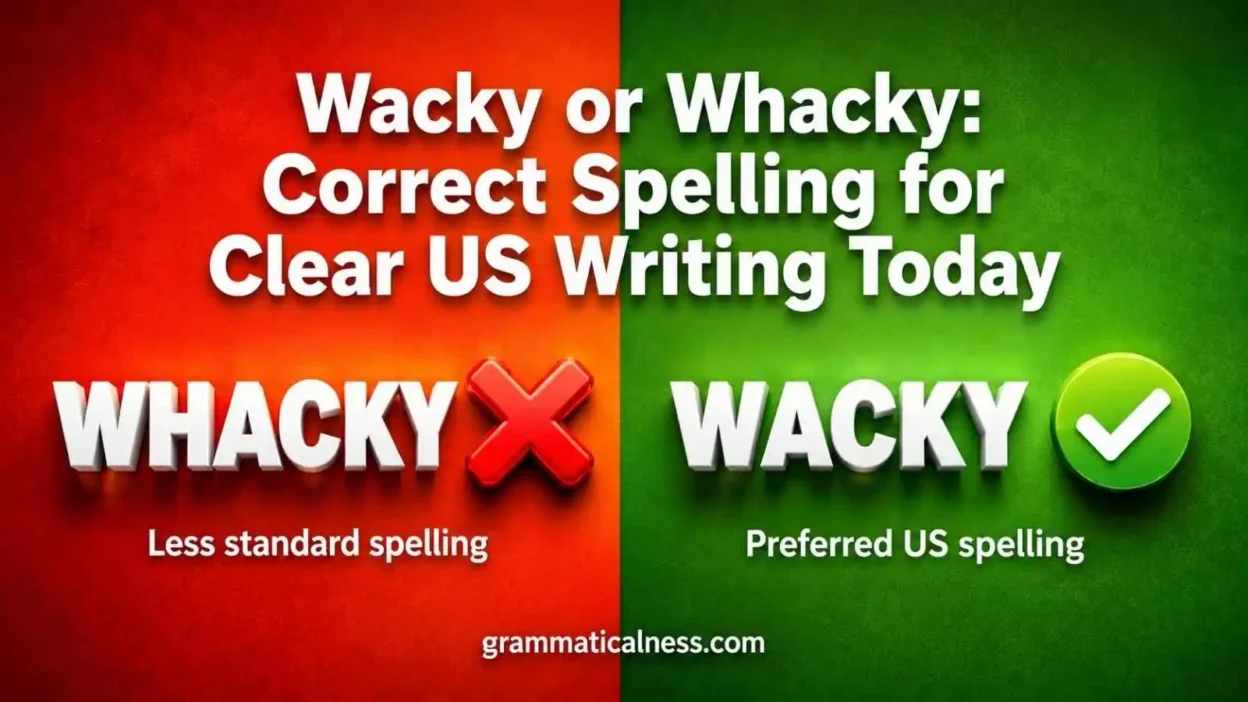
Wacky or whacky is a spelling choice, not a difference in meaning. In modern US English, wacky is the better choice for almost every situation. It means silly, odd, eccentric, or funny in a slightly strange way.
Whacky exists as a variant spelling, but it is much less common. Some readers may accept it, but others may see it as a typo or an old-fashioned form. That makes it risky in school papers, business writing, articles, captions, and any polished text.
So the practical answer is simple: write wacky unless you have a special reason to copy a title, brand name, quoted text, or deliberate creative spelling.
Quick Answer
Use wacky in standard modern US English.
Whacky means the same thing, but it is a less common variant. It is not the best choice for clear everyday writing because many readers expect the spelling without the h.
Correct: That was a wacky idea, but it worked.
Less common: That was a whacky idea, but it worked.
Why People Confuse Them
People confuse wacky and whacky because both look connected to whack. Since whack has an h, some writers assume the adjective should also keep the h.
That guess makes sense visually, but modern spelling does not always follow the shape of a related word. In current usage, wacky became the normal spelling for the adjective.
The confusion also comes from seeing whacky in older writing, casual posts, names, and creative titles. A person may read it once and assume it is the main spelling. Still, for most readers in the United States, wacky looks cleaner and more familiar.
Key Differences At A Glance
| Context | Best Choice | Why |
| School paper | Wacky | It is the standard modern spelling. |
| Business email | Wacky | It avoids looking like a typo. |
| Blog article | Wacky | It matches reader expectations. |
| Social caption | Wacky | It feels natural and clear. |
| Quoting someone else | Whacky, if quoted | Keep the original spelling in a quote. |
| Brand name or title | Whacky, if official | Do not change official names. |
| Creative voice | Whacky, rarely | It may work as a deliberate style choice. |
Meaning and Usage Difference
Wacky means funny, silly, eccentric, or strange in an amusing way. It usually has a light tone. A wacky idea is unusual, but it is not always bad.
In comedy, wacky often means odd on purpose.
A playful friend may seem wacky when they act goofy, unpredictable, or silly.
Whacky means the same thing. The difference is not meaning. The difference is usage and reader expectation. Wacky is the preferred spelling. Whacky is a variant that appears less often.
Both words are adjectives. They describe a person, idea, plan, joke, outfit, show, or situation.
The pronunciation is usually the same: WAK-ee. For most US readers, pronunciation does not create a real distinction.
Tone, Context, and Formality
Both wacky and whacky are informal. You would not usually use either word in a serious legal, medical, or academic context unless the tone is intentionally casual.
Wacky fits friendly writing, entertainment coverage, reviews, humor, personal stories, and light descriptions. It can sound positive, neutral, or mildly critical depending on the sentence.
Example: The movie has a wacky sense of humor.
That sounds playful.
Example: The proposal felt wacky and unrealistic.
That sounds critical.
Whacky carries the same meaning, but the spelling may pull attention away from the sentence. In polished US writing, that distraction is the main problem.
Which One Should You Use?
Use wacky when you are writing in your own voice.
Choose wacky for articles, essays, emails, captions, product descriptions, jokes, reviews, and everyday messages. It is clear, expected, and easy to read.
Use whacky only when the spelling itself matters. That includes quoted material, official titles, names, older text, or a deliberate creative choice. Even then, make sure the unusual spelling helps rather than distracts.
Compact comparison:
- Wacky: preferred modern spelling; best for nearly all US writing.
- Whacky: less common variant; same meaning, but more likely to look unusual.
- Main rule: when in doubt, write wacky.
When One Choice Sounds Wrong
Whacky can sound wrong when the reader expects clean, standard spelling. It may stand out in a résumé, school assignment, formal email, news-style article, or professional post.
For example, this sentence may distract some readers:
Our team tested a whacky new idea for the campaign.
The meaning is clear, but the spelling may look accidental. This version is smoother:
Our team tested a wacky new idea for the campaign.
Wacky rarely sounds wrong when the intended meaning is “silly,” “odd,” or “funny in a strange way.” The only time you should avoid changing it is when Whacky appears in an official name or exact quote.
Common Mistakes (and Quick Fixes)
Mistake: Using whacky because whack has an h.
Fix: Use wacky for the adjective in modern writing.
Mistake: Treating wacky and whacky as two different meanings.
Fix: Remember that they mean the same thing.
Mistake: Using wacky in a serious context where the tone feels too casual.
Fix: Use a more neutral word like unusual, unconventional, or eccentric.
Mistake: Calling whacky completely impossible.
Fix: Say it is a less common variant, not the preferred modern spelling.
Mistake: Overusing wacky for anything strange.
Fix: Use it when the strangeness feels silly, funny, playful, or lightly odd.
Everyday Examples
The kids came up with a wacky game during recess.
That commercial has a wacky ending, but people remember it.
My uncle tells wacky stories at every family dinner.
The startup tried a wacky idea that actually solved the problem.
Her Halloween costume was wacky without being scary.
The show mixes smart writing with wacky characters.
That is a wacky theory, but I can see why people share it.
The party had a wacky photo booth with giant sunglasses.
I like the design, but the color choice feels a little wacky.
He sent a wacky text that made the whole group laugh.
Use whacky only when you are copying someone’s exact spelling:
The flyer called it a “Whacky Weekend Sale.”
Dictionary-Style Word Details
Verb
Wacky: Not commonly used as a verb in standard US English. Do not write I wackied the plan.
Whacky: Not commonly used as a verb in standard US English. The spelling does not create a separate verb form.
Noun
Wacky: Not commonly used as a standard noun. In everyday writing, it works mainly as an adjective. Use wackiness for the noun form when you mean the quality of being wacky.
Example: The wackiness of the scene made it fun.
Whacky: Not commonly used as a standard noun. If you need the noun idea, wackiness is still the natural choice.
Synonyms
Wacky: Closest plain alternatives include silly, goofy, zany, odd, eccentric, quirky, and offbeat.
Whacky: The same alternatives apply because the meaning is the same.
Useful antonyms depend on context. Possible opposites include serious, ordinary, conventional, sensible, or normal. These are not perfect opposites in every sentence, so choose based on meaning.
Example Sentences
The teacher used a wacky example to help the class remember the rule.
After dinner, we watched a wacky comedy.
At first, her plan sounded wacky, but it saved money.
The old poster advertised a “whacky night of games and prizes.”
In the booklet, the character’s name was spelled “Whacky Jack.”
Keep whacky if it appears that way in a title, brand name, or quoted wording.
Word History
Wacky is linked to whack plus the adjective ending -y. The spelling history is not the main concern for everyday writers. The practical point is that wacky is now the preferred modern spelling.
Whacky reflects the older-looking spelling with wh, but current usage treats it as less common. Because it can look unusual to many readers, it is usually not the safest choice.
Phrases Containing
Wacky: Common phrases include wacky idea, wacky sense of humor, wacky character, wacky comedy, wacky plan, and wacky adventure.
Whacky: The same phrases are possible, but they look less standard: whacky idea, whacky character, whacky comedy. Use them mainly when the spelling is intentional.
FAQs
Wacky is the preferred spelling in modern US English. Whacky is a less common variant, but it may look unusual or mistaken to many readers. For clear everyday writing, use wacky.
Yes, whacky is recorded as a variant spelling of wacky. However, it is not the spelling most readers expect today. Use it mainly in names, titles, quotes, or deliberate creative writing.
Yes. Both mean silly, odd, eccentric, or funny in a strange way. The difference is spelling and usage, not meaning.
Use wacky in American English. It is the safer choice for articles, school writing, emails, captions, reviews, and professional content.
Whacky is not completely wrong, but it is less common. In polished writing, it can look like a typo. That is why wacky is usually the better choice.
Yes, use whacky if it is part of an official title, brand name, event name, or quote. Do not “correct” someone else’s official spelling unless you are editing your own text.
Yes. Wacky is informal and playful. It works well for humor, casual descriptions, entertainment, and light commentary. In serious writing, words like unusual, unconventional, or eccentric may fit better.
Example: The kids came up with a wacky plan for the school talent show.
In this sentence, wacky means silly, unusual, and funny.
The common noun form is wackiness.
Example: The wackiness of the movie made it fun to watch.
Good synonyms include silly, goofy, zany, quirky, eccentric, odd, and offbeat. Choose the word that best matches the tone of your sentence.
Conclusion
For modern US writing, wacky is the spelling you should use. It means silly, odd, eccentric, or funny in a slightly strange way.
Whacky has the same meaning, but it is less common and may look like a mistake to some readers. Save it for quotes, official names, older text, or intentional creative style.
When your goal is clear, natural writing, choose wacky.