
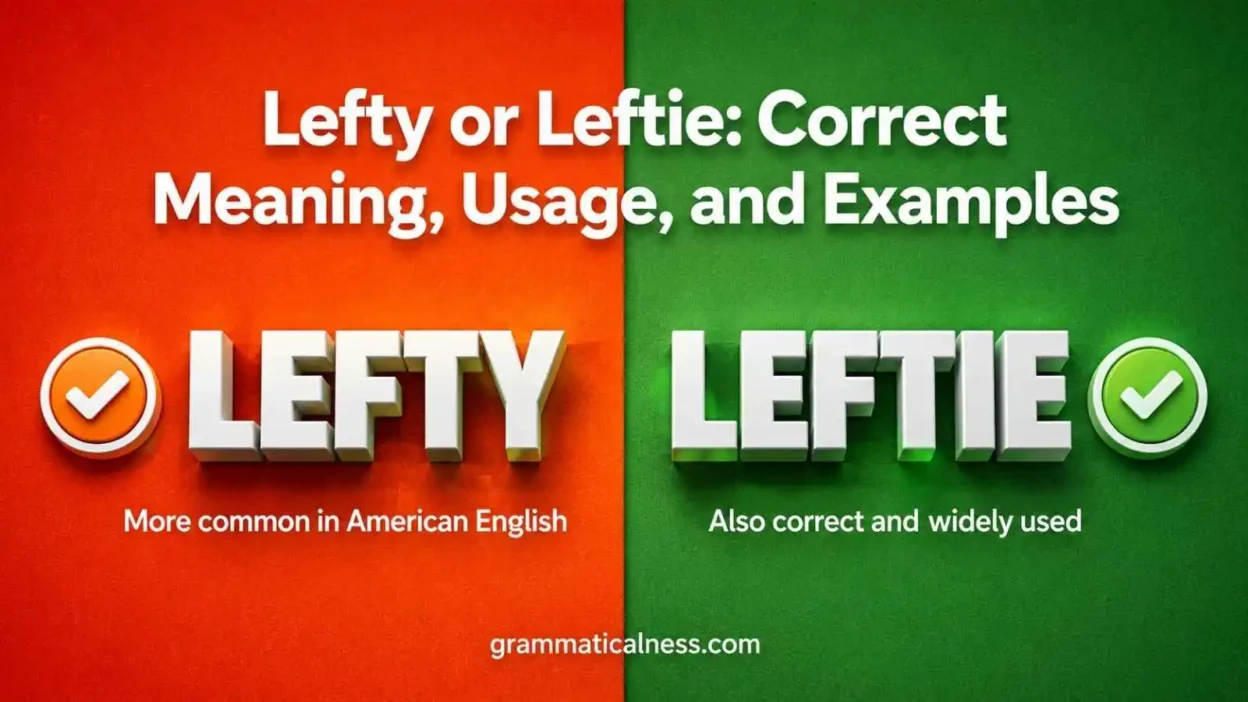
Both lefty and leftie are correct words, but they are not equally common in US English.
For most American readers, lefty is the better everyday choice. It can mean a left-handed person, a left-handed athlete, or an informal term for someone with left-wing political views.
Leftie can mean the same thing, but it is less common in US writing. It often feels more British, more playful, or more tied to informal political speech.
So the choice is not really about right or wrong. It is about audience, tone, and context.
Quick Answer
Use lefty in most US writing.
Use leftie only when you want that spelling on purpose, such as in quoted material, British-style writing, or a casual voice where the softer “-ie” ending feels natural.
| Context | Best Choice | Why |
| US sports writing | lefty | This is the normal form for a left-handed player or pitcher. |
| Everyday US speech | lefty | It sounds familiar and natural. |
| Formal writing | left-handed person | Both lefty and leftie are informal. |
| British-style political writing | leftie | This spelling often appears in informal political use. |
| A nickname or playful label | lefty or leftie | Either can work, but lefty is safer in the US. |
Why People Confuse Them
People confuse lefty and leftie because they sound the same and often mean the same thing.
The endings also look familiar. English has many casual words that end in -y or -ie, such as doggy, doggie, buddy, and sweetie. Because both endings can feel friendly or informal, readers may assume the spellings are fully equal.
However, real use is not always equal. In American English, lefty is the more expected spelling, especially in sports and everyday writing. Leftie is understood, but it may stand out more.
Key Differences At A Glance
• lefty: the best default in US English
• leftie: a recognized variant, but less common in US use
• lefty: common in sports, especially baseball
• leftie: often feels British, informal, or slightly playful
• lefty: can work as a noun, adjective, or casual adverb
• leftie: most often works as a noun
• both: can refer to handedness or politics
• both: are informal, not ideal for formal academic or business writing
Meaning and Usage Difference
A lefty is usually a left-handed person.
Example:
My brother is a lefty, so he keeps the mouse on the other side of the desk.
In sports, lefty often means a left-handed player, especially a pitcher or hitter.
Example:
The coach brought in a lefty to face the next batter.
In politics, lefty can mean a person with left-wing views. This use is informal and can sound neutral, joking, or critical depending on the sentence.
Example:
Her uncle is a proud lefty who talks about labor issues at every family dinner.
Leftie can carry the same meanings. Still, in US English, it is not the usual first choice for a left-handed person or athlete.
Example:
He called himself a leftie because everyone in his family is right-handed.
The pronunciation is the same for both: LEFT-ee. Since the sound does not change, the choice is mainly visual and stylistic.
Tone, Context, and Formality
Both words are informal.
That matters. In a school paper, medical form, hiring document, or formal report, use left-handed person instead of either word.
Better formal sentence:
The study included both left-handed and right-handed participants.
More casual sentence:
The study included both lefties and righties.
In US sports writing, lefty sounds natural and clear. A phrase like lefty pitcher is common. A phrase like leftie pitcher may be understood, but it looks less standard to many American readers.
In political writing, both words can sound loaded. Be careful. Calling someone a lefty or leftie may sound dismissive unless the tone is clearly friendly or self-describing.
Which One Should You Use?
Choose lefty when writing for a US audience.
It is short, familiar, and widely understood. It works well in casual writing, sports writing, and everyday examples.
Use leftie only when the spelling fits the voice. It may work in a casual blog post, a character’s dialogue, a quote, or writing aimed at readers who expect that form.
Here is the easiest rule:
Use lefty as your normal choice. Use leftie only when you have a clear reason.
When One Choice Sounds Wrong
Leftie can sound wrong in US sports sentences because readers expect lefty.
Awkward in US sports writing:
The manager called for a leftie from the bullpen.
Better:
The manager called for a lefty from the bullpen.
Lefty can sound too casual in formal writing.
Too casual:
The classroom had three lefties.
More formal:
The classroom had three left-handed students.
In political writing, either word can sound judgmental if the rest of the sentence is sharp.
Loaded:
Those lefties want to ruin everything.
Clearer:
People on the political left disagree with that policy.
Common Mistakes (and Quick Fixes)
One common mistake is treating leftie as wrong. It is not wrong. It is a real variant, but it is not the best default for most US writing.
Another mistake is using lefty in a formal context where left-handed person would sound more respectful and precise.
A third mistake is mixing both spellings in the same article.
Inconsistent:
My sister is a lefty, and my cousin is a leftie.
Better:
My sister is a lefty, and my cousin is a lefty.
Finally, do not assume the political meaning when the context is about handedness or sports.
Confusing:
The team signed another lefty.
Clear meaning:
In sports, this almost certainly means a left-handed player, not a political person.
Everyday Examples
My dad is a lefty, so he always checks where the scissors are.
The team has two right-handed pitchers and one lefty.
She writes with her left hand, but she does almost everything else right-handed.
My roommate calls herself a leftie because she likes the softer spelling.
That desk is hard for a lefty to use.
The coach wanted a lefty in the final inning.
He used “leftie” in the quote, so the editor kept the original spelling.
In a formal note, write “left-handed student,” not “lefty student.”
The word “lefty” can also describe someone’s politics, but context matters.
She meant “lefty” as a joke about handwriting, not politics.
Dictionary-Style Word Details
Verb
• lefty: Not commonly used as a verb in standard US English.
• leftie: Not commonly used as a verb in standard US English.
Noun
• lefty: A left-handed person; in sports, often a left-handed player or pitcher. It can also mean a person with left-wing political views.
• leftie: A variant noun with the same basic meanings, but it is less common in US English and often feels more British, playful, or informal.
Synonyms
• lefty: Closest plain alternatives include left-handed person, left-hander, and, in baseball, southpaw. In politics, leftist may fit, but it can sound more direct or ideological.
• leftie: Closest plain alternatives are the same: left-handed person, left-hander, southpaw, or leftist, depending on context.
Useful opposites include righty or right-hander for handedness. In politics, an opposite such as right-winger only works when the sentence is clearly about political views.
Example Sentences
• lefty: My son is a lefty, so we bought him left-handed scissors.
• lefty: The Yankees struggled against the lefty in the seventh inning.
• lefty: She is a lefty on most economic issues.
• leftie: He proudly calls himself a leftie, even though most Americans would write lefty.
• leftie: The article used leftie because it had a British tone.
• leftie: My aunt is the only leftie in her family.
Word History
• lefty: Formed from left plus the informal -y ending. It became strongly associated with left-handed people and later also gained political use.
• leftie: Formed from left plus the informal -ie ending. It developed as a variant spelling with the same general meaning.
The exact history is not needed to choose between them. For modern US writing, the practical point is simple: lefty is the normal choice.
Phrases Containing
• lefty: lefty pitcher, lefty batter, lefty guitarist, proud lefty, political lefty
• leftie: proud leftie, old leftie, political leftie, leftie writer, leftie friend
Some phrases sound more natural with lefty in US English, especially sports phrases. Leftie works better when the tone is casual, personal, or British-style.
FAQs About Lefty vs Leftie
Yes, both refer to a left-handed person or someone with left-wing political views. The main difference is stylistic and regional.
Lefty is the standard, widely recognized form in American writing, especially in sports and everyday contexts.
Yes, but it is less common. It works best in casual writing, playful tone, or when quoting a source that uses it.
No, both are pronounced LEFT-ee. The distinction is visual and stylistic, not phonetic.
Neither is formal. In academic, business, or professional writing, use left-handed person instead.
Yes. Both can refer to someone with left-wing political views, but context is key. The tone can sound friendly, informal, or slightly critical.
Yes. For example: “He is a lefty pitcher.” Leftie is primarily used as a noun, rarely as an adjective.
Use lefty by default. Use leftie only for stylistic effect, British influence, or playful tone.
For handedness: righty or right-hander. For politics: right-winger. Only include if the context makes it clear.
It’s best to stick with one spelling for consistency, usually lefty in US English.
Conclusion
Lefty and leftie are both correct, but lefty is the better choice for most US readers.
Use lefty for a left-handed person, a left-handed athlete, or an informal political label when the context is clear. Use leftie only when that spelling fits the voice, region, or quoted wording.
For formal writing, avoid both and write left-handed person instead.