
You may see SMT in a text, group chat, comment, or direct message. The letters can be confusing because they do not have one fixed meaning in every conversation. In casual online use, SMT may express irritation, replace the word “something,” or ask another person to send a post.
That makes context more important than memorizing one expansion. The words around SMT, the message’s tone, and where it appears usually reveal the intended meaning. A standalone “SMT” after bad news does a different job from “I need to tell you smt.”
This guide explains the main SMT meaning in text, its common alternatives, and the clues that separate them. You will also see natural examples, possible replies, common mistakes, and a short quiz. The goal is to help you read SMT correctly without assuming that every sender uses it the same way.
Quick Answer
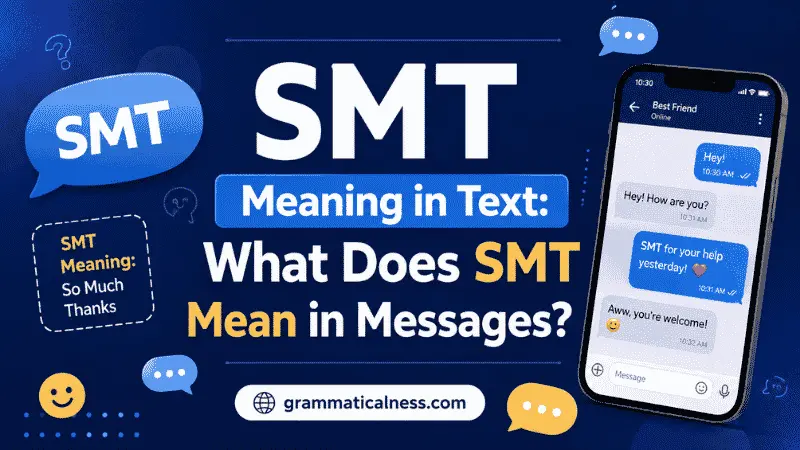
SMT meaning in text is context-dependent. It often means “sucking my teeth” as an annoyed reaction. It can also mean “something” or “send me this” in casual messages.
TL;DR
• SMT can express annoyance as “sucking my teeth.”
• Lowercase smt can be shorthand for “something.”
• “Send me this” is another social-message meaning.
• Sentence position often reveals the intended meaning.
• Avoid SMT when clarity or formality matters.
What Does SMT Mean in Text?
SMT has several meanings in casual digital communication. No single expansion works in every message. The three useful interpretations are “sucking my teeth,” “something,” and “send me this.”
| Context | Best Interpretation | What It Communicates |
| Annoyed reaction | Sucking my teeth | Irritation or disapproval |
| Inside a sentence | Something | An unspecified thing or idea |
| Reply to a post | Send me this | A request for the content |
When SMT means “sucking my teeth,” it acts like a written reaction. The sender is representing a familiar gesture or sound associated with annoyance, impatience, or disapproval.
Example: “SMT, they changed the plans again.”
When smt means “something,” it is simply a shortened spelling used in fast, informal writing. It takes the same place that the word something would take.
Example: “I have smt funny to tell you.”
When SMT means “send me this,” it works as a short request. This reading is most likely when someone replies to a photo, video, meme, link, or other shared content.
Example: “That wallpaper is perfect. SMT please.”
The grammatical role also changes with the meaning. As “something,” smt replaces an indefinite pronoun. As an annoyed reaction, SMT behaves more like an interjection or reaction marker. As “send me this,” it represents an entire command.
How Context Changes the Meaning of SMT
The easiest way to interpret SMT is to look at its job in the message. Start with the words immediately before and after it.
If SMT fills the place of a thing or idea, “something” is usually the natural reading. For example, “She said smt strange” becomes “She said something strange.” The sentence still makes sense.
If SMT appears by itself after frustrating news, “sucking my teeth” is more likely. In that use, it shows a reaction rather than naming an object or idea.
A reply attached to content gives another clue. If a friend responds “SMT” to your photo or video, “send me this” may fit better. The surrounding post supplies the object represented by “this.”
Outside casual messaging, SMT can have unrelated meanings. In computing, for example, it can refer to simultaneous multithreading. Gaming conversations may use SMT for Shin Megami Tensei. Those meanings depend on a clearly different subject.
SMT Examples in Real Conversations
For an annoyed reaction:
• “SMT, why would he cancel five minutes before dinner?”
• “SMT. I already explained that twice.”
In each example, SMT reacts to an irritating situation. Replacing it with “something” would not make grammatical sense.
For “something”:
• “Can I ask you smt?”
• “There’s smt in the kitchen for you.”
Here, smt occupies the same position as the full word something. Expanding the shorthand makes each sentence clear.
For “send me this”:
• “That recipe looks great. SMT.”
• “I want that photo for my wallpaper. SMT please.”
The request interpretation becomes clearer because a specific item has already been shared.
Is SMT Rude, Friendly, or Formal?
SMT is informal. It fits casual texts, comments, and chats better than formal school, business, or official writing.
When it means “something,” the tone is usually neutral.
When it means “send me this,” the tone can be friendly and direct. Adding “please” makes the request clearer and more polite.
The “sucking my teeth” meaning can sound annoyed or dismissive. It does not automatically insult the other person, but tone and relationship matter. In a tense conversation, it may make frustration feel stronger.
For professional communication, write the full message instead. “Could you send me this file?” or “I need to tell you something” is clearer for a broad audience.
How to Respond to SMT
Your reply should match the meaning you infer from context. If the message is unclear, asking a short question is safer than guessing.
If SMT shows annoyance, respond to the problem. You might say, “Yeah, that was frustrating,” or ask, “What happened?”
If smt means “something,” answer the sentence normally. A message such as “Can I tell you smt?” may simply need “Sure, what is it?”
If SMT means “send me this,” send the requested item when appropriate. You can also reply, “Sure, I’ll send it,” if you need to confirm first.
When two interpretations seem possible, use a simple clarification. “Do you mean something, or send me this?” prevents unnecessary confusion.
Common Mistakes and Misunderstandings
The biggest mistake is treating SMT as a universal abbreviation with one fixed expansion.
Another mistake is assuming that an app determines the definition. Instagram, TikTok, Snapchat, and ordinary text messages can all contain context-dependent shorthand. The surrounding sentence is more useful than the app name.
Do not assume smt always means “something.” That reading works well inside sentences, but it fails when SMT is clearly being used as an emotional reaction.
Likewise, do not expand every standalone SMT as “sucking my teeth.” A reply to a shared image may instead be a request to send the content.
Finally, avoid using SMT with readers who may not know the abbreviation. Writing the full phrase takes little extra space and removes ambiguity.
Mini Quiz
- In “I need to tell you smt,” what does smt most likely mean?
- In “SMT, they canceled again,” which meaning fits best?
- A friend replies “SMT please” to your photo. What may they want?
- Should SMT normally appear in a formal work email?
Answer key:
- Something.
- Sucking my teeth.
- They may want you to send the photo.
- No. The full wording is clearer and more professional.
FAQs
SMT can mean “sucking my teeth,” “something,” or “send me this.” The correct meaning depends on sentence structure, tone, and surrounding content. Do not assume one definition fits every message.
On Snapchat, SMT can carry the same meanings it has in other casual chats. An annoyed standalone reply may mean “sucking my teeth.” A message attached to shared content may instead mean “send me this.”
On Instagram, SMT may mean “something,” “send me this,” or “sucking my teeth.” A comment under a photo can suggest a request, while an irritated reaction can signal the teeth-sucking meaning. Read the full exchange.
Yes, smt is used as informal shorthand for “something.” It is easiest to recognize when the full word can replace smt without changing the sentence. For example, “Tell me smt” becomes “Tell me something.”
It can. This meaning is most plausible when SMT appears as a reply to a photo, video, link, or post. The shared item gives the word “this” a clear reference.
Not always. The “something” and “send me this” meanings can be neutral or friendly. The “sucking my teeth” meaning expresses annoyance, so it may sound dismissive in a tense exchange.
Final Takeaway
The SMT meaning in text depends on context. It may express irritation, stand in for “something,” or ask someone to “send me this.”
Check the sentence, tone, and shared content before deciding. When the meaning remains unclear, ask the sender rather than guessing.