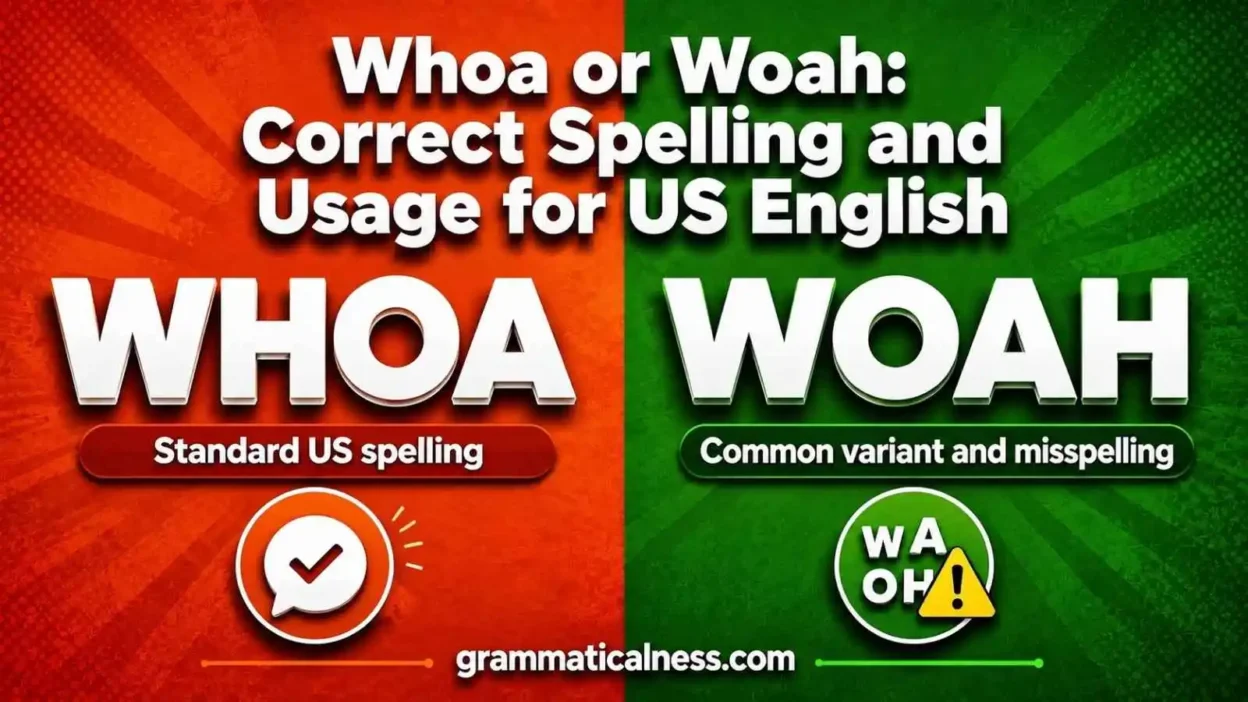
Whoa or woah is a common spelling question because both forms appear online. You may see whoa in books, articles, captions, and dialogue. You may also see woah in texts, memes, comments, and casual posts.
For standard US English, whoa is the better choice. Woah usually means the same thing, but it is less common and more informal. In polished writing, schoolwork, business messages, and edited content, use whoa.
Quick Answer
Use whoa in standard US English. It is the safest spelling when you mean “stop,” “slow down,” or “I am surprised.” Woah is a less common informal variant. It may appear in casual online writing, but it can still look like a spelling mistake in edited or professional contexts.
Why People Confuse Them
People confuse whoa and woah because the word is mostly heard, not carefully studied. It sounds like woe, so many writers spell it by sound and choose woah.
The spelling whoa also looks unusual. The letters wh at the start can feel odd because many speakers pronounce the word simply like “woe.” That makes woah look more natural to some people, even though whoa is the safer standard form.
Another reason is online writing. In comments, captions, and messages, informal spellings spread quickly. Once readers see woah often enough, it starts to feel familiar.
Key Differences At A Glance
| Context | Best Choice | Why |
| Standard US writing | whoa | It is the safest accepted spelling. |
| School assignments | whoa | Teachers and editors are more likely to expect it. |
| Business messages | whoa | It looks cleaner and less casual. |
| Dialogue in fiction | whoa | It works for surprise, warning, or stopping someone. |
| Texts and memes | whoa or woah | Woah may feel casual, but whoa is still safer. |
| A command to stop | whoa | This is the traditional spelling for that use. |
| A surprised reaction | whoa | It clearly expresses shock, wonder, or alarm. |
Meaning and Usage Difference
Whoa is an interjection. That means it is a short word used to express a reaction, command, or sudden feeling. It can stand alone or appear at the start of a sentence.
Use whoa when telling someone or something to stop or slow down.
Example: Whoa, slow down before you answer.
You can also use whoa when you feel surprised, impressed, alarmed, or caught off guard.
Example: Whoa, that storm came out of nowhere.
Woah usually has the same meaning, but it has a different usage status. It is not a different word with a separate meaning. It is a less common spelling of whoa, and many readers still see it as informal or nonstandard.
Pronunciation is simple: both forms are usually pronounced like woe. The spelling changes more than the sound.
Tone, Context, and Formality
Whoa is casual, but it is still the better spelling in standard writing. It fits dialogue, headlines, examples, social posts, classroom explanations, and light business writing when the tone allows it.
Woah feels more informal. It can work in a text message, a meme, or a casual caption when the writer wants a loose online tone. However, it may distract careful readers.
Here is the practical difference:
| Feature | whoa | woah |
| Standard US choice | Yes | Less safe |
| Common in edited writing | Yes | Less common |
| Casual online use | Yes | Yes |
| Separate meaning | No | No |
| Safest for school or work | Yes | No |
Because whoa already covers all main meanings, there is rarely a strong reason to choose woah in serious writing.
Which One Should You Use?
Use whoa almost every time. It is clear, familiar, and accepted in standard US English.
Choose whoa when you write:
Examples With Whoa
Whoa, that was close.
Let’s not rush this decision—whoa.
This view is amazing. Whoa.
Use woah only when you want a very casual or stylized feel. For example, a character in a text thread might write, “Woah, that’s wild.” Even then, whoa would still be correct and less likely to be questioned.
For articles, essays, emails, captions for a broad audience, and brand content, whoa is the stronger choice.
When One Choice Sounds Wrong
Woah can sound wrong when the writing needs polish. In a school paper, client email, product page, or edited article, it may look like a typo.
Weak: Woah, this update changes the whole schedule.
Better: Whoa, this update changes the whole schedule.
Whoa can sound too casual if the surrounding sentence is formal. In that case, the issue is not the spelling. The issue is the word itself.
Too casual: Whoa, the quarterly revenue decline is significant.
Better: The quarterly revenue decline is significant.
So, use whoa for casual reaction. Use a more formal phrase when the setting calls for restraint.
Common Mistakes (and Quick Fixes)
Mistake: Using woah in polished US writing.
Fix: Use whoa instead.
Mistake: Treating whoa and woah as two different meanings.
Fix: Remember that they usually mean the same thing. The difference is spelling, acceptance, and tone.
Mistake: Using whoa too often in formal writing.
Fix: Replace it with a calmer phrase such as “That is surprising,” “Pause,” or “Slow down.”
Mistake: Writing woah because it looks closer to the sound.
Fix: Use whoa as your default spelling.
Mistake: Forgetting punctuation after whoa.
Fix: Use a comma for a lighter pause and an exclamation point for stronger emotion.
Everyday Examples
Correct: Whoa, I did not expect the meeting to end that fast.
Correct: Whoa! That truck came around the corner quickly.
Examples With Whoa
Whoa, let’s check the numbers before we send this.
Your new desk setup looks great—whoa.
Whoa! The concert tickets sold out in two minutes.
Informal: Woah, that clip is everywhere today.
Better for standard writing: Whoa, that clip is everywhere today.
Informal: Woah, I completely missed that detail.
Better for standard writing: Whoa, I completely missed that detail.
Dictionary-Style Word Details
Verb
• whoa: Can be used as a verb in a limited sense, meaning to stop or slow by saying “whoa,” especially to an animal. This use is uncommon in everyday writing.
• woah: Not commonly used as a verb in standard US English.
Noun
• whoa: Not commonly used as a noun in standard US English. It is mainly an interjection or command.
• woah: Not commonly used as a noun in standard US English.
Synonyms
• whoa: Closest plain alternatives include stop, slow down, hold on, wait, wow, and that’s surprising. The best choice depends on context.
• woah: Uses the same closest plain alternatives because it usually carries the same meaning as whoa.
Clear antonyms do not fit well because whoa is an interjection, not a regular descriptive word. In the “stop” sense, loose opposites could include go on or keep going, but those are not exact antonyms.
Example Sentences
• whoa: Whoa, I need a second to think about that.
• whoa: Whoa! That dog jumped over the whole fence.
• whoa: Whoa, don’t click send until we review the file.
• woah: Woah, that was unexpected.
• woah: In a casual text, someone might write, “Woah, you got there early.”
Word History
• whoa: The word has long been used as a command to stop or slow a horse or other animal. It later became common as a general reaction of surprise, concern, or amazement.
• woah: This spelling appears as a later variant. Its rise is often linked with informal writing, especially online use. The safest point is simple: woah exists in real usage, but whoa remains the better standard spelling.
Phrases Containing
• whoa: Common phrases include whoa there, whoa, Nelly, whoa, whoa, whoa, and like whoa.
• woah: The same phrases may appear with woah in casual writing, but standard US writing usually keeps whoa.
FAQ
Is whoa or woah correct?
Whoa is the correct and safer spelling in standard US English. Use it when you mean “stop,” “slow down,” or “I am surprised.” Woah appears in casual writing, especially online, but many readers still see it as informal or less polished.
Is woah a real word?
Woah appears in real usage, so readers may recognize it. However, it is not the best choice for schoolwork, business writing, articles, or edited content. If you want the spelling most people expect, choose whoa instead.
What does whoa mean?
Whoa can mean “stop,” “slow down,” or “hold on.” It can also show surprise, shock, concern, or amazement. For example, you might say, “Whoa, that car came close,” or “Whoa, this view is amazing.” The meaning depends on the sentence.
Why do people spell whoa as woah?
People often spell whoa as woah because they write it the way it sounds. Since whoa sounds like “woe,” the spelling can feel unusual. Online writing also spreads informal spellings quickly, which makes woah look familiar to many readers.
Should I use whoa or woah in formal writing?
Use whoa if the tone allows a casual reaction word. It is the standard spelling and looks cleaner in polished writing. In very formal writing, you may want to replace whoa with a phrase like “That is surprising,” “Please pause,” or “Slow down.”
Can whoa and woah mean the same thing?
Yes. Whoa and woah usually carry the same meaning. The difference is not meaning but spelling, tone, and acceptance. Whoa is the standard choice. Woah is more informal and can look like a mistake in edited US writing.
Conclusion
The best choice is whoa. Use it when you mean “stop,” “slow down,” or “that surprised me.” It is the safer spelling for standard US English and works in nearly every context where this casual reaction word belongs.
Woah usually means the same thing, but it is less common and more informal. It may fit a casual text or stylized post, but in edited writing, whoa is the form most readers expect.
Whoa is the correct and safer spelling in standard US English. Use it when you mean “stop,” “slow down,” or “I am surprised.” Woah appears in casual writing, especially online, but many readers still see it as informal or less polished.
Woah appears in real usage, so readers may recognize it. However, it is not the best choice for schoolwork, business writing, articles, or edited content. If you want the spelling most people expect, choose whoa instead.
Whoa can mean “stop,” “slow down,” or “hold on.” It can also show surprise, shock, concern, or amazement. For example, you might say, “Whoa, that car came close,” or “Whoa, this view is amazing.” The meaning depends on the sentence.
People often spell whoa as woah because they write it the way it sounds. Since whoa sounds like “woe,” the spelling can feel unusual. Online writing also spreads informal spellings quickly, which makes woah look familiar to many readers.
Use whoa if the tone allows a casual reaction word. It is the standard spelling and looks cleaner in polished writing. In very formal writing, you may want to replace whoa with a phrase like “That is surprising,” “Please pause,” or “Slow down.”
Yes. Whoa and woah usually carry the same meaning. The difference is not meaning but spelling, tone, and acceptance. Whoa is the standard choice. Woah is more informal and can look like a mistake in edited US writing.