
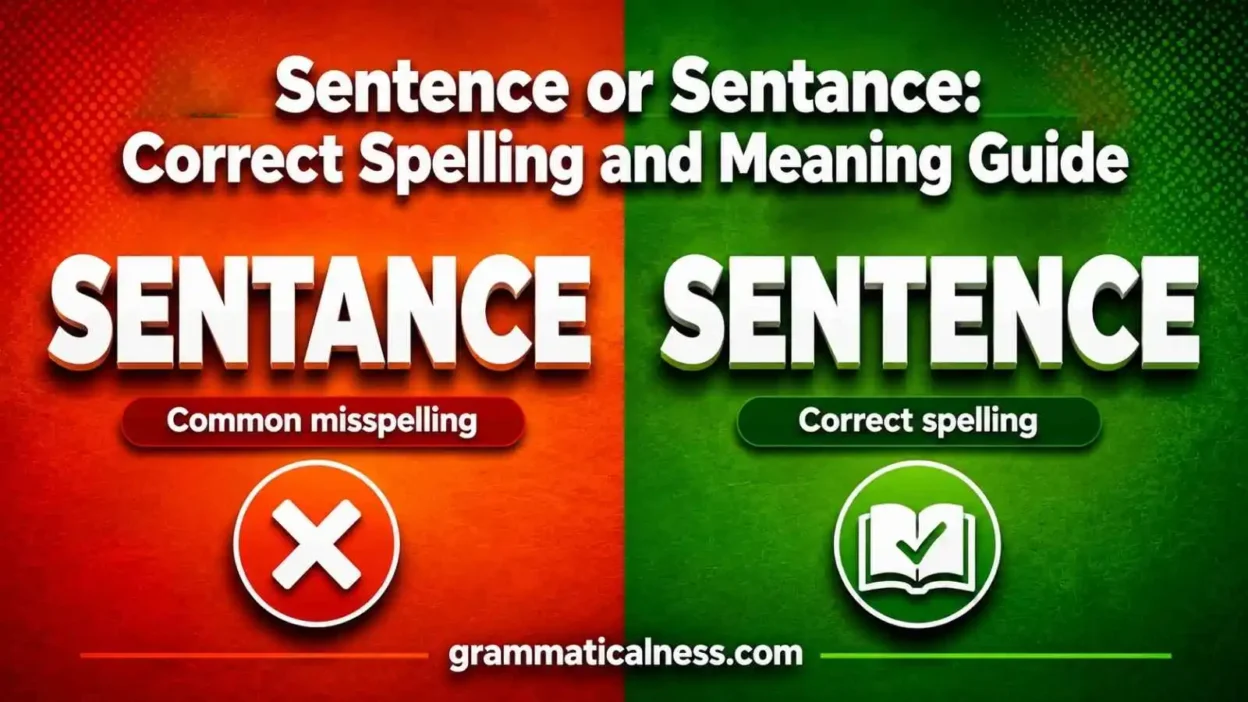
Sentence or sentance is a simple spelling question with one clear answer. The correct spelling is sentence. The form sentance is not standard in modern US English.
This mistake is easy to make because the middle sound in sentence is unstressed. When people hear the word quickly, they may guess -ance instead of -ence. Still, in schoolwork, emails, articles, legal writing, and everyday messages, sentence is the spelling you should use.
Quick Answer
Use sentence. Do not use sentance in standard writing.
Sentence can mean a group of words that expresses a complete idea. It can also mean a punishment given by a court. As a verb, sentence means to give that legal punishment. Sentance is a misspelling.
Why People Confuse Them
People confuse sentence and sentance because the word does not sound exactly like it looks. In everyday speech, many speakers say it like SEN-tens. The second syllable is soft, so the vowel can sound unclear.
That weak vowel sound makes writers guess the ending. Since many English words end in -ance, sentance may look possible at first. However, the accepted spelling is always sentence.
Another reason is that sentence has more than one meaning. A student may write a grammar sentence. A judge may give a legal sentence. Both meanings use the same spelling.
Key Differences At A Glance
| Context | Best Choice | Why |
| Grammar class | sentence | It means a group of words that expresses a complete idea. |
| School essay | sentence | It is the correct spelling in standard writing. |
| Business email | sentence | It looks professional and correct. |
| Court or legal context | sentence | It means a legal punishment. |
| Verb meaning “give punishment” | sentence | Example: The judge will sentence the defendant. |
| Any polished writing | sentence | Sentance is a misspelling. |
| Casual texting | sentence | Even casual writing usually keeps the correct spelling. |
Meaning and Usage Difference
The real difference is not a subtle meaning difference. Sentence is the correct word. Sentance is the incorrect spelling.
As a grammar word, sentence means a word group that expresses a complete thought. It often has a subject and a verb.
Correct: This sentence is short.
Incorrect: This sentance is short.
As a legal word, sentence can mean the punishment a court gives.
Correct: The judge gave him a five-year sentence.
Incorrect: The judge gave him a five-year sentance.
As a verb, sentence means to give someone a legal punishment.
Correct: The court will sentence her next month.
Incorrect: The court will sentance her next month.
Tone, Context, and Formality
Sentence is neutral and standard. You can use it in formal writing, casual writing, school assignments, workplace documents, and legal contexts.
Sentance has no special tone because it is not a standard choice. It usually signals a spelling error. In a text message, readers may still understand you, but in an essay, resume, email, or article, it can make the writing look careless.
| Feature | sentence | sentance |
| Standard spelling | Yes | No |
| Grammar meaning | Yes | No |
| Legal noun meaning | Yes | No |
| Legal verb meaning | Yes | No |
| Formal writing | Correct | Incorrect |
| Casual writing | Correct | Still a mistake |
Which One Should You Use?
Use sentence every time.
Use it when you talk about writing:
Please rewrite the last sentence.
Use it when you talk about grammar:
A sentence usually begins with a capital letter.
Use it when you talk about court punishment:
The sentence was reduced after the appeal.
Use it as a verb in legal writing:
The judge will sentence the defendant on Friday.
Do not use sentance unless you are showing the mistake itself.
When One Choice Sounds Wrong
Sentance sounds wrong in any edited context because it is not the accepted spelling. It may also distract readers from your message.
Wrong: Write one sentance about your weekend.
Right: Write one sentence about your weekend.
Wrong: The court will sentance him tomorrow.
Right: The court will sentence him tomorrow.
Wrong: Your opening sentance needs a stronger idea.
Right: Your opening sentence needs a stronger idea.
A useful memory tip is this: sentence has -ence, just like presence and difference. The sound may be soft, but the spelling stays fixed.
Common Mistakes (and Quick Fixes)
Mistake: Using sentance in schoolwork.
Fix: Write sentence.
Mistake: Thinking grammar and legal meanings have different spellings.
Fix: Use sentence for both meanings.
Mistake: Writing sentance because of pronunciation.
Fix: Remember that the second syllable is weak, but the spelling is -ence.
Mistake: Using sentance as a verb.
Fix: Write sentence when you mean “give a legal punishment.”
Mistake: Relying only on sound.
Fix: Check the word visually: sen-tence, not sen-tance.
Everyday Examples
Correct Examples With Sentence
The first sentence of your essay is clear.
Can you make this sentence shorter?
Each sentence should connect to the next idea.
The teacher asked us to write a complete sentence.
The final sentence made the message sound warmer.
The judge announced the sentence in court.
The court may sentence him next week.
She read the sentence twice before replying.
Incorrect: This sentance has a spelling mistake.
Incorrect: The judge will sentance the defendant today.
Dictionary-Style Word Details
Verb
• sentence: Used as a verb in legal contexts. It means to give someone an official punishment.
Example: The judge will sentence the defendant after the hearing.
• sentance: Not commonly used as a verb in standard US English. Use sentence instead.
Noun
• sentence: A noun with two common meanings. In grammar, it means a group of words that expresses a complete idea. In law, it means a punishment given by a court.
Example: The sentence ends with a question mark.
Example: The sentence was three years in prison.
• sentance: Not a standard noun in modern US English. It is usually a misspelling of sentence.
Synonyms
• sentence: For the grammar meaning, closest plain alternatives include statement, line, clause, or complete thought, depending on context. These are not always exact replacements. For the legal meaning, possible alternatives include punishment, penalty, ruling, or judgment.
• sentance: No true synonyms apply because it is not a standard word. If you mean the grammar or legal word, use sentence.
Antonyms do not clearly fit the grammar meaning. For the legal meaning, words such as pardon or reprieve may work in some contexts, but they are not opposites in every sentence.
Example Sentences
Examples With Sentence
Your topic sentence should introduce the main idea.
The sentence was too long, so I split it into two parts.
The court will sentence the driver next month.
Examples With Sentance
Sentance is not the correct spelling in standard writing.
If you typed sentance, change it to sentence.
Word History
• sentence: The word comes through older French from Latin roots connected with thought, opinion, and judgment. That history helps explain why sentence can refer both to a complete thought in grammar and to a judgment in law.
• sentance: No separate standard word history is needed for this comparison. In normal modern use, it is treated as a misspelling of sentence.
Phrases Containing
• sentence: complete sentence, topic sentence, opening sentence, final sentence, simple sentence, compound sentence, sentence structure, jail sentence, prison sentence, death sentence, sentence someone to prison.
• sentance: No standard phrases use sentance. In any of the phrases above, use sentence.
FAQs
Is it sentence or sentance?
The correct spelling is sentence. Sentance is not a standard spelling in modern US English. Use sentence when you mean a group of words that expresses a complete idea, such as “This sentence is clear.” Also use sentence when talking about a court punishment.
Is sentance a real word?
No. Sentance is usually a misspelling of sentence. Readers may understand what you mean, but it should not appear in schoolwork, emails, articles, resumes, or professional writing. The correct form is always sentence.
Why do people spell sentence as sentance?
People often spell sentence as sentance because the second syllable is weak when spoken. The word may sound like “SEN-tens,” so some writers guess the ending should be -ance. However, the correct spelling uses -ence.
Can sentence mean a punishment?
Yes. Sentence can mean a punishment given by a court. For example, “The judge gave him a two-year sentence.” It can also work as a verb, as in “The judge will sentence the defendant next week.”
Can sentence mean a group of words?
Yes. In grammar, a sentence is a group of words that expresses a complete thought. For example, “She closed the door” is a sentence because it has a subject, a verb, and a complete idea.
How can I remember the correct spelling?
Remember that sentence ends in -ence, not -ance. You can also connect it with words like difference and presence, which have the same ending sound and spelling pattern.
Conclusion
The correct choice is sentence, not sentance. Use sentence when you mean a group of words that expresses a complete idea. Also use sentence for a court punishment and as the legal verb meaning “to give a punishment.”
The spelling sentance is a common mistake, but it is not the standard form. For clear, correct US English, write sentence every time.
The correct spelling is sentence. Sentance is not a standard spelling in modern US English. Use sentence when you mean a group of words that expresses a complete idea, such as “This sentence is clear.” Also use sentence when talking about a court punishment.
No. Sentance is usually a misspelling of sentence. Readers may understand what you mean, but it should not appear in schoolwork, emails, articles, resumes, or professional writing. The correct form is always sentence.
People often spell sentence as sentance because the second syllable is weak when spoken. The word may sound like “SEN-tens,” so some writers guess the ending should be -ance. However, the correct spelling uses -ence.
Yes. Sentence can mean a punishment given by a court. For example, “The judge gave him a two-year sentence.” It can also work as a verb, as in “The judge will sentence the defendant next week.”
Yes. In grammar, a sentence is a group of words that expresses a complete thought. For example, “She closed the door” is a sentence because it has a subject, a verb, and a complete idea.
Remember that sentence ends in -ence, not -ance. You can also connect it with words like difference and presence, which have the same ending sound and spelling pattern.