

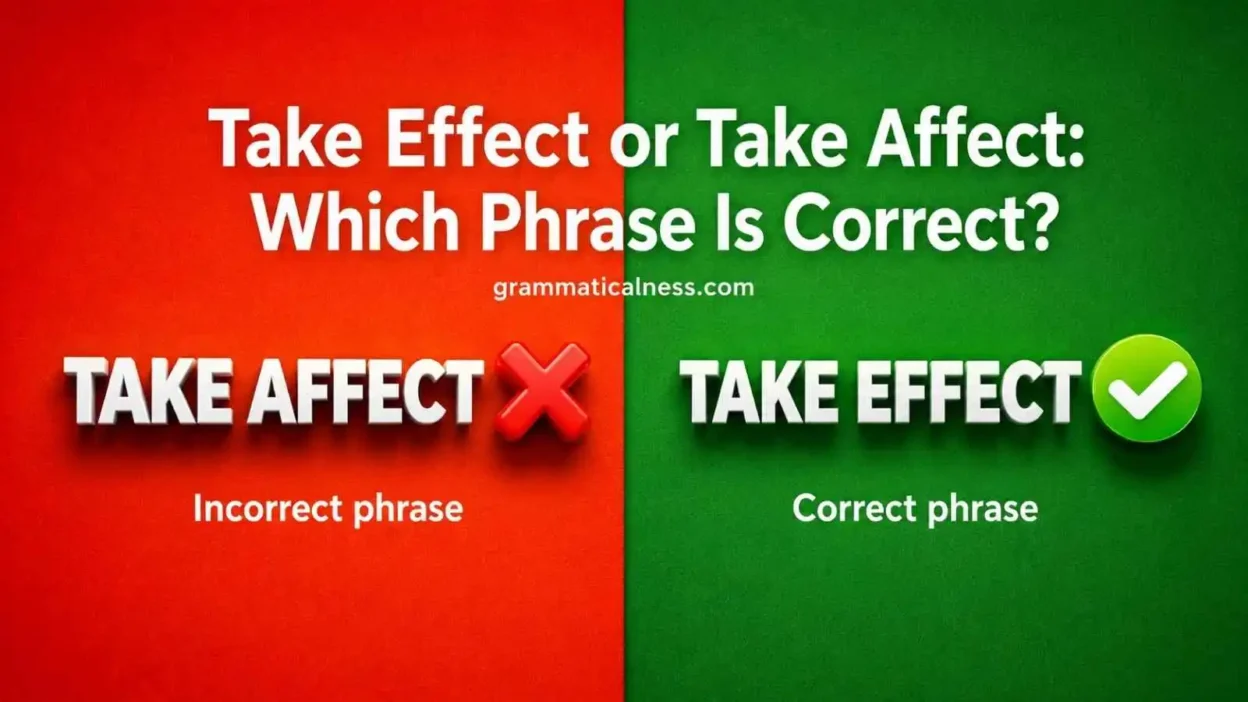
The correct phrase is take effect.
Use take effect when something starts to work, starts to apply, or becomes active. Do not write take affect in standard US English.
Example:
The new policy will take effect on Monday.
Not:
The new policy will take affect on Monday.
Quick Answer
Take effect is correct. Take affect is incorrect in this phrase.
The reason is simple: in take effect, the word effect works as a noun inside a fixed phrase. The whole phrase means “to begin working” or “to become active.”
Affect is usually a verb meaning “to influence.” That meaning does not fit after take in this phrase.
Why People Confuse Them
People confuse take effect and take affect because affect and effect look and sound very similar.
They are also connected in meaning. If one thing affects another thing, it may create an effect. That connection makes the words easy to mix up.
But the phrase is not built from the verb affect. The standard phrase is take effect.
If you still get confused by similar-sounding English words, don’t miss this clear breakdown of “Affend or Offend” to avoid another common writing mistake with confidence.
Key Differences At A Glance
| Context | Best Choice | Why |
| A rule starts to apply | take effect | The rule becomes active |
| A medicine starts working | take effect | The medicine begins producing results |
| A change becomes official | take effect | The change begins to operate |
| Something influences another thing | affect | Use affect as a separate verb |
| The phrase after “take” | take effect | Take affect is not standard |
Compact comparison:
• take effect: correct phrase; means to start working or become active
• take affect: not standard; usually a mistake for take effect
• affect: useful as a separate verb, as in “This may affect your schedule”
• effect: useful as a noun, as in “The change had a clear effect”
Meaning and Usage Difference
Take effect means something begins to work, apply, or produce results.
You can use it for laws, policies, contracts, medicine, updates, rules, and decisions.
Examples:
The rent increase will take effect on July 1.
The pain reliever should take effect soon.
The new password rules take effect tonight.
Take affect does not carry a standard meaning in this phrase. It usually appears when someone meant to write take effect.
The key difference is not tone or style. It is correctness. One phrase is standard; the other is a mistake in normal writing.
Tone, Context, and Formality
Take effect works in both formal and everyday writing.
It sounds natural in business emails, legal notices, school updates, medical instructions, HR messages, and casual speech.
Examples:
Your new benefits will take effect after enrollment.
The city ordinance takes effect next month.
The allergy medicine usually takes effect within an hour.
Take affect sounds wrong in all of those settings. It may make a sentence look careless, especially in professional or official writing.
Pronunciation can add to the confusion. Effect usually sounds like “ih-FEKT.” Affect often sounds similar, especially in fast speech. Since the sound is close, the safest fix is to remember the phrase visually: take effect.
Which One Should You Use?
Use take effect every time you mean “start working,” “start applying,” or “become active.”
Use affect only when you need a verb meaning “influence” or “change.”
Correct:
The update will take effect after you restart the app.
The update may affect your saved settings.
In the first sentence, the update starts applying. In the second sentence, the update may change something.
When One Choice Sounds Wrong
Take affect sounds wrong because affect does not fit the phrase.
Wrong:
The discount will take affect at checkout.
Correct:
The discount will take effect at checkout.
Wrong:
The new schedule takes affect tomorrow.
Correct:
The new schedule takes effect tomorrow.
A good test is to replace the phrase with “start working” or “become active.”
The new schedule becomes active tomorrow.
So the correct phrase is takes effect.
Common Mistakes (and Quick Fixes)
Mistake:
The policy will take affect immediately.
Fix:
The policy will take effect immediately.
Mistake:
The medication took affect after 20 minutes.
Fix:
The medication took effect after 20 minutes.
Mistake:
These changes may effect your account.
Fix:
These changes may affect your account.
That last example is different. When you need a verb meaning “influence,” use affect. When you need the phrase meaning “become active,” use take effect.
Everyday Examples
Here are natural examples for US writing:
The new parking rates will take effect on June 1.
Your health coverage will take effect after your first full month of work.
The software changes take effect after the device restarts.
The court order took effect at noon.
The caffeine finally took effect during my morning meeting.
The refund policy takes effect once the receipt is uploaded.
The new classroom rule will take effect after spring break.
The dosage change may take effect slowly, so follow your doctor’s instructions.
Dictionary-Style Word Details
Verb
• take effect: A verb phrase meaning “to become active,” “to begin working,” or “to start producing results.”
Example: The new rule will take effect tomorrow.
• take affect: Not commonly used as a verb phrase in standard US English. Use take effect instead.
Noun
• take effect: Not a noun. It is a verb phrase. Inside the phrase, effect is a noun.
• take affect: Not a noun. The word affect can be a noun in specialized psychology contexts, but that use does not make take affect correct in this phrase.
Synonyms
• take effect: Closest plain alternatives include start, begin, become active, apply, come into force, and start working.
• take affect: No true synonyms as a standard phrase because it is not the correct form.
Antonyms for take effect depend on the context. Useful opposites may include expire, end, stop applying, or be canceled.
Example Sentences
• take effect: The new insurance plan will take effect on January 1.
• take effect: The changes took effect after the final approval.
• take effect: The medicine should take effect in about 30 minutes.
• take affect: This is not standard in these sentences. Write take effect instead.
Word History
• take effect: The phrase is built from take plus effect, where effect means a result, operation, or working force. The exact phrase history is not needed to use it correctly.
• take affect: No standard phrase history supports take affect as the correct choice for “begin working” or “become active.”
Phrases Containing
• take effect: take effect immediately, take effect on, take effect after, take effect once, take effect next month, take effect at midnight.
• take affect: No standard phrases. In normal US writing, replace it with take effect.
FAQs
The correct phrase is “take effect.” It means to begin working, operating, or producing a result. For example, “The new law will take effect next month.” The phrase “take affect” is generally incorrect because affect is usually a verb meaning to influence something.
Take effect means to start having an impact or to become officially active. It is commonly used for laws, rules, medications, policies, and changes. For example, “The medicine should take effect within 30 minutes” means the medicine should begin working during that time.
Take affect is incorrect in most standard contexts because the fixed expression uses the noun effect, not the verb affect. In “take effect,” effect means a result or change. Since affect usually means to influence something, it does not fit this expression naturally.
A law takes effect when it officially becomes active and enforceable. A law may be approved on one date but take effect later. For example, “The new tax rules take effect on January 1” means the rules officially begin operating on that date.
Yes. When medicine takes effect, it begins producing its intended result. For example, “The painkiller took effect after 20 minutes.” This phrasing is common when talking about medications, treatments, anesthesia, or other substances that need time to start working.
Remember that effect often refers to a result. When something takes effect, its result begins to happen. A simple memory trick is: effect = result, so “take effect” means “begin producing a result.”
Conclusion
Use take effect, not take affect.
Take effect means something starts to work, starts to apply, or becomes active. It fits laws, policies, medicine, updates, contracts, and rules.
Take affect is not standard in this phrase. When you see it, the fix is almost always simple: change affect to effect.