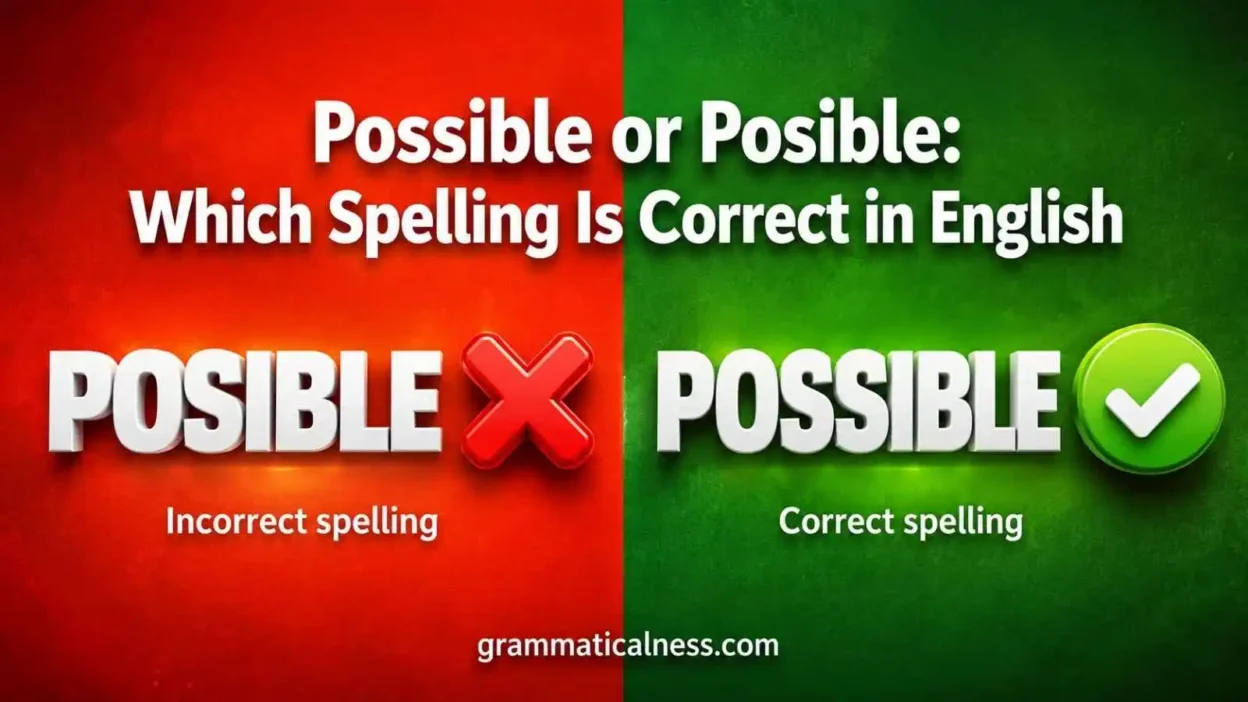
Possible is the correct spelling in standard English. Posible is usually a misspelling when you are writing in English.
Use possible when you mean something can happen, can be done, or may be true.
Correct: It is possible to finish the report today.
Incorrect: It is posible to finish the report today.
There is one important note: posible is a real word in Spanish. That does not make it correct in English. If your sentence is in English, write possible with double s.
Quick Answer
The correct choice is possible.
Possible means “able to happen,” “able to be done,” or “able to exist.”
Posible is not a standard English spelling. It usually appears because someone left out one s, typed too quickly, or was influenced by Spanish spelling.
Use this simple rule:
Write possible in English. Do not write posible unless you are writing Spanish or using a name, title, or brand that spells it that way.
Why People Confuse Them
People confuse possible and posible because the missing letter is easy to overlook. The word is pronounced quickly, and the double s does not always feel obvious when you hear it.
The spelling also looks close to Spanish posible, which means “possible.” Bilingual writers and English learners may carry that spelling into English by mistake.
Typing speed adds another reason. When people write texts, captions, emails, or comments quickly, one small letter can disappear.
So the problem is not meaning. The problem is spelling in the correct language.
Key Differences At A Glance
| Context | Best Choice | Why |
| Standard English writing | possible | This is the correct English spelling. |
| School essays | possible | Teachers expect the standard form. |
| Work emails | possible | The correct spelling looks polished and professional. |
| Text messages in English | possible | Casual writing still uses the same spelling. |
| Spanish sentence | posible | This spelling belongs to Spanish, not English. |
| Brand name or title | depends | Keep the official spelling if it is a proper name. |
Compact comparison:
- Possible: correct English word.
- Posible: not correct as an English word.
- Possible: has double s.
- Posible: missing one s.
- Possible: works in formal and casual English.
- Posible: only fits English when it is a proper name or part of another language.
Meaning and Usage Difference
Possible means something can happen, can be done, can exist, or may be true.
Examples:
It is possible to reschedule the meeting.
A refund is possible if you have the receipt.
There may be a possible delay because of traffic.
Posible does not have a standard meaning in English. In an English sentence, it is treated as a spelling error.
The pronunciation of possible in American English is close to PAH-suh-buhl. Because the word is spoken smoothly, the double s is easy to miss in writing. Still, pronunciation does not change the spelling.
Tone, Context, and Formality
Possible is neutral. You can use it in casual, formal, academic, and professional writing.
It works in everyday messages:
Is it possible to call me later?
Possible also fits business writing.
It may be possible to extend the deadline.
In school writing, possible sounds natural and clear.
A possible cause of the change is lower demand.
Posible looks incorrect in English. In a school paper, email, résumé, article, or report, it can make the sentence look unedited.
The only time posible is acceptable is when the surrounding context is not standard English, such as Spanish text, a quoted title, a username, or a brand spelling.
Which One Should You Use?
Use possible almost every time you are writing in English.
Choose possible when you mean:
- able to happen
- able to be done
- able to exist
- maybe true
- available as an option
Examples:
A weekend trip is possible.
Is it possible to pay online?
We found three possible solutions.
It is possible that she missed the message.
Do not use posible in English sentences like these. The meaning may still be understood, but the spelling is wrong.
When One Choice Sounds Wrong
Posible sounds wrong in English because readers expect possible. Even if the sentence is easy to understand, the spelling stands out.
Wrong: A better result is posible.
Right: A better result is possible.
Wrong: Is it posible to change my order?
Right: Is it possible to change my order?
Wrong: We need the best posible answer.
Right: We need the best possible answer.
The word possible can appear before a noun:
a possible reason
a possible problem
a possible solution
It can also appear after a linking verb:
That is possible.
Anything is possible.
A delay is possible.
In all of these English patterns, the spelling stays possible.
Common Mistakes (and Quick Fixes)
Mistake: Dropping one s
Wrong: It is posible.
Fix: It is possible.
Mistake: Copying the Spanish spelling into English
Wrong: This is a posible answer.
Fix: This is a possible answer.
Mistake: Writing too fast and missing the double letter
Wrong: Let me know if that is posible.
Fix: Let me know if that is possible.
Mistake: Thinking posible is an accepted English variant
Wrong: Both spellings are fine.
Fix: In English, only possible is standard.
Mistake: Using possible when you mean “likely”
Weak: It is possible that he will win.
Clearer, if you mean a strong chance: It is likely that he will win.
That last point is about meaning, not spelling. Possible means it can happen. It does not always mean it will probably happen.
Everyday Examples
Correct examples with possible:
I will reply as soon as possible.
Is it possible to get a table for four?
The coach listed three possible starters.
A small delay is possible during the update.
We need the best possible plan before Friday.
It is possible that I left my keys in the car.
Please send the file today if possible.
The doctor explained the possible side effects.
Anything is possible with enough time and effort.
A refund may be possible, but it is not guaranteed.
Incorrect examples with posible:
I will reply as soon as posible.
Is it posible to get a table for four?
A small delay is posible during the update.
We need the best posible plan before Friday.
The fix is always the same in English: add the second s.
Dictionary-Style Word Details
Verb
Possible: Not commonly used as a verb in standard US English. Use it as an adjective in normal writing.
Example: A solution is possible.
Posible: Not used as a verb in standard US English. In English, it is usually a misspelling of possible.
Noun
Possible: Usually an adjective, but it can be used as a noun in limited contexts. For example, “a possible” can mean a possible choice, candidate, or option.
Example: The manager marked three possibles for the final interview.
This noun use is much less common than the adjective use.
Posible: Not a standard English noun. It may appear as a Spanish word or a proper name, but not as a normal English noun.
Synonyms
Possible: Closest plain alternatives include feasible, doable, achievable, workable, conceivable, and potential. These do not all fit every sentence.
Best match for “able to be done”: feasible, doable, achievable.
Best match for “able to happen”: conceivable, potential.
Clear opposite: impossible.
Posible: No English synonyms, because it is not a standard English word. If the intended English word is possible, use the synonyms above.
Example Sentences
Possible:
It is possible to finish early.
We reviewed every possible option.
A power outage is possible during the storm.
Please arrive as soon as possible.
That explanation is possible, but I need more proof.
Posible:
In English, this spelling is incorrect in normal sentences.
Incorrect: It is posible to finish early.
Correct: It is possible to finish early.
In Spanish, posible can be correct, but that belongs to Spanish usage, not English spelling.
Word History
Possible: The English word comes through older French forms from Latin possibilis, connected to the idea of being able.
That history helps explain the double s in English spelling.
Posible: This is not the standard English form. It is, however, the Spanish form of the word. That overlap is one reason English writers sometimes confuse the two spellings.
Phrases Containing
Possible:
as soon as possible
if possible
whenever possible
as much as possible
the best possible
the worst possible
a possible reason
a possible solution
anything is possible
humanly possible
Posible:
Not used in standard English phrases. If you are writing English, use possible in the phrases above.
FAQs
Possible is correct in English. Posible is usually a misspelling in English because it is missing the second s.
Posible is not a standard English word. It is a valid Spanish word, but in English you should write possible.
Possible means something can happen, can be done, can exist, or may be true.
Example: It is possible to finish the project today.
People often write posible because the double s is easy to miss. Some writers may also be influenced by Spanish, where posible is the correct spelling.
Possible is spelled with two s letters: p-o-s-s-i-b-l-e.
No. In standard American English, use possible. Posible looks like a spelling mistake unless you are writing in Spanish or quoting a proper name.
The correct sentence is: Is it possible?
Good synonyms for possible include feasible, doable, achievable, workable, and conceivable. The best choice depends on the sentence.
The opposite of possible is impossible.
Remember that possible has double s, just like misspell has double letters. In English, the correct spelling is always possible.
Conclusion
The choice between possible and posible is simple in English: possible is correct, and posible is usually a misspelling.
Use possible when something can happen, can be done, can exist, or may be true.
Remember the double s:
possible = correct English
posible = not standard English
If you are writing in Spanish, posible may be correct. If you are writing in English, choose possible every time.