
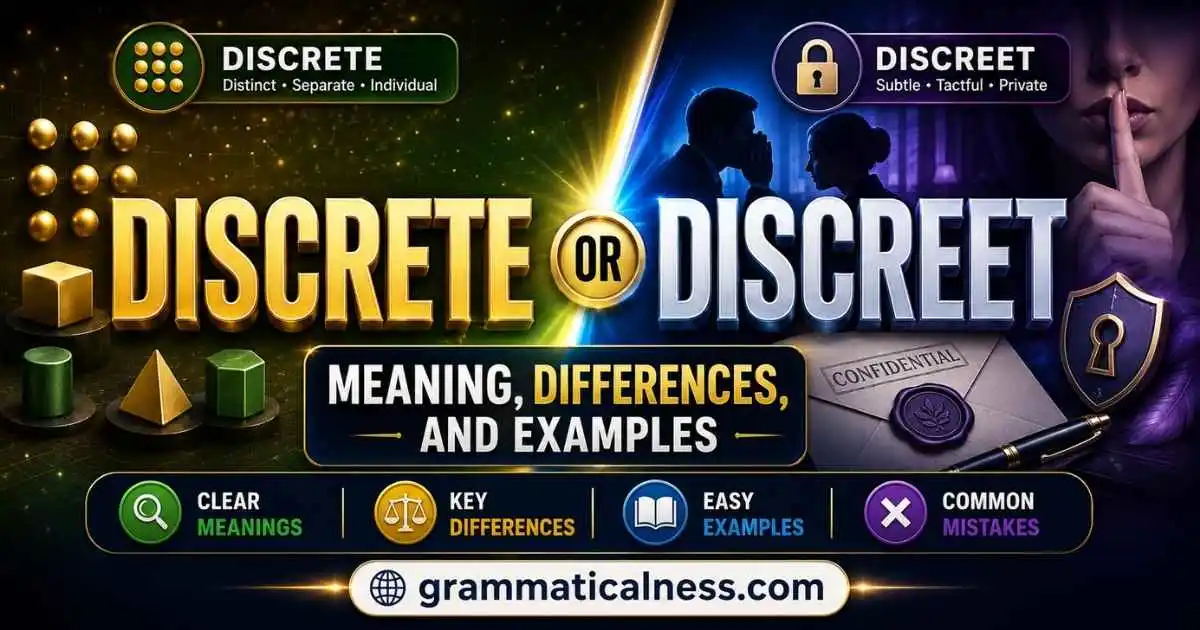
Discrete and discreet are both correct English words, but they do not mean the same thing.
Use discrete when something is separate, distinct, or divided into individual parts. Use discreet when someone or something is careful, tactful, private, restrained, or unlikely to attract attention.
Because the words look similar and sound the same, choosing the correct spelling depends entirely on the meaning you want.
Quick Answer
Use discrete to mean separate or individually distinct:
The project has three discrete phases.
Use discreet to mean careful, tactful, private, or unobtrusive:
Please be discreet about the surprise party.
A simple memory trick helps: in discrete, the two e’s are separated by the letter t. Think separate e’s = separate things.
Why People Confuse Them
The words are easy to mix up because their spellings differ only in the placement of the final letters.
They are also pronounced the same in standard American English: dis-KREET.
That means pronunciation gives you no clue about which spelling to choose. You must look at the sentence’s intended meaning.
Their shared history also helps explain why they look so similar. Modern English, however, treats them as separate words with clearly different uses.
Key Differences At A Glance
| Feature | discrete | discreet |
| Main meaning | Separate, distinct, individually identifiable | Careful, tactful, private, unobtrusive |
| Part of speech | Adjective | Adjective |
| Common contexts | Parts, groups, categories, data, math, science | People, behavior, communication, appearance, sensitive matters |
| Example | Three discrete sections | A discreet conversation |
| Pronunciation | dis-KREET | dis-KREET |
The fastest distinction is simple: discrete deals with separation, while discreet deals with care, privacy, or avoiding attention.
Meaning and Usage Difference
Discrete describes things that exist as separate units, parts, groups, or categories.
For example:
The report examines four discrete issues.
Each issue can be considered separately from the others.
The word is especially common in technical, mathematical, scientific, and academic contexts. A discrete variable, for example, takes separate countable values rather than forming an uninterrupted range.
However, the word is not limited to technical writing.
You might also say:
The renovation was divided into three discrete stages.
Here, the stages are separate and identifiable.
Discreet, by contrast, describes careful or restrained behavior, especially when privacy, sensitivity, or unwanted attention matters.
For example:
She was discreet when discussing the employee’s personal situation.
It can also describe something deliberately subtle or unobtrusive:
The restaurant has a discreet entrance on the side street.
In that sentence, the entrance does not attract much attention.
Both words function primarily as adjectives, and both are pronounced dis-KREET.
Tone, Context, and Formality
Discrete often sounds more formal or specialized than everyday alternatives such as separate or distinct.
You are especially likely to see it in phrases involving data, categories, units, systems, stages, variables, or individual components.
Still, it can appear naturally in general formal writing whenever separate parts need to be emphasized.
Discreet fits both everyday and professional situations.
A person can be discreet with confidential information. A business may offer discreet service. Someone may make a discreet gesture so that few people notice.
The word does not always mean that something is secret. Sometimes it simply means restrained, tactful, or intentionally low-key.
Which One Should You Use?
Choose the word by asking one question:
Am I describing separation, or am I describing careful and unobtrusive behavior?
| Context | Best Choice | Why |
| Separate stages of a project | discrete | The stages are individually distinct |
| Countable values in statistics | discrete | The values occur as separate units |
| Keeping sensitive news private | discreet | Care and privacy are involved |
| A subtle signal across a room | discreet | The signal avoids attracting attention |
| Separate departments in an organization | discrete | The departments are distinct units |
| A quiet entrance for private guests | discreet | The entrance is intentionally unobtrusive |
When separate or distinct could replace the word without changing the meaning, discrete is usually the correct choice.
Choose discreet when the meaning is closer to tactful, careful, private, or unobtrusive.
When One Choice Sounds Wrong
Using discrete for privacy or tact changes the meaning.
Incorrect:
Please be discrete about my medical appointment.
This suggests being separate rather than being careful with private information.
Correct:
Please be discreet about my medical appointment.
Likewise, discreet does not mean separate.
Incorrect:
The system contains five discreet components.
That wording suggests the components are tactful or unobtrusive.
Correct:
The system contains five discrete components.
The components are separate and distinct.
Context can occasionally make a grammatically possible sentence mean something very different from what the writer intended.
For example:
The hotel has discreet rooms.
This could suggest rooms designed to provide privacy or avoid attention.
The hotel has discrete rooms.
This emphasizes that the rooms are separate units.
The spelling changes the meaning.
Common Mistakes (and Quick Fixes)
A common mistake is using discrete whenever the writer means something private.
Wrong:
They held a discrete meeting about the issue.
Better:
They held a discreet meeting about the issue.
The meeting was handled privately or without attracting attention.
Another mistake is assuming discreet means “separate.”
Wrong:
The course contains six discreet modules.
Correct:
The course contains six discrete modules.
Each module is a separate part.
Also watch the adverb forms.
Discretely means in separate or distinct parts.
The researchers analyzed the categories discretely.
Discreetly means carefully, privately, or without attracting attention.
She discreetly handed him the note.
A useful check is to substitute a simpler word. Try separate for discrete and tactful or unobtrusive for discreet. The sentence’s meaning usually becomes clear immediately.
Everyday Examples
Here are natural examples of both words in modern American English:
Discrete
- The company divided the rollout into four discrete phases.
- Each apartment has a discrete storage area.
- The survey measures several discrete categories.
- The engineer examined each discrete component separately.
- Attendance is a discrete variable because students are counted in whole numbers.
Discreet
- Maya gave me a discreet signal to change the subject.
- Please be discreet when discussing the promotion.
- The hotel offers a discreet entrance for private events.
- He made a discreet inquiry about the open position.
- Her jewelry was elegant but discreet.
Notice that discrete focuses on boundaries between things. Discreet focuses on restraint, judgment, privacy, or avoiding unnecessary attention.
Dictionary-Style Word Details
Verb
Discrete: Not commonly used as a verb in standard modern American English. It primarily functions as an adjective.
Discreet: Not commonly used as a verb in standard modern American English. It primarily functions as an adjective.
Noun
Discrete: The word itself is generally not used as an ordinary noun. The related noun discreteness refers to the quality of being separate or distinct.
Discreet: The word itself is not normally used as a noun. Discreetness can mean the quality of being discreet. Discretion is also closely related and commonly refers to careful judgment or restraint, although it has additional meanings.
Synonyms
Discrete: Closest plain alternatives include separate, distinct, individual, independent, detached, and unconnected, depending on context.
Possible opposites include connected and continuous, depending on the intended meaning.
Discreet: Closest plain alternatives include tactful, prudent, cautious, restrained, unobtrusive, and careful.
Possible opposites include indiscreet and, for the unobtrusive sense, conspicuous.
Example Sentences
Discrete:
The proposal addresses three discrete problems.
The software processes each discrete unit separately.
Discreet:
The manager was discreet when answering questions about the investigation.
They chose a discreet location for the private meeting.
Word History
Discrete and discreet share a historical Latin source connected with ideas of separating and discerning.
Over time, English settled on different spellings for different meanings.
Discrete became associated with things that are separate or distinct.
Discreet developed the established sense of showing judgment, restraint, tact, or an effort not to attract attention.
Their shared background helps explain their similar spelling, but modern usage keeps their meanings separate.
Phrases Containing
Common phrases with discrete include:
- discrete variable
- discrete mathematics
- discrete categories
- discrete units
- discrete components
- discrete stages
Common phrases with discreet include:
- discreet inquiry
- discreet manner
- discreet gesture
- discreet service
- discreet distance
- discreet location
The surrounding noun often gives a useful clue. Technical or separately identifiable units frequently take discrete, while behavior involving tact or low visibility usually takes discreet.
FAQs
Is it discrete or discreet?
Both words are correct, but they have different meanings. Use discrete for things that are separate or distinct. Use discreet for behavior that is careful, private, tactful, or unobtrusive.
What is the difference between discrete and discreet?
Discrete means separate or individually distinct, as in three discrete stages. Discreet means careful or private, as in a discreet conversation.
Are discrete and discreet pronounced the same?
Yes. In standard American English, both are pronounced dis-KREET. Because they sound the same, you must use the sentence meaning to choose the correct spelling.
How can I remember discrete vs. discreet?
Look at discrete: the letter t separates the two e’s. Think separate e’s = separate things. Use discreet when you mean tactful, private, or careful.
What does discreet mean in a sentence?
Discreet often means careful not to attract attention or reveal private information.
Example: She was discreet when discussing the confidential matter.
Can discrete and discreet be used interchangeably?
No. Their meanings are different. Discrete refers to separation or distinct parts, while discreet refers to tact, privacy, restraint, or avoiding attention. Using the wrong spelling can change the meaning of a sentence.
Conclusion
Both discrete and discreet are correct, but they serve different meanings.
Use discrete for something separate, distinct, or individually identifiable.
Use discreet for something careful, tactful, private, restrained, or unobtrusive.
To remember the difference, look at discrete: the letter t separates the two e’s. That separation can remind you that discrete means separate.
For privacy, tact, or avoiding attention, choose discreet.
Both words are correct, but they have different meanings. Use discrete for things that are separate or distinct. Use discreet for behavior that is careful, private, tactful, or unobtrusive.
Discrete means separate or individually distinct, as in three discrete stages. Discreet means careful or private, as in a discreet conversation.
Yes. In standard American English, both are pronounced dis-KREET. Because they sound the same, you must use the sentence meaning to choose the correct spelling.
Look at discrete: the letter t separates the two e’s. Think separate e’s = separate things. Use discreet when you mean tactful, private, or careful.
Discreet often means careful not to attract attention or reveal private information.
Example: She was discreet when discussing the confidential matter.
No. Their meanings are different. Discrete refers to separation or distinct parts, while discreet refers to tact, privacy, restraint, or avoiding attention. Using the wrong spelling can change the meaning of a sentence.