
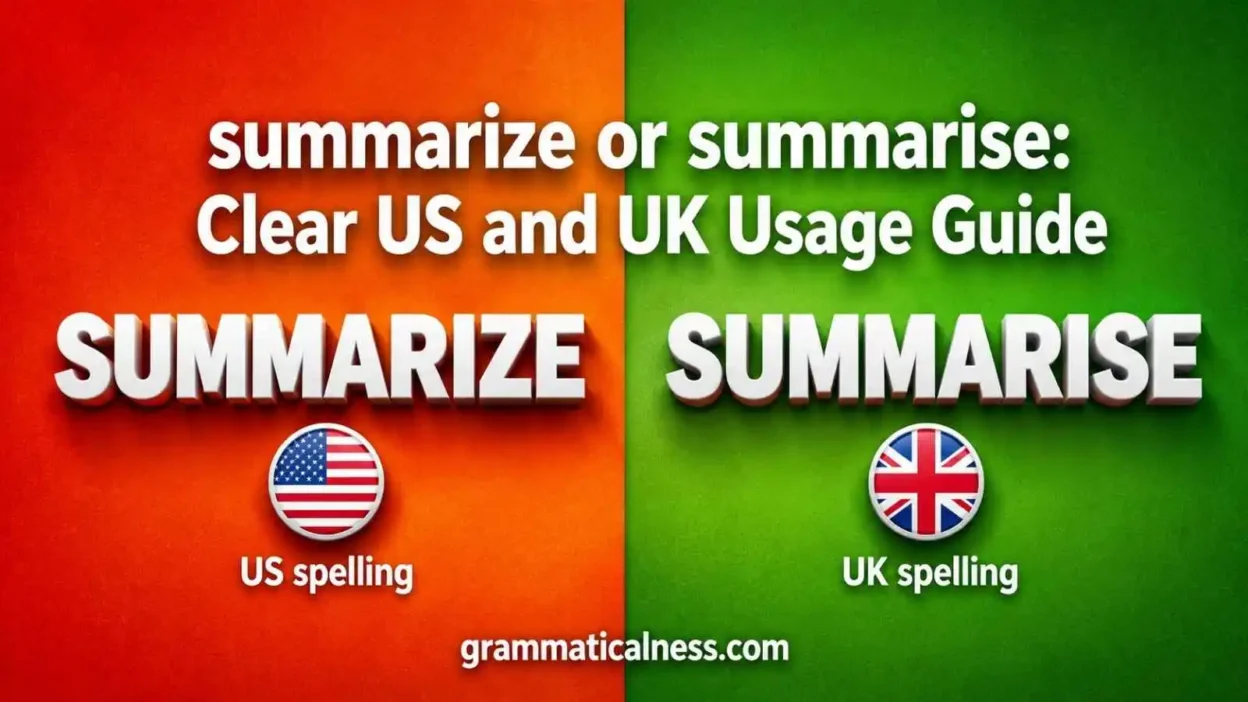
The choice between summarize and summarise is easy once you know what changes. The meaning does not change. The grammar does not change. The main difference is spelling style.
For a US audience, summarize is the normal choice. Summarise is mainly British-style spelling. Both mean to give the main points of something in a shorter form.
Quick Answer
Use summarize in American English.
Use summarise when writing in British-style English, especially for readers in the UK or other places that commonly follow British spelling.
Correct US example:
Please summarize the report before Friday.
Correct British-style example:
Please summarise the report before Friday.
The action is the same in both sentences.
Why People Confuse Them
People confuse these words because they look and sound almost the same. The only visible difference is z in summarize and s in summarise.
Another reason is online reading. A US reader may see summarise in British articles, school materials, or international documents. A British reader may see summarize in US books, websites, and software text.
The confusion is not about meaning. It is about matching the spelling style your audience expects.
Key Differences At A Glance
| Feature | summarize | summarise |
|---|---|---|
| Main use | American English | British-style English |
| Meaning | To state the main points briefly | To state the main points briefly |
| Part of speech | Verb | Verb |
| Past tense | summarized | summarised |
| Present participle | summarizing | summarising |
| Best for | US readers, US schools, US workplaces | British-style documents and audiences |
Pronunciation does not need much attention here because the two forms are usually said the same way: SUM-uh-rise.
Meaning and Usage Difference
Summarize means to give the main points of something in a shorter, clearer form.
Example:
Can you summarize the meeting in three bullet points?
Summarise means the same thing.
Example:
Can you summarise the meeting in three bullet points?
Both can take an object:
She summarized the article.
She summarised the article.
Both can also appear without a direct object:
To summarize, we need more time.
To summarise, we need more time.
For US writing, the first version is the one most readers expect.
Tone, Context, and Formality
Neither word is more polite, more academic, or more serious by meaning. Summarize and summarise can both appear in formal writing, school writing, business writing, and everyday messages.
The real issue is style fit.
In a US business email, summarise may look foreign or inconsistent. In a British-style report, summarize may be accepted in some settings, but it can look out of place if the rest of the document uses British spellings such as analyse, organise, and recognise.
Good writing usually keeps one spelling style from start to finish.
Which One Should You Use?
| Context | Best Choice | Why |
| US school essay | summarize | Matches American English |
| US workplace email | summarize | Looks natural to US readers |
| US blog or article | summarize | Best fit for a US audience |
| British-style report | summarise | Matches common British spelling |
| International document | Choose one style | Consistency matters more than switching |
| Quoting a source | Keep the original spelling | Do not change a direct quote |
For most US readers, the safest choice is summarize.
When One Choice Sounds Wrong
Summarise can sound wrong in American writing because US readers are used to summarize. It may not be misunderstood, but it can look like the writer is using British spelling by accident.
Less natural in US writing:
Please summarise the customer feedback.
More natural in US writing:
Please summarize the customer feedback.
The reverse can happen in a British-style document. If every other word follows British spelling, summarize may stand out.
Less consistent in British-style writing:
Please summarize the findings and analyse the results.
More consistent in British-style writing:
Please summarise the findings and analyse the results.
Common Mistakes (and Quick Fixes)
One common mistake is mixing forms in the same document.
Mixed:
I will summarize the notes, then send the summarised version.
Fixed for US style:
I will summarize the notes, then send the summarized version.
Fixed for British style:
I will summarise the notes, then send the summarised version.
Another mistake is using either word as a noun.
Wrong:
Send me a summarize of the article.
Correct:
Send me a summary of the article.
Use summary when you need the noun. Use summarize or summarise when you need the verb.
Everyday Examples
US style:
Please summarize the chapter in one paragraph.
The manager summarized the client’s concerns.
This chart summarizes our sales results.
To summarize, we need a clearer plan.
I summarized the lecture for my study group.
British-style spelling:
Please summarise the chapter in one paragraph.
The manager summarised the client’s concerns.
This chart summarises our sales results.
To summarise, we need a clearer plan.
I summarised the lecture for my study group.
Both sets are correct in the right audience context.
Dictionary-Style Word Details
Verb
summarize: A verb meaning to give the main points of something briefly. It is the standard spelling in American English.
Example:
The teacher asked us to summarize the article.
summarise: A verb with the same meaning. It is mainly used in British-style English.
Example:
The teacher asked us to summarise the article.
Noun
summarize: Not commonly used as a noun in standard US English. Use summary for the noun.
Example:
Correct: I wrote a summary of the article.
summarise: Not commonly used as a noun in standard English. Use summary for the noun.
Example:
Correct: I wrote a summary of the article.
Related nouns include summarization in US style and summarisation in British style, but summary is the plain everyday noun.
Synonyms
For both summarize and summarise, the closest plain alternatives are:
sum up
condense
outline
recap
abridge
state briefly
These are not always exact replacements. Recap often sounds more conversational. Abridge often means shortening a written work. Outline may mean giving the structure rather than a full short version.
Clear antonyms are not always direct, but in some contexts expand, elaborate, or go into detail can work as opposites.
Example Sentences
summarize:
Can you summarize the main points before the call?
The final slide summarizes the budget changes.
I do not need every detail; just summarize the issue.
summarise:
Can you summarise the main points before the call?
The final slide summarises the budget changes.
I do not need every detail; just summarise the issue.
Word History
summarize: Formed from summary plus the verb ending -ize. It is the expected form in American English today.
summarise: A spelling variant using -ise. It is mainly associated with British-style English.
The useful point for modern writers is not the exact first date of either form. The practical point is that US readers expect summarize, while British-style writing often uses summarise.
Phrases Containing
summarize:
to summarize
summarize the findings
summarize the report
summarize the main points
briefly summarize
summarise:
to summarise
summarise the findings
summarise the report
summarise the main points
briefly summarise
Use the phrase that matches your spelling style.
FAQs
Both are correct. Summarize is the standard spelling in American English. Summarise is mainly used in British-style English.
Use summarize in the US. It is the spelling most American readers expect in school, business, and everyday writing.
Yes. Both mean to give the main points of something in a shorter form. The difference is spelling style, not meaning.
It is not wrong as a word, but it looks British to most US readers. In American writing, summarize is the better choice.
The common noun form is summary. For example: “Please send me a summary of the report.” Do not write “a summarize.”
Use summarized in American English. Use summarised in British-style English. Keep the spelling style consistent throughout your writing.
Conclusion
For a US audience, choose summarize. It is the standard American spelling and will look natural in school, business, and everyday writing. Summarise means the same thing, but it belongs mainly to British-style English. The best rule is simple: match your audience and stay consistent. If you are writing for Americans, use summarize, summarized, and summarizing. If you are following British style, use summarise, summarised, and summarising.