
Homey or homie can be confusing because the words look almost the same and sound the same in everyday speech. They are both real forms, but they are not usually used the same way.
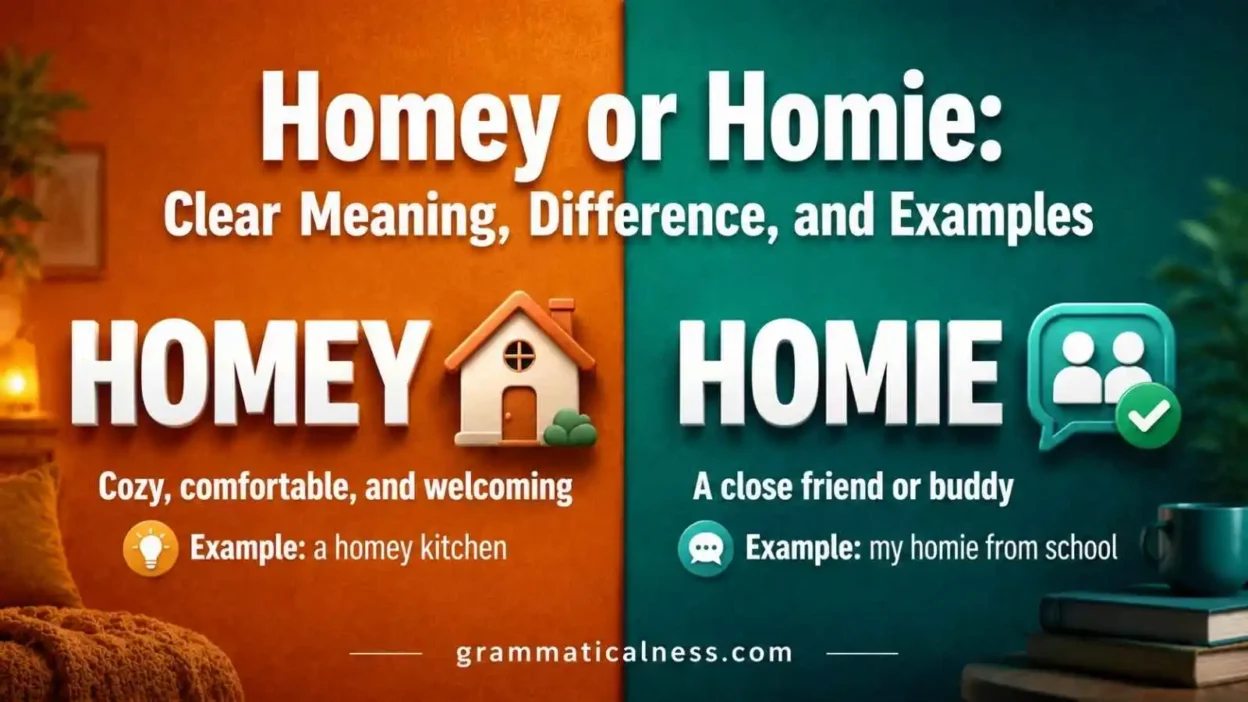
In most US writing, homey describes a place, feeling, or style that feels cozy and comfortable, like home. Homie is an informal noun for a close friend.
That means this sentence works:
The café feels homey.
And this sentence works:
He’s my homie from college.
But this sounds wrong in normal use:
The café feels homie.
Quick Answer
Use homey when you mean warm, cozy, comfortable, familiar, or home-like.
Use homie when you mean a close friend, buddy, or trusted person in casual speech.
The practical rule is simple: a room can feel homey; a friend can be your homie.
There is one nuance. Homey can also appear as a noun spelling for homie, especially in dictionaries or older/casual use. Still, for modern readers, homie is usually the clearer spelling when you mean a friend.
Why People Confuse Them
People confuse homey and homie for three main reasons.
First, they sound alike. Both are commonly pronounced like “HOH-mee.” In speech, listeners rely on context.
Second, they share the idea of “home.” Homey points to the feeling of home. Homie is tied to a person from your home area, neighborhood, or close circle.
Third, homey has more than one recorded use. It is mainly an adjective, but it can also be used as a noun meaning a close friend. That overlap is real, but it does not mean the words are equally natural in every sentence.
Key Differences At A Glance
Here is the compact version:
Homey: usually an adjective. It describes a place, mood, meal, room, or style that feels cozy, familiar, and comfortable.
Homie: a noun. It names a close friend or trusted person. It is informal and belongs in relaxed conversation, texts, social posts, music, dialogue, or casual storytelling.
Homey as a noun: possible, but less clear for many readers than homie.
The biggest difference is not spelling. It is meaning and role in the sentence.
Meaning and Usage Difference
Homey usually describes something. It works before a noun or after a linking verb.
The cabin had a homey feel.
Her kitchen is small but homey.
A homey place feels welcoming, familiar, and relaxed. It does not have to be fancy. In fact, homey often suggests simple comfort rather than luxury.
Homie names a person. It is slang for a close friend or someone in your trusted circle.
I’m meeting my homie after work.
Thanks for helping me out, homie.
Because homie is casual, it can sound too relaxed in business, school, or formal writing. It can work well in dialogue, captions, songs, jokes, and personal messages.
The tricky part is homey as a noun. You may see “my homey” used to mean “my friend.” That use exists, but my homie is usually the clearer and more expected spelling today.
Tone, Context, and Formality
Homey has a warm, positive tone when used for places or feelings. It can fit naturally in lifestyle writing, restaurant reviews, real estate descriptions, hospitality copy, and everyday speech.
A homey office sounds comfortable and welcoming.
A homey dinner sounds simple, warm, and satisfying.
Homie has a very casual tone. It can sound friendly, loyal, funny, or personal. It can also sound out of place if the setting is formal.
You might text:
See you later, homie.
But you probably would not write in a formal email:
Dear homie, please review the attached report.
That does not make homie wrong. It means the word has a strong casual flavor. Use it when that tone matches the speaker, audience, and setting.
Which One Should You Use?
| Context | Best Choice | Why |
| Describing a cozy room | homey | It describes a comfortable, home-like feeling. |
| Talking about a close friend | homie | It is the clearer slang noun for a friend. |
| Writing a restaurant review | homey | It fits atmosphere, service, food, and setting. |
| Texting a close friend | homie | It fits casual, personal language. |
| Writing a business email | usually neither | Homey may work for atmosphere, but homie is too casual. |
| Describing an apartment listing | homey | It suggests warmth and comfort. |
| Writing dialogue for a character | depends | Homey fits a place; homie fits a person. |
| Referring to “my homey” | homie is clearer | Homey can be a noun, but homie is easier for modern readers. |
When One Choice Sounds Wrong
Homie sounds wrong when you are describing a place.
Wrong: The hotel lobby felt homie.
Better: The hotel lobby felt homey.
The problem is that homie names a person, not a feeling or atmosphere.
Homey can sound wrong when you mean a friend and your reader expects the modern slang spelling.
Unclear: I’m going out with my homey.
Clearer: I’m going out with my homie.
The first sentence may be understood, but some readers may pause because homey is so strongly linked to cozy places.
Homie also sounds wrong in stiff professional writing unless you are quoting someone or using a deliberately casual voice.
Too casual: My homie Jason will send the contract.
Better: My friend Jason will send the contract.
Common Mistakes (and Quick Fixes)
A common mistake is using homie as an adjective.
Wrong: This restaurant is so homie.
Correct: This restaurant is so homey.
Another mistake is using homey when a cleaner word would fit better.
Awkward: My homey from work helped me move.
Better: My homie from work helped me move.
More neutral: My friend from work helped me move.
A third mistake is using homie in a setting where slang sounds too personal.
Too casual: Please contact my homie in accounting.
Better: Please contact my colleague in accounting.
A fourth mistake is thinking homey means cheap or messy. It does not. A space can be neat, stylish, and still homey if it feels comfortable and welcoming.
Everyday Examples
The living room feels homey with the soft rug and warm lighting.
Their new apartment is small, but it already feels homey.
That diner has a homey vibe, especially on cold mornings.
She made a homey meal after a long week.
I’m grabbing coffee with my homie later.
He’s been my homie since middle school.
Thanks for showing up for me, homie.
My homies are coming over to watch the game.
The guesthouse was homey, not flashy.
In a formal bio, use friend, colleague, or teammate instead of homie.
Dictionary-Style Word Details
Verb
Homey: Not commonly used as a verb in standard US English.
Homie: Not commonly used as a verb in standard US English.
Noun
Homey: Can be used as a noun meaning a close friend, but this use is informal and can be less clear than homie. It is much more common to see homey as an adjective.
Homie: A noun meaning a close friend, buddy, or trusted person. It is informal slang.
Synonyms
Homey: Closest plain alternatives include cozy, comfortable, warm, welcoming, familiar, and homelike. Possible opposites include cold, impersonal, uncomfortable, or unwelcoming, depending on the sentence.
Homie: Closest plain alternatives include friend, buddy, pal, close friend, and trusted friend. Exact opposites are not always clean, but stranger or enemy may fit some contexts.
Example Sentences
Homey: The small café felt homey without trying too hard.
Homey: We added lamps and plants to make the room feel more homey.
Homie: That’s my homie from back home.
Homie: I trust her completely; she’s been my homie for years.
Word History
Homey: The adjective is built from home plus the ending -y, which creates the idea of “like home.” Its safest modern meaning is cozy, familiar, or comfortable like home.
Homie: The noun is connected to homeboy and homegirl, with a shortened informal form used for a friend or someone from a close community. Dictionary date labels can vary, so it is better not to treat one date as the whole story.
Phrases Containing
Homey: Common phrases include homey atmosphere, homey feel, homey touch, homey kitchen, homey restaurant, and homey vibe.
Homie: Common phrases include my homie, old homie, close homie, one of my homies, and what’s up, homie?
FAQs
Both are correct, but they usually mean different things. Homey describes something cozy, warm, or comfortable like home. Homie means a close friend in informal speech.
Homey means comfortable, cozy, familiar, or welcoming. For example: “The small café felt homey.”
Homie is a casual noun for a close friend, buddy, or trusted person. For example: “He’s my homie from high school.”
Yes, homey can sometimes be used as a noun meaning a friend, but homie is the clearer and more common spelling for that meaning in modern casual English.
Yes. Homie is informal slang. It works in texts, casual speech, captions, jokes, dialogue, and friendly conversation, but it may sound too casual in formal writing.
No. Say a room feels homey. Homey describes a cozy place or feeling. Homie refers to a person.
Use homey for places and feelings. Use homie for people. A cozy room is homey. A close friend is your homie.
Usually no. In professional writing, use friend, colleague, teammate, or the person’s name instead. Homie is best for casual situations.
Conclusion
The difference between homey and homie is easy once you focus on meaning.
Use homey for something that feels cozy, warm, familiar, or like home.
Use homie for a close friend in informal speech.
The safest rule is: places and feelings are homey; close friends are homies. If you mean a friend and want the clearest modern spelling, choose homie.