
Former or latter can confuse readers because both words point back to something already mentioned. The difference depends on order.
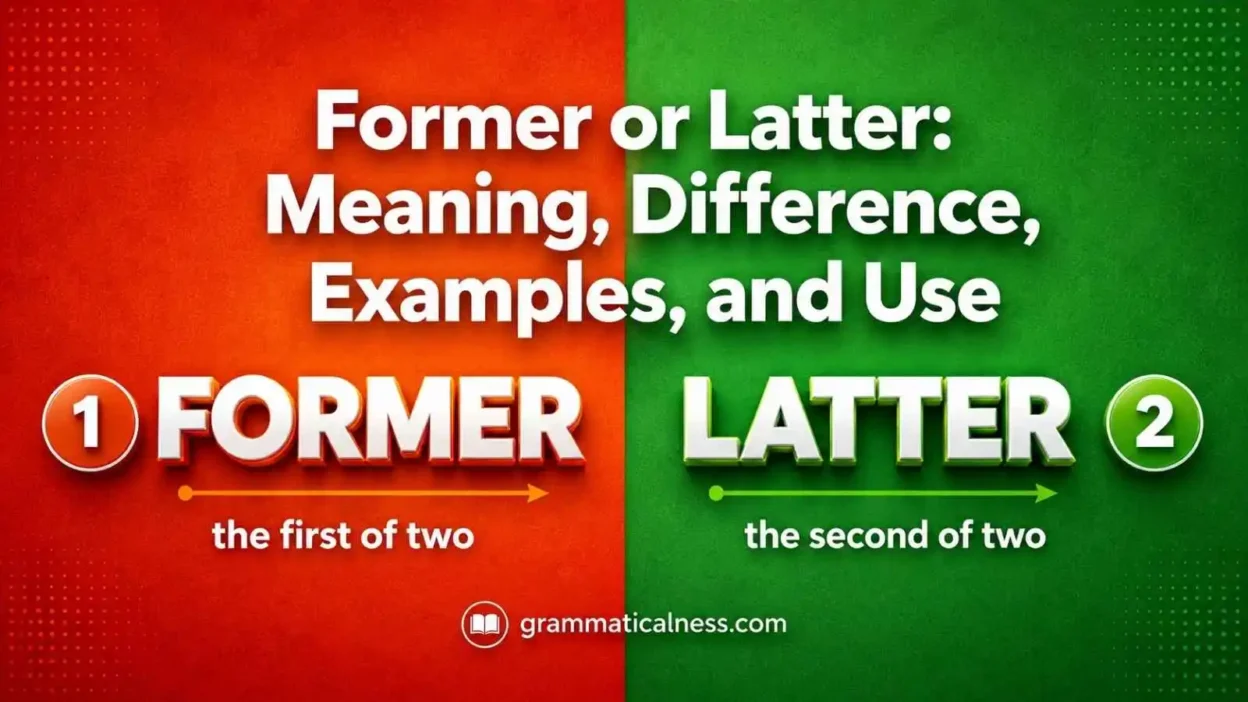
Former refers to the first of two things. Latter refers to the second of two things.
These words are useful in formal writing, school essays, reports, and polished explanations. Still, they can make a sentence harder to follow if the earlier choices are not clear.
Quick Answer
Use former when you mean the first item mentioned.
Choose latter when you mean the second item mentioned.
Example:
I can work from home or from the office. I prefer the former.
This means I prefer working from home.
Another example:
I can work from home or from the office. I prefer the latter.
Here, I prefer working from the office.
So, the choice is simple: former means the first one, and latter means the second one.
Why People Confuse Former and Latter
Many people confuse these words because they both refer backward. The reader has to remember which item came first and which came second.
Long sentences make the problem worse. If the two choices appear far away from former or latter, the meaning can become unclear.
Tone also matters. Former and latter sound more formal than “the first one” and “the second one.” In everyday American English, simpler wording often feels more natural.
A helpful memory trick is this:
• Former starts with f, like first.
• Latter starts with l, like last.
This trick works best when the sentence compares only two things.
Key Differences at a Glance
| Context | Best Choice | Why |
| First of two named items | former | It points back to the first item |
| Second of two named items | latter | It points back to the second item |
| Previous job, role, or status | former | It means no longer current |
| Later part of a time period | latter | It means closer to the end |
| Casual conversation | first one / second one | These sound clearer and more natural |
| More than two items | exact noun / first / last | Former and latter may confuse readers |
Meaning of Former
Former has two common uses.
The first use refers to the first item in a pair.
Example:
We discussed renting and buying. The former is cheaper short term.
In this sentence, former means renting.
The second use means previous or no longer current.
Example:
My former manager now works for another company.
Here, former does not mean “first.” It means the person used to be the manager.
You can also use former before nouns such as employee, owner, teacher, president, or roommate.
Examples:
She is a former teacher.
They bought a former bank building.
My former roommate lives in Denver.
Meaning of Latter
Latter usually refers to the second item in a pair.
Example:
We discussed renting and buying. The latter is better long term.
In this sentence, latter means buying.
Latter can also describe the later part of something.
Example:
The team improved during the latter half of the season.
Here, latter means closer to the end.
Common phrases include latter half, latter part, latter years, and latter stages.
Examples:
The latter chapters are more exciting.
Sales increased in the latter part of the year.
The latter stages of the project took the most time.
Former or Latter: Which One Should You Use?
Pick former when you are pointing to the first item mentioned.
Example:
The menu has tacos and pasta. I’ll take the former.
Former means tacos.
Pick latter when you are pointing to the second item mentioned.
Example:
The menu has tacos and pasta. I’ll take the latter.
Latter means pasta.
When the meaning is “previous,” former is the correct choice.
Example:
She is a former nurse.
For something near the end of a period, latter is usually the better word.
Example:
The latter half of the movie was stronger.
Tone, Context, and Formality
Former and latter sound formal, clear, and slightly polished. They fit well in essays, business writing, reports, and careful explanations.
In casual speech, they may sound stiff. Many people would simply say “the first one” or “the second one.”
Formal:
The company considered a price cut and a new ad campaign. The latter was approved.
More natural:
The company considered a price cut and a new ad campaign. They approved the second one.
Use former and latter only when they make the sentence easier to read. If the reader has to stop and count the choices, name the item directly.
When Former Sounds Wrong
Former sounds wrong when you mean the second item.
Wrong:
We can meet Monday or Friday. I prefer the former, so Friday works.
Correct:
We can meet Monday or Friday. I prefer the latter, so Friday works.
The first item is Monday. The second item is Friday. Since the speaker prefers Friday, latter is correct.
Former also sounds wrong when the sentence refers to the later part of something.
Wrong:
The former half of the year was busier.
Better:
The first half of the year was busier.
When Latter Sounds Wrong
Latter sounds wrong when you mean a previous role, job, or status.
Wrong:
He is a latter coach for the team.
Correct:
He is a former coach for the team.
The meaning is that he used to be a coach. That makes former the right word.
Be careful not to confuse latter with later.
Wrong:
I will call you latter.
Correct:
I will call you later.
Later means at a future time. Latter means the second item or the later part of something.
Common Mistakes and Quick Fixes
One common mistake is using former or latter without a clear pair.
Unclear:
The latter is better.
Clear:
Between the basic plan and the premium plan, the latter is better.
Another mistake is leaving out the.
Wrong:
I chose former.
Correct:
I chose the former.
In this type of sentence, use the former or the latter.
A third mistake is using these words after a long list.
Confusing:
We reviewed email, social posts, landing pages, and ads. The latter needs work.
Clearer:
We reviewed email, social posts, landing pages, and ads. The ads need work.
When several items appear in a list, naming the item directly is usually clearer.
Everyday Examples
I can take the bus or drive. The former saves money.
Driving takes less time, so I prefer the latter.
She liked the old logo and the new logo, but she preferred the former.
Between pizza and sushi, the latter sounds better tonight.
My former roommate lives in Denver now.
The store moved into a former bank building.
Sales improved in the latter half of the year.
A refund is simpler, but store credit may be faster. I would choose the former.
The basic plan is cheaper, while the premium plan has more features. For a small team, the latter may be worth it.
Dictionary-Style Word Details
Verb
Former is not commonly used as a verb in standard American English. It is mainly used as an adjective or in the phrase the former.
Latter is not used as a verb in standard American English. It is used as an adjective or in the phrase the latter.
Noun
In the phrase the former, former acts like a noun. It means the first of two people, things, or groups already mentioned.
Example:
Coffee and tea are available. The former is stronger.
In the phrase the latter, latter also acts like a noun. It means the second of two people, things, or groups already mentioned.
Example:
Coffee and tea are available. The latter is lighter.
Some dictionaries allow latter to refer to the last item in a longer list. Even so, that use can confuse readers. In everyday writing, use the exact noun when more than two choices appear.
Synonyms
Closest plain alternatives for former include first, first-mentioned, previous, earlier, past, and one-time.
Closest plain alternatives for latter include second, second-mentioned, last-mentioned, later, final, and later part.
When former and latter refer to two named items, they work as opposites. Former points to the first item. Latter points to the second item.
Example Sentences
Former:
We tried email and text alerts. The former worked better for older customers.
Her former job required a long commute.
Between a refund and store credit, I chose the former.
Latter:
We tried email and text alerts. The latter worked better for younger customers.
The latter stages of the project took the most time.
Between a refund and store credit, I chose the latter.
Word History
Former is connected with the idea of coming before or being earlier.
Latter is connected with the idea of coming later or being nearer the end.
For modern readers, the history matters less than the order. Former points back to the first item. Latter points to the second item or a later part.
Phrases Containing
Common phrases with former include the former, former employee, former president, former owner, former self, and former glory.
Common phrases with latter include the latter, latter half, latter part, latter stages, latter years, and latter-day.
Former phrases usually describe a previous identity, role, or condition. Latter phrases usually refer to the second-mentioned item or the later part of a time period.
Former or Latter Examples in Real Sentences
The school offers online classes and in-person classes. The former is more flexible.
The school offers online classes and in-person classes. The latter gives students more face-to-face support.
We can use the old design or the new design. The former feels familiar.
We can use the old design or the new design. The latter looks more modern.
Her former boss wrote a recommendation letter.
The latter part of the meeting focused on budget questions.
FAQs
Former means the first of two things already mentioned. Latter means the second of two things already mentioned.
Example:
I like coffee and tea, but I prefer the former.
This means I prefer coffee.
Example:
I like coffee and tea, but I prefer the latter.
This means I prefer tea.
Former means first. It points back to the first item in a pair.
Example:
We can walk or drive. The former is healthier.
Here, former means walking.
Latter usually means the second of two things already mentioned. It can also mean the later or final part of something.
Example:
We can walk or drive. The latter is faster.
Here, latter means driving.
It is better to avoid former and latter with more than two things. Readers may not know which item you mean.
Confusing:
We tested emails, texts, calls, and ads. The latter worked best.
Clearer:
We tested emails, texts, calls, and ads. The ads worked best.
No. Latter and later are different words.
Later means at a future time.
Example:
I will call you later.
Latter means the second item or the later part of something.
Example:
Between tea and coffee, I prefer the latter.
Yes, when former and latter refer to earlier choices, use the former or the latter.
Correct:
I chose the former.
Correct:
She preferred the latter.
Wrong:
I chose former.
Both words sound formal. They are common in essays, reports, business writing, and careful explanations.
In casual speech, “the first one” and “the second one” often sound more natural.
Remember this simple trick:
Former starts with f, like first.
Latter starts with l, like last.
This helps when you are comparing two things.
Conclusion
Former and latter are both correct words, but they do not mean the same thing.
Former refers to the first item mentioned or to something previous. Latter refers to the second item mentioned or to the later part of something.
For the clearest writing, use these words only when the earlier pair is close and easy to understand. When the sentence feels crowded, say “the first one,” “the second one,” or name the item directly.