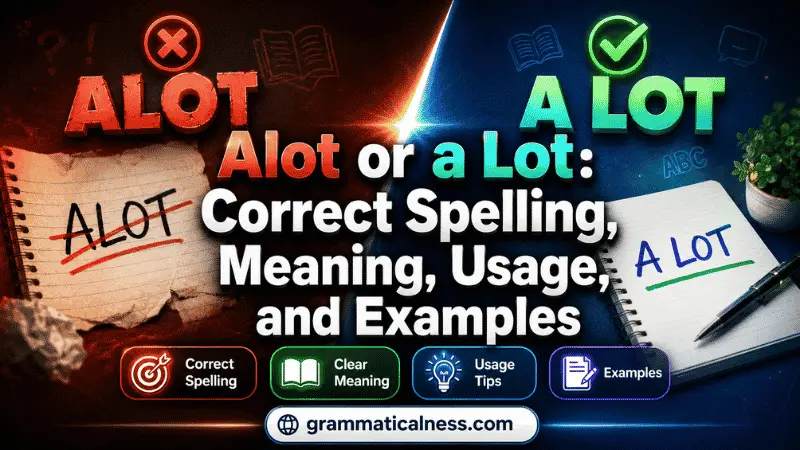
Choosing between alot or a lot becomes simple once you know that only one form is accepted in standard American English.
Write a lot as two separate words when you mean a large quantity, a high degree, or something that happens often. The joined spelling alot is a common writing mistake.
The space matters in school assignments, workplace messages, articles, social posts, and everyday texts.
Quick Answer
A lot is correct. Alot is incorrect in standard American English.
Use a lot to mean “many,” “much,” “very much,” or “often.”
- Correct: We have a lot of work today.
- Correct: I travel a lot for my job.
- Incorrect: We have alot of work today.
The safest rule is simple: always leave a space between a and lot.
Why People Confuse Them
People often write alot because a lot sounds like one unit in everyday speech. The words are usually spoken quickly, so the space is not noticeable.
The same thing can happen with other common expressions. A phrase may sound connected even though it remains separate in writing.
Frequent exposure to the misspelling in texts, comments, and informal posts can also make it appear acceptable. However, seeing a form often does not make it standard.
Remember that a is an article and lot is the following word. They work together, but they do not merge.
Key Differences At A Glance
- Alot: A common misspelling with no standard grammatical role in this meaning.
- A lot: A standard two-word expression used for quantity, frequency, or degree.
- Spacing rule: Always put a space between a and lot.
- Formality: “A lot” is correct in both casual and professional writing, although more precise alternatives may suit formal reports.
Meaning and Usage Difference
A lot can express three closely related ideas.
First, it can describe a large quantity or number when followed by of and a noun:
- a lot of emails
- a lot of traffic
- a lot of information
It works with plural countable nouns and uncountable nouns:
- We received a lot of applications.
- The project requires a lot of patience.
Second, it can mean “often”:
- We eat at that restaurant a lot.
- She calls her parents a lot.
Third, it can mean “very much” or “to a great degree”:
- This version is a lot better.
- I appreciate your help a lot.
Alot does not have these standard uses. When it appears with these intended meanings, it should be corrected to a lot.
Tone, Context, and Formality
A lot is natural in conversation, messages, personal writing, news writing, and many workplace situations. It is standard English, not slang.
However, it can sound general. In formal or technical writing, a more exact expression may communicate the idea better.
For example:
- General: A lot of customers completed the survey.
- More precise: More than 800 customers completed the survey.
You may also replace a lot of with many, much, a large number of, or a large amount of, depending on the noun and context.
The issue is precision, not basic correctness. A lot remains correct, while alot remains a spelling error.
Which One Should You Use?
Always choose a lot when expressing a large quantity, repeated activity, or strong degree.
| Context | Best Choice | Why |
| A large number of items | a lot of | It correctly introduces a plural countable noun. |
| A large amount of something | a lot of | It correctly introduces an uncountable noun. |
| An action happens often | a lot | It works after the verb as an expression of frequency. |
| A strong degree or extent | a lot | It can strengthen a comparison or describe intensity. |
| Formal writing | a lot or a precise alternative | “A lot” is correct, but an exact number may be clearer. |
| Any intended use of “alot” | a lot | The standard expression is written as two words. |
A useful memory check is to compare a lot with a little. You would not normally join “a little” into one word. Treat a lot the same way.
When One Choice Sounds Wrong
Alot looks wrong in edited American English because it removes the required space.
- Incorrect: I learned alot during the training.
- Correct: I learned a lot during the training.
- Incorrect: There were alot of cars outside.
- Correct: There were a lot of cars outside.
“A lot” may also sound weak when the reader needs exact information. For example, “Sales increased a lot” does not explain the size of the increase. “Sales increased by 18 percent” is clearer.
That weakness does not make a lot ungrammatical. It only means the sentence may need greater precision.
Common Mistakes (and Quick Fixes)
Common Mistakes With “A Lot”
Mistake: Joining the words
Wrong: Thanks alot.
Correct: Thanks a lot.
Mistake: Forgetting “of” before a noun
Wrong: We have a lot assignments.
Correct: We have a lot of assignments.
Mistake: Using a vague quantity when an exact number is available
Vague: A lot of employees joined the program.
Clearer: Seventy employees joined the program.
Whenever you know the exact number, using it can make your writing clearer and more informative.
Mistake: Assuming an informal expression is incorrect
Although “a lot” often sounds conversational, it is still standard English. You only need to replace it when a more formal or precise expression better suits the context.
Mistake: Choosing the verb based on “lot”
Verb agreement normally depends on the noun that follows “of,” not on the word “lot”:
- A lot of people are waiting.
- A lot of time is required.
Everyday Examples
- We took a lot of pictures during our road trip.
- Maya has a lot of experience in customer service.
- The kids laughed a lot during the movie.
- I feel a lot better after getting some sleep.
- Our neighborhood has changed a lot in five years.
- There was a lot of traffic near the stadium.
- He spends a lot of time practicing the guitar.
- Thanks a lot for helping me move.
- We learned a lot from the customer feedback.
- A lot of students applied for the scholarship.
In every example, writing alot would be incorrect.
Dictionary-Style Word Details
Verb
- Alot: Not used as a standard verb.
- A lot: Not a verb. It may modify a verb by showing frequency or degree, as in “We travel a lot.”
The expression adds information about the action, but it does not become the action itself.
Noun
- Alot: Not a standard noun for the meaning discussed here.
- A lot: The word lot is a noun inside the expression. The full expression can work as a noun phrase or a pronoun-like quantity expression.
Example:
- We expected several complaints, but we received a lot.
Here, a lot represents a large number of complaints.
Synonyms
The best alternative depends on the intended meaning.
For quantity, common alternatives include:
- many
- much
- numerous
- plenty of
- a large number of
- a large amount of
- a great deal of
When referring to frequency, you can use:
- often
- frequently
- regularly
To express degree, suitable alternatives include:
- greatly
- considerably
- very much
- significantly
Because alot is a misspelling of a lot, it has no separate standard synonyms.
Depending on the sentence, possible opposites include a little, a few, rarely, and slightly.
Example Sentences
- Alot: “I read alot” should be corrected to “I read a lot.”
- A lot: I read a lot before going to sleep.
- A lot: We have a lot of food left.
- A lot: Her presentation was a lot clearer this time.
- A lot: A lot has happened since we last spoke.
Word History
- Alot: The joined form does not have a separate standard history for this meaning. It commonly appears when writers leave out the space in a lot.
- A lot: The expression combines the article a with the noun lot. Over time, the combination developed common quantity, frequency, and degree uses.
No historical date is needed to apply the modern rule: standard American writing keeps the words separate.
Phrases Containing
Common expressions containing a lot include:
- a lot of
- quite a lot
- a whole lot
- an awful lot
- thanks a lot
- a lot better
- a lot more
- a lot less
- think a lot of someone
- have a lot to do
There are no standard phrases that require alot for this intended meaning.
FAQs
No. In standard American English, alot is considered a misspelling. The correct form is a lot, written as two separate words. Use it when referring to a large quantity, frequent action, or strong degree.
People often join the words because they sound like one unit in fast speech. Informal texting and social media can also reinforce the mistake. However, edited writing should always keep the space.
A lot can mean a large number, a large amount, often, or very much. For example, “We received a lot of emails” refers to quantity, while “I travel a lot” refers to frequency.
Yes, a lot is grammatically correct in formal writing. However, it may sound general. In reports, academic work, or business documents, a precise number or a phrase such as “a large amount” may be clearer.
Its role depends on the sentence. The word lot is a noun, but the full expression can act as a quantity phrase or an adverbial expression. In “We learned a lot,” it represents quantity. In “She travels a lot,” it describes frequency.
Yes. Use it with plural countable nouns, such as “a lot of books,” and with uncountable nouns, such as “a lot of water.”
Compare it with a little or a few. These expressions stay as separate words, and a lot follows the same pattern. When in doubt, leave a space between a and lot.
Conclusion
When deciding between alot or a lot, choose a lot every time in standard American English.
The two-word expression can describe a large quantity, something that happens often, or a strong degree. The joined form alot is a misspelling and should be corrected.
Keep the simple pattern in mind: just as you write a little and a few with spaces, write a lot with a space too.