
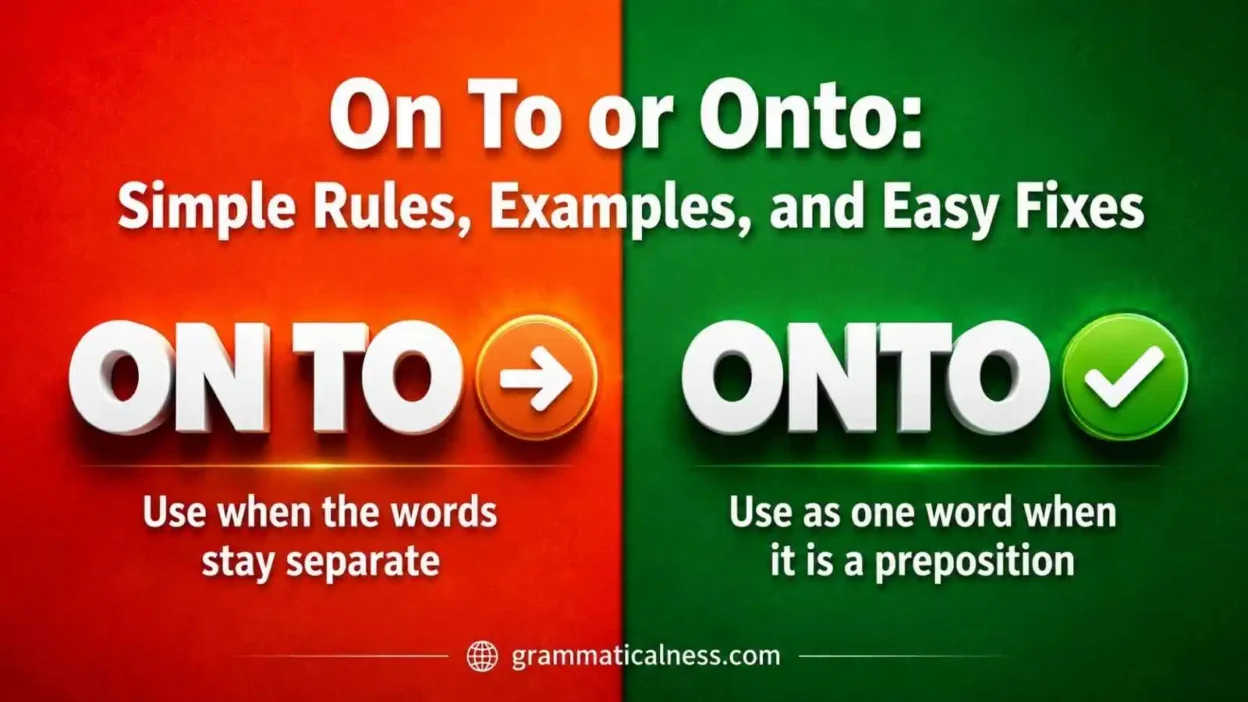
The choice between on to or onto can look tiny, but the space changes the grammar. In American English, both forms are standard, but they do different jobs.
Use onto when you mean movement to a position on a surface, a change onto something, or awareness of something. Use on to when on belongs with the verb and to starts the next part of the sentence.
That sounds technical, but the everyday rule is simple: if something is landing, moving, jumping, turning, or being placed on a surface, onto often works. If someone is continuing, moving forward, logging on, holding on, or going on, you often need on to.
Quick Answer
Use onto as one word when it means “to a position on” or “aware of.”
Use on to as two words when on is part of the verb phrase and to has its own job.
Correct: She stepped onto the porch.
Correct: Let’s move on to the next question.
Why People Confuse Them
People confuse these forms because they sound almost the same. In speech, no one can hear the space between on and to. In writing, that space matters.
Another reason is that both forms can appear after action verbs. You might write:
She climbed onto the bus.
That sentence is clear because she moved to a position on the bus. But then you might write:
She went on to study law.
Here, went on means continued or proceeded. The word to introduces what came next. Writing went onto study law would sound wrong because she did not move onto the surface of “study law.”
Key Differences At A Glance
• on to: two separate words; often appears after verbs such as move on, go on, log on, hold on, and read on.
• onto: one word; usually a preposition showing movement to a surface, direction, attachment, or awareness.
• on to: often means continuing to the next thing.
• onto: often means getting on top of, into contact with, or becoming aware of something.
• on to: the word on usually belongs with the verb.
• onto: the whole word points to the object that follows.
Meaning and Usage Difference
The main difference is structure.
Onto is a one-word preposition. It connects an action to a place, surface, target, or state of awareness.
Examples:
She dropped the keys onto the counter.
The dog jumped onto the couch.
The detective was onto the truth.
On to is not one word. It is on plus to. Usually, on stays with the verb before it, while to introduces the next destination, action, topic, or result.
Examples:
Let’s move on to the next slide.
He went on to become a teacher.
Please log on to your account.
A helpful test: if on belongs with the verb, keep it separate from to.
Tone, Context, and Formality
Both forms are normal in everyday and formal American English. The issue is not politeness or style. The issue is whether the sentence needs one preposition or two separate words.
Onto sounds natural in physical movement:
The kids ran onto the field.
It also works in common figurative phrases:
I think she’s onto something.
On to sounds natural when the idea is continuation:
After lunch, we moved on to budget planning.
It also appears in account and computer language when on is part of the verb:
Sign on to the portal before noon.
Pronunciation does not usually help much. The two forms are often said so similarly that writers should decide by grammar, not sound.
Which One Should You Use?
| Context | Best Choice | Why |
| Movement to a surface | onto | The object moves to a position on something. |
| Continuing to the next topic | on to | “On” belongs with the idea of continuing. |
| Logging in or signing in | on to | “On” often stays with the verb phrase. |
| Becoming aware of something | onto | It means aware of, suspicious of, or informed about. |
| Placing something on a surface | onto | The object ends up on that surface. |
| Moving forward in a process | on to | The meaning is progress, not physical placement. |
Use onto when you can replace it with upon or “to a position on” without changing the basic meaning.
Use on to when the sentence would still make sense if you paused after on.
When One Choice Sounds Wrong
Some sentences become strange when you use the wrong form.
Wrong: Let’s move onto the next question.
Better: Let’s move on to the next question.
Why? You are not physically moving onto the question. You are continuing to it.
Wrong: She stepped on to the stage.
Better: She stepped onto the stage.
Why? She moved to a position on the stage.
Wrong: He went onto become a doctor.
Better: He went on to become a doctor.
Why? Went on means continued or proceeded. The word to introduces the result.
Wrong: I’m on to your plan.
Better in most cases: I’m onto your plan.
Why? The meaning is awareness or suspicion.
Common Mistakes (and Quick Fixes)
Mistake 1: Using onto after “move on.”
Weak: We can move onto the next topic.
Better: We can move on to the next topic.
Mistake 2: Splitting onto when the meaning is physical placement.
Weak: Put the folder on to my desk.
Better: Put the folder onto my desk.
Mistake 3: Using onto before an infinitive.
Weak: She went onto open her own business.
Better: She went on to open her own business.
Mistake 4: Treating every surface sentence the same.
Sometimes on alone also works with motion verbs.
Natural: The cat jumped on the bed.
Also natural: The cat jumped onto the bed.
The second version gives a stronger sense of movement toward the bed.
Everyday Examples
The waiter placed the plates onto the table.
After the meeting, we moved on to client calls.
The player ran onto the court.
Next, the coach went on to explain the drill.
Please log on to the website.
Later, the app loaded onto my phone.
She’s onto his excuse.
Now, let’s go on to the next example.
He climbed onto the roof to clean the gutter.
After high school, she went on to college.
Water spilled onto the floor.
Read on to learn the final rule.
Dictionary-Style Word Details
Verb
on to: Not commonly used as a verb by itself in standard American English. In many sentences, on is part of a verb phrase, such as move on, go on, log on, or hold on.
onto: Not commonly used as a verb in standard American English. It is mainly a preposition. In specialized math writing, it can also work as an adjective, but that use is not part of everyday word choice.
Noun
on to: Not used as a noun. It is two separate words that meet in a sentence.
onto: Not commonly used as a noun in standard American English.
Synonyms
on to: There is no exact synonym because it depends on the verb before it. Closest plain alternatives include toward the next, forward to, or ahead to, but only in certain sentences.
Example: Move on to the next step = move ahead to the next step.
onto: Closest plain alternatives include upon, to a position on, and sometimes on. In the awareness sense, closest alternatives include aware of, suspicious of, or informed about.
Clear antonyms do not fit every use. For physical movement, a practical opposite of onto may be off or off of, depending on the sentence.
Example Sentences
on to: Let’s go on to the next chapter.
on to: She went on to win the scholarship.
on to: Please sign on to the employee portal.
on to: Hold on to the railing.
onto: The cat jumped onto the windowsill.
onto: He turned onto Maple Street.
onto: She copied the file onto the drive.
onto: I think they’re onto us.
Word History
on to: This is not one historical word. It is a normal pairing of two separate words: on and to. The meaning depends on the surrounding sentence.
onto: The one-word form has long-established use as a preposition. It developed from the idea of on plus to, which explains why it often points to movement toward a surface or position.
Phrases Containing
on to:
move on to
go on to
log on to
sign on to
hold on to
read on to
continue on to
onto:
jump onto
step onto
turn onto
climb onto
load onto
copy onto
onto something
onto your plan
FAQs
Both are correct, but they are used differently. Use onto when something moves to a position on a surface or when someone becomes aware of something. Use on to when on belongs with the verb and to introduces the next thing.
Onto is one word and works as a preposition. It often means “to a position on.” Example: She stepped onto the porch. On to is two words. It often appears in phrases like move on to, go on to, and log on to.
Usually, move on to is correct when you mean continue to the next topic, step, or task. Example: Let’s move on to the next question. Use move onto only when someone physically moves onto a surface, such as The dancers moved onto the stage.
In careful writing, log on to is usually the better choice because log on is the verb phrase and to introduces the account, website, or system. Example: Log on to your account before the meeting.
Both appear in real usage, but hold on to is often preferred in careful writing because hold on acts as the verb phrase. Example: Hold on to the railing. Hold onto is common in casual writing, especially when the meaning feels like gripping something.
Use go on to when you mean someone continued and did something later. Example: She went on to become a doctor. Use go onto only for physical movement onto a surface or place. Example: The actor went onto the stage.
Ask whether on belongs with the verb. If it does, keep on to as two words: move on to the next part. If the sentence means “to a position on,” use onto: step onto the sidewalk.
Conclusion
The safest way to choose between on to and onto is to look at the job of on. If on belongs with the verb, keep on to as two words: move on to, go on to, log on to, hold on to. If the sentence means movement to a surface, placement, direction, or awareness, use onto as one word: step onto the porch, turn onto Main Street, or be onto a plan. The space is small, but the meaning is not.