

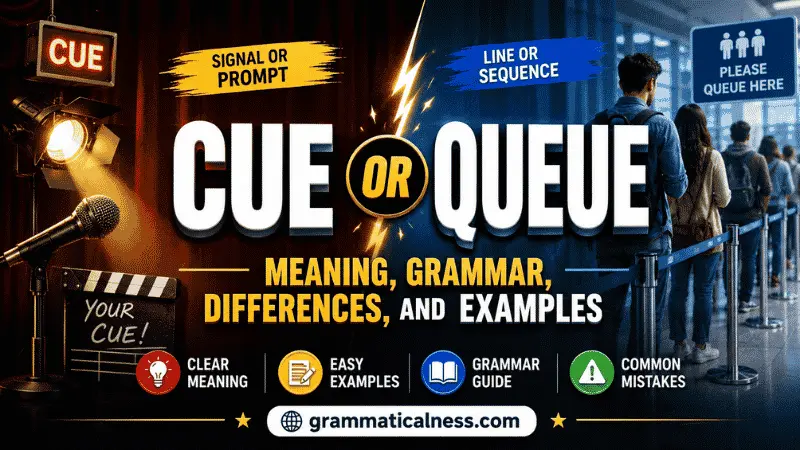
Cue and queue are both correct English words, but they are not interchangeable. Use cue for a signal, prompt, hint, or billiards stick. Use queue for a waiting line or an ordered sequence of people, calls, files, or tasks.
Both words are pronounced “kyoo,” like the letter Q. This identical pronunciation explains much of the confusion.
Quick Answer
Choose cue when something signals that an action should begin.
Choose queue when people or things wait in an order.
“Her nod was my cue to speak.” By contrast, “Your document is in the print queue.”
A useful memory rule is simple: a cue causes action, while a queue keeps things waiting.
Why People Confuse Them
Cue and queue sound exactly alike, yet their spellings and meanings differ.
Both words can also be nouns and verbs. A director can cue an actor, while a phone system can queue incoming calls. Context tells you which spelling fits.
Key Differences At A Glance
| Context | Best Choice | Why |
| A signal to begin | Cue | It prompts an action |
| A hint from behavior | Cue | It suggests what to do |
| A stick used in pool | Cue | It names the playing stick |
| A line of waiting people | Queue | It describes an ordered line |
| Calls or files awaiting processing | Queue | It describes a waiting sequence |
| Preparing media to start | Cue | It makes the recording ready |
Meaning and Usage Difference
As a noun, cue usually refers to a signal, hint, or prompt. The word can also name the long stick used in pool or billiards. When used as a verb, cue means to signal someone or prepare audio or video to begin at a specific point.
The noun queue means a waiting line or an ordered sequence. Used as a verb, it means to join, form, or arrange people or items in that order.
Compact Comparison
Cue: A signal, hint, prompt, or billiards stick; also, to signal or prepare something to begin.
Queue: A waiting line or ordered sequence; also, to join, form, or arrange that sequence.
For an authoritative explanation of these commonly confused homophones, read Merriam-Webster’s guide to cue vs. queue.
Tone, Context, and Formality
Both words are standard in casual, professional, and formal writing.
Americans usually say line rather than queue for people waiting. However, queue is natural in computing, customer service, streaming, and printing. Cue is common in theater, broadcasting, music, sports, and descriptions of body language.
Which One Should You Use?
Ask what the sentence describes.
When something tells a person to begin, react, or notice, choose cue. When people, messages, songs, or tasks wait for their turn, choose queue.
For media, the exact action matters. Cue a song when you prepare or start it at the right moment. Queue a song when you add it behind other songs in a playlist.
When One Choice Sounds Wrong
“Her smile was my queue to begin” sounds wrong because a smile acts as a signal, not a waiting line. Write cue.
“The support requests are in a cue” also sounds wrong because the requests are waiting in order. Write queue.
The phrase right on cue refers to perfect or expected timing. By contrast, in the queue means waiting for attention, service, playback, or processing.
Common Mistakes (and Quick Fixes)
Mistake: Writing “on queue” for timing
Incorrect: The rain started right on queue.
Fix: The rain started right on cue.
Mistake: Writing “queue the music” when it should start
Incorrect: Queue the music as the speaker enters.
Fix: Cue the music as the speaker enters.
Mistake: Writing “cue” for a waiting list
Incorrect: My request is still in the cue.
Fix: My request is still in the queue.
Mistake: Mixing up past-tense forms
Use cued for signaling and queued for arranging or waiting: “She cued the video” but “She queued the next episode.”
Everyday Examples
The host gave us a cue to take our seats.
A flashing light cued the crew to open the doors.
Jordan replaced the damaged pool cue before the game.
Five print jobs were waiting in the queue.
Our call was queued for the next available representative.
Maya queued three podcasts for her morning commute.
Dictionary-Style Word Details
Verb
Cue: To signal, prompt, or prepare something for action or playback. Common forms are cue, cues, cued, and cueing or cuing.
Queue: To arrange items in a waiting order, form a line, or wait in one. Common forms are queue, queues, queued, and queuing or queueing.
Noun
Cue: A signal, prompt, hint, perceptual sign, or stick used in pool and billiards.
Queue: A waiting line or ordered sequence of people, calls, files, messages, or jobs. It can also name a historical braid.
Synonyms
Cue: Depending on context, close alternatives include signal, prompt, hint, indication, and suggestion.
Queue: Depending on context, close alternatives include line, waiting list, sequence, row, and order.
Neither word has one clear antonym that works across all its meanings.
Example Sentences
Cue: The producer cued the camera operator before the live segment.
Queue: The upload entered a queue and began after the earlier files finished.
Cue: Her raised hand was a cue for everyone to become quiet.
Queue: Fans queued outside before the store opened.
Word History
The signal sense of cue probably developed from q or qu, abbreviations connected with the Latin word quando, meaning “when,” once used in actors’ scripts.
The word queue came through French from a word meaning “tail.” That image later suited a braid and then a line of people or things stretching behind one another.
The billiards sense of cue has a separate history connected with the same French “tail” word.
Phrases Containing
Cue: on cue, right on cue, as if on cue, take your cue from, cue up, cue in, visual cue, and pool cue.
Queue: join the queue, in the queue, queue up, front of the queue, print queue, call queue, and message queue.
FAQs
“Cue the music” is correct when you mean start the music at the planned moment. Use “queue the music” only when you mean place tracks in an ordered waiting list. The intended action—starting or arranging—determines the spelling.
“On cue” is the standard phrase for something happening at the expected or perfectly timed moment. “On queue” is not the timing expression; queue belongs in wording about waiting lists, ordered tasks, or items awaiting their turn.
Yes, both words can function as verbs. To cue someone is to signal or prompt that person. To queue people, files, calls, or songs is to arrange them in an order, or to have them wait for processing.
Yes, queue is standard in American English, especially for computer jobs, customer calls, downloads, and other ordered tasks. Americans usually say “line” for people waiting, but using “queue” in that setting remains understandable and grammatically correct.
Both forms are correct, but they describe different actions. “Cue up” usually means prepare audio or video to begin at a chosen point. “Queue up” means join a waiting line or place something behind other items awaiting their turn.
Connect cue with a signal and queue with a waiting order. A stage cue tells someone to act, while a queue holds people or tasks until their turn. For music, ask whether you are starting it or arranging its order.
Conclusion
Use cue for a signal, prompt, hint, or billiards stick. Use queue for a waiting line or ordered sequence.
Both words can be nouns or verbs, and both sound like “Q.” Meaning makes the choice clear: cue starts or guides an action; queue organizes what must wait.


