
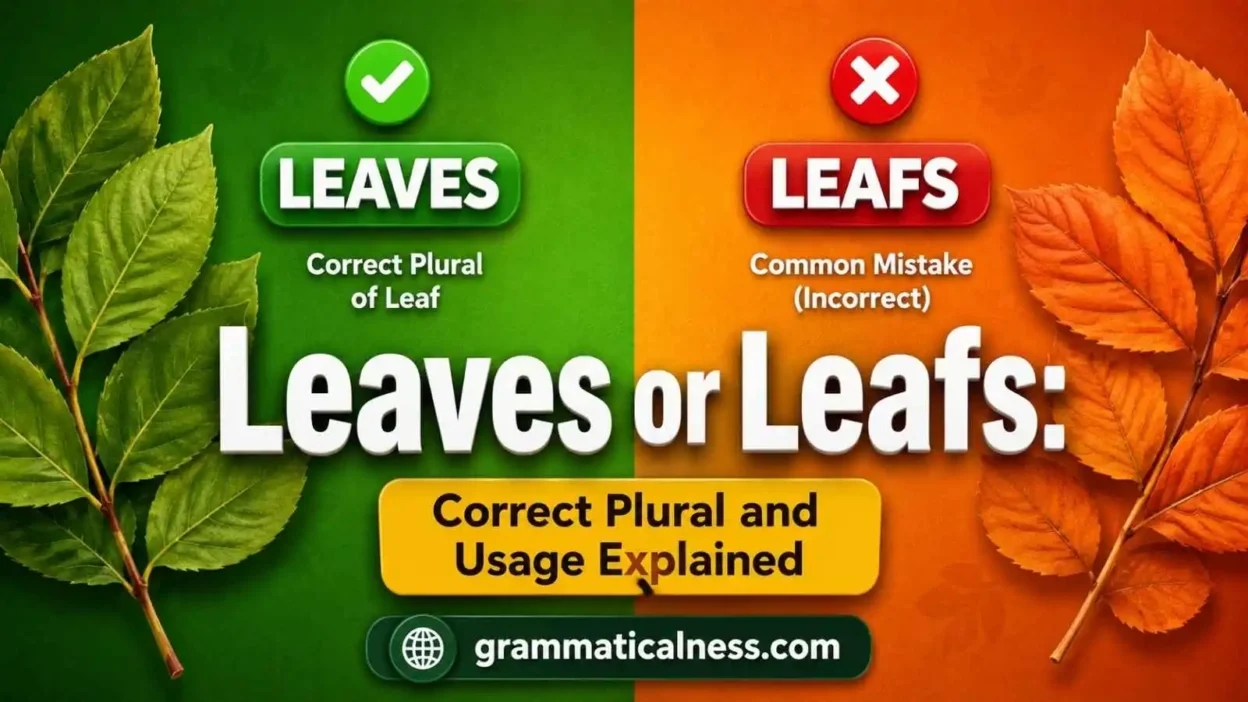
“Leaves or leafs” is a common grammar question, especially when writing about nature or everyday actions. At first glance, both forms seem logical. However, they are not interchangeable.
The difference comes down to grammar and usage. One is the correct plural noun, while the other is a verb form. Understanding that distinction makes the choice simple and avoids mistakes.
Quick Answer
Use leaves as the plural of “leaf.”
Use leafs only as a verb form (third-person singular).
Example:
• The tree has many leaves. ✅
• She leafs through the magazine. ✅
Why People Confuse Them
The confusion comes from a common English pattern. Many words ending in “f” simply add “-s” for the plural. So “leafs” feels natural.
However, “leaf” follows an irregular pattern where “f” changes to “ves.” This creates “leaves.”
At the same time, “leafs” exists as a verb, which makes things even trickier.
Key Differences At A Glance
| Feature | leaves | leafs |
|---|---|---|
| Part of Speech | Noun (plural) | Verb (present tense) |
| Meaning | More than one leaf | Turns pages quickly |
| Common Use | Very common | Less common |
| Grammar Role | Object or subject | Action word |
Meaning and Usage Difference
Leaves is the plural noun of “leaf.” It refers to multiple plant leaves or similar flat objects.
Example:
• The ground is covered with leaves.
Leafs is a verb form of “leaf,” meaning to flip through pages quickly.
Example:
• He leafs through the notebook.
This is the key difference:
• Leaves = thing (noun)
• Leafs = action (verb)
Tone, Context, and Formality
Leaves works in all contexts. It’s standard, formal, and expected in writing.
Leafs is neutral but less common. It appears mostly in casual or descriptive writing.
Example:
• Formal: The tree sheds its leaves in fall.
• Casual: She leafs through old photos.
There is no US vs UK difference here. Both follow the same rule.
Which One Should You Use?
Use this simple rule:
• Talking about plants or objects → leaves
• Talking about flipping pages → leafs
If you’re unsure, test the sentence:
Can you replace it with “turns pages”?
• Yes → use leafs
• No → use leaves
When One Choice Sounds Wrong
Some sentences instantly sound incorrect:
• The tree has many leafs ❌
• He leaves through the book ❌
Why?
Because each word is being used in the wrong grammatical role.
Matching part of speech fixes the issue every time.
Common Mistakes (and Quick Fixes)
• Mistake: “There are many leafs on the tree.”
Fix: “There are many leaves on the tree.”
• Mistake: “She leaves through the magazine.”
Fix: “She leafs through the magazine.”
• Mistake: Using “leafs” as a plural noun
Fix: Always use leaves
Everyday Examples
• The wind blew the leaves across the yard.
• These leaves turn red in autumn.
• He leafs through his planner every morning.
• She leafs through recipes before dinner.
• The pile of leaves grew overnight.
These examples show how clearly the roles differ.
Dictionary-Style Word Details
Verb
• leaves: Not commonly used as a verb in this comparison (different word meaning “to depart”).
• leafs: Third-person singular form of “leaf,” meaning to flip through pages.
Noun
• leaves: Plural of “leaf,” referring to plant parts or similar shapes.
• leafs: Not used as a noun in standard US English.
Synonyms
• leaves: foliage, greenery (closest plain alternatives)
• leafs: flips, browses, skims
Antonyms are not strongly applicable in this comparison.
Example Sentences
• leaves: The leaves fell early this year.
• leafs: He leafs through the catalog quickly.
Word History
• leaves: Comes from an older English plural pattern where “f” changes to “ves.”
• leafs: Developed as a regular verb form from “leaf.”
Phrases Containing
• leaves: “turn over a new leaf,” “fall leaves”
• leafs: “leafs through a book,” “leafs through notes”
FAQs
Yes. “Leafs” is correct only as a verb, meaning to flip through pages.
Example: He leafs through the magazine while waiting.
The correct plural is “leaves.”
Example: The tree is full of green leaves.
Because “leaf” follows an irregular plural rule where “f” changes to “ves.”
That’s why it becomes leaves, not “leafs.”
No. In standard US English, “leafs” is not used as a noun.
Use “leaves” instead for plural.
Both American and British English follow the same rule:
• leaves = plural noun
• leafs = verb form
Think of this:
• Leaves = things (on trees) 🌿
• Leafs = action (flipping pages) 📖
“Leaves” is far more common because it’s used in everyday language about nature.
“Leafs” appears less often since it’s only a specific verb form.
Yes, but it’s somewhat less common than alternatives like “flips through” or “browses.”
Example: She leafs through old journals.
No. They are not interchangeable.
• Leaves = noun (things)
• Leafs = verb (action)
Using “leafs” as a plural noun.
Incorrect: The ground is covered with leafs ❌
Correct: The ground is covered with leaves ✅
Conclusion
The difference between “leaves or leafs” is simple once you see it clearly.
Use leaves when talking about more than one leaf. This is the standard plural form and the one you’ll use most often.
Use leafs only as a verb when someone flips through pages.
If you remember that one is a noun and the other is a verb, you’ll avoid almost every mistake.