
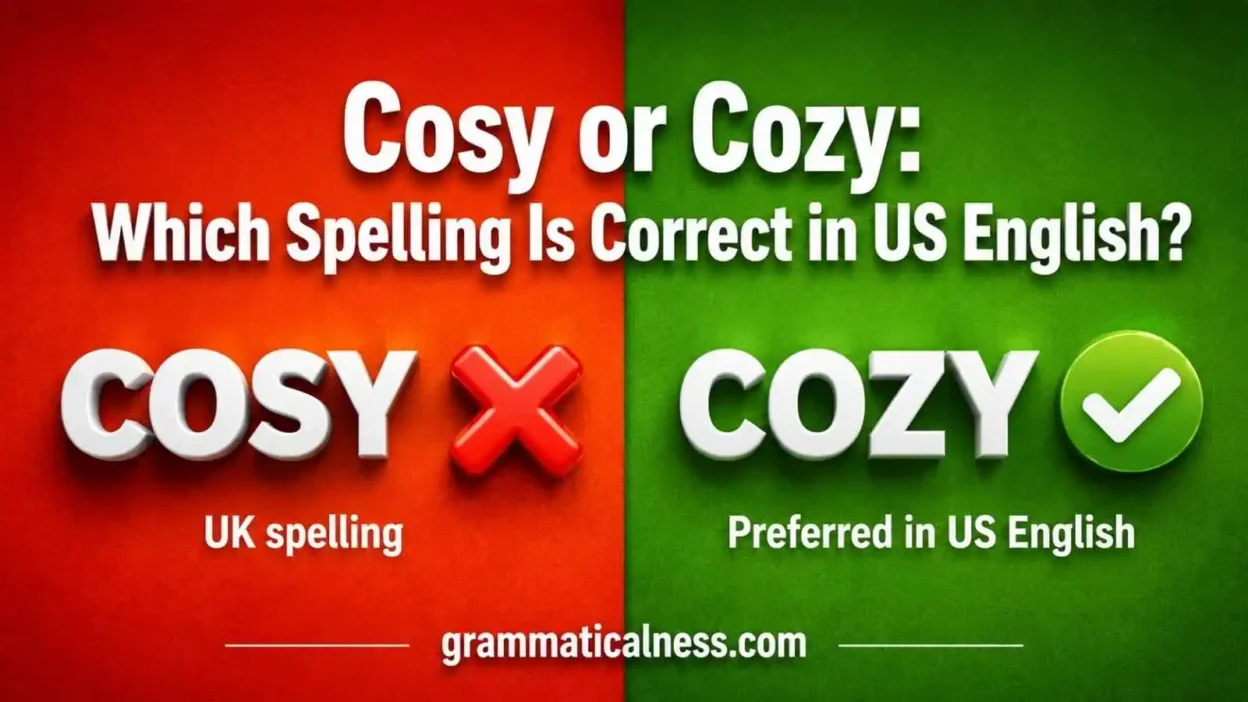
Cosy or cozy is a common spelling question because both forms are real. They also have the same basic meaning. However, they belong to different English spelling styles.
For American English, cozy is the correct and expected spelling. Therefore, it is the best choice for US articles, school writing, captions, emails, product copy, and everyday sentences.
Meanwhile, cosy is mainly used in British English. American readers will usually understand it, but it may look British or slightly out of place in US writing.
Quick Answer
Use cozy for American English.
For British English, use cosy.
Both words describe something warm, comfortable, snug, pleasant, or friendly. In some contexts, though, they can also describe a relationship that seems too close or possibly unfair, as in “a cozy relationship between a company and an agency.”
In short, the best US forms are cozy, cozier, coziest, cozily, and coziness.
Why People Confuse Them
People often confuse cosy and cozy because they look almost the same. Only one letter changes: s in cosy and z in cozy.
Also, the words sound the same when spoken. Since listeners cannot hear the spelling difference, the confusion usually appears in writing.
Another reason is online content. American readers may see cosy in British articles, while British readers may see cozy in US posts. As a result, both spellings can feel familiar even when only one fits the audience.
Key Differences At A Glance
| Context | Best Choice | Why |
| US article, blog post, or essay | cozy | Standard American spelling |
| British article or UK-style writing | cosy | Standard British spelling |
| Writing for American readers | cozy | Looks natural in US English |
| Writing for British readers | cosy | Matches British spelling style |
| Product or brand name | Follow the official spelling | Names keep their chosen form |
| Quoted text | Keep the original spelling | Do not change someone else’s wording |
| US comparative forms | cozier, coziest | The z spelling continues |
| British comparative forms | cosier, cosiest | The s spelling continues |
Meaning and Usage Difference
There is no real meaning difference between cosy and cozy. Both words can describe a place, object, feeling, or situation that feels warm, comfortable, and pleasant.
In US English, you would write:
“The cabin felt cozy during the snowstorm.”
By contrast, British English often uses this spelling:
“The cabin felt cosy during the snowstorm.”
The word can describe a physical feeling. For example, you might say, “She wore a cozy sweater.”
It can also describe a warm social feeling, as in, “We had a cozy dinner with friends.”
However, the word sometimes has a less positive meaning. In a sentence like “a cozy relationship with officials,” it may suggest that two sides are too close in a suspicious or unfair way.
That meaning belongs to both spellings. Therefore, the spelling itself does not change the meaning.
Tone, Context, and Formality
In American English, cozy feels normal, natural, and modern. It works well in casual writing, but it also fits polished writing.
By comparison, cosy may feel charming or British to US readers. It can work when you are writing with a British voice, quoting British text, or following a British brand style.
Neither spelling is more formal by meaning. Instead, the tone depends on the sentence.
A cozy blanket sounds warm and positive.
A cozy deal, however, may sound suspicious.
Similarly, a cozy café sounds inviting, while a cozy arrangement can sound questionable if the context involves money, power, or influence.
Which One Should You Use?
Choose cozy if your audience is mainly in the United States.
This spelling fits everyday US phrases such as:
• a cozy room
• a cozy blanket
• a cozy café
• a cozy winter night
• a cozy mystery novel
• a cozy relationship
On the other hand, choose cosy if your audience expects British English.
That spelling fits phrases such as:
• a cosy room
• a cosy blanket
• a cosy cottage
• a cosy chat
• a tea cosy
For international writing, choose one spelling style and stay consistent. Otherwise, switching between cosy and cozy may look like a mistake.
When One Choice Sounds Wrong
Cosy can look unusual in American writing because US readers expect cozy.
Less natural for US English:
“We booked a cosy cabin in Vermont.”
Better for US English:
“We booked a cozy cabin in Vermont.”
In British-style writing, the reverse can happen. A British reader may expect cosy instead of cozy.
Less natural for British style:
“She made the room feel cozy.”
Better for British style:
“She made the room feel cosy.”
The meaning stays the same in each pair. However, the spelling style changes.
Common Mistakes (and Quick Fixes)
A common mistake is mixing the spellings in the same piece of writing.
Incorrect for US English:
“The hotel room was cozy, and the lobby felt cosier.”
Correct for US English:
“The hotel room was cozy, and the lobby felt cozier.”
Correct for British English:
“The hotel room was cosy, and the lobby felt cosier.”
Another mistake is using made-up spellings such as cozie, cozey, cosie, or cosey. These are not the standard choices for normal writing.
For American English, use cozy.
For British English, choose cosy.
Also, keep official names exactly as written. If a company, book, café, or product uses Cosy in its name, do not change it to Cozy unless you are correcting a clear typo.
Everyday Examples
Here are natural examples for American English:
“I bought a cozy sweater for the trip.”
“The apartment is small, but it feels cozy.”
“We found a cozy diner near the station.”
“She spent a quiet Sunday reading in a cozy chair.”
“The hotel lobby had a cozy fireplace.”
“The report questioned the cozy relationship between the company and the agency.”
For British-style writing, these examples use cosy:
“The family stayed in a cosy cottage near the coast.”
“They enjoyed a cosy chat over tea.”
“The shop sold a handmade tea cosy.”
“A cosy fire made the room feel welcoming.”
Compact comparison:
• Cosy is the British spelling.
• Cozy is the American spelling.
• Both forms have the same core meaning.
• Therefore, the best choice depends on your audience.
• In US writing, cozy is the safer choice.
Dictionary-Style Word Details
Verb
• cosy: In British English, cosy can work as a verb, usually in the phrase cosy up. It can mean to move close for warmth or comfort. It can also mean to become friendly with someone for personal gain.
Example: “The child cosied up under the blanket.”
• cozy: In American English, cozy can also work as a verb, usually in cozy up.
Example: “The dog cozied up beside the couch.”
In a less positive sense, it can suggest trying to gain favor.
Example: “The lobbyist cozied up to powerful officials.”
Noun
• cosy: As a noun, cosy is used in British English for a cover that keeps something warm, especially a tea cosy or egg cosy.
Example: “She placed a knitted tea cosy over the pot.”
• cozy: In American English, cozy can be used the same way in phrases such as tea cozy. It also appears in labels like cozy mystery, which means a gentle mystery story with limited violence and a lighter tone.
Example: “My aunt loves reading cozy mysteries.”
Synonyms
• cosy: Closest plain alternatives include warm, snug, comfortable, pleasant, safe, and welcoming.
• cozy: Closest plain alternatives include warm, snug, comfortable, pleasant, homey, and inviting.
Useful opposites include cold, chilly, uncomfortable, harsh, bare, and unwelcoming. However, the best opposite depends on the sentence.
Example Sentences
Use cosy in British English when describing something warm, comfortable, or pleasant: “The little cottage looked cosy in the rain.”
In British-style writing, you could also use it for a warm emotional moment: “They shared a cosy conversation after dinner.”
Additionally, cosy can work as a noun in phrases like tea cosy: “The tea cosy kept the pot warm.”
For American English, cozy is the standard spelling: “The cabin felt cozy after we lit the fire.”
Similarly, everyday US writing often uses cozy for relaxed plans or comfortable settings: “We planned a cozy movie night at home.”
However, cozy can also have a less positive meaning when it suggests an overly close or suspicious relationship: “The article criticized the cozy relationship between the company and the agency.”
Word History
• cosy: The deeper origin is not completely certain. In modern English, cosy is widely used as the British spelling.
• cozy: This is the standard American spelling. It has the same basic meaning as cosy, but American English uses z instead of s.
For that reason, do not treat cosy and cozy as two different words with separate meanings. They are spelling variants from different English traditions.
Phrases Containing
• cosy: Common phrases include cosy up, cosy room, cosy cottage, cosy chat, tea cosy, egg cosy, and cosy relationship.
• cozy: Common phrases include cozy up, cozy room, cozy cabin, cozy night, cozy sweater, tea cozy, cozy mystery, and cozy relationship.
In American writing, use cozy up. However, use cosy up when you are following British spelling.
FAQs
In American English, cozy is the correct spelling. Use it for US articles, essays, captions, emails, and everyday writing.
Cosy is not wrong, but it is mainly British English. American readers will understand it, although cozy looks more natural in US writing.
Yes. Cosy and cozy have the same meaning. Both can describe something warm, comfortable, snug, pleasant, or friendly.
Use cozy for a US audience. For example, write cozy room, cozy blanket, cozy cabin, and cozy winter night.
In American English, use cozier. In British English, use cosier. The same pattern applies to coziest and cosiest.
Yes. Although cozy often sounds warm and positive, it can also suggest that a relationship is too close or suspicious. For example, “a cozy relationship with officials” may sound questionable.
Both can be correct, depending on the spelling style. In American English, tea cozy is the better choice. In British English, tea cosy is more common.
The simple rule is this: use cozy for American English and cosy for British English. The meaning stays the same, but the spelling changes by region.
Conclusion
For US English, cozy is the correct choice. For British English, cosy is the expected spelling.
Both words mean warm, comfortable, snug, or pleasant. In some contexts, they can also describe a relationship that seems too close or questionable.
The difference is spelling style, not meaning. Therefore, American readers usually expect cozy, while British readers often expect cosy.
For a US audience, use cozy, cozier, coziest, cozily, and coziness. As a result, your writing will look clean, natural, and consistent.