
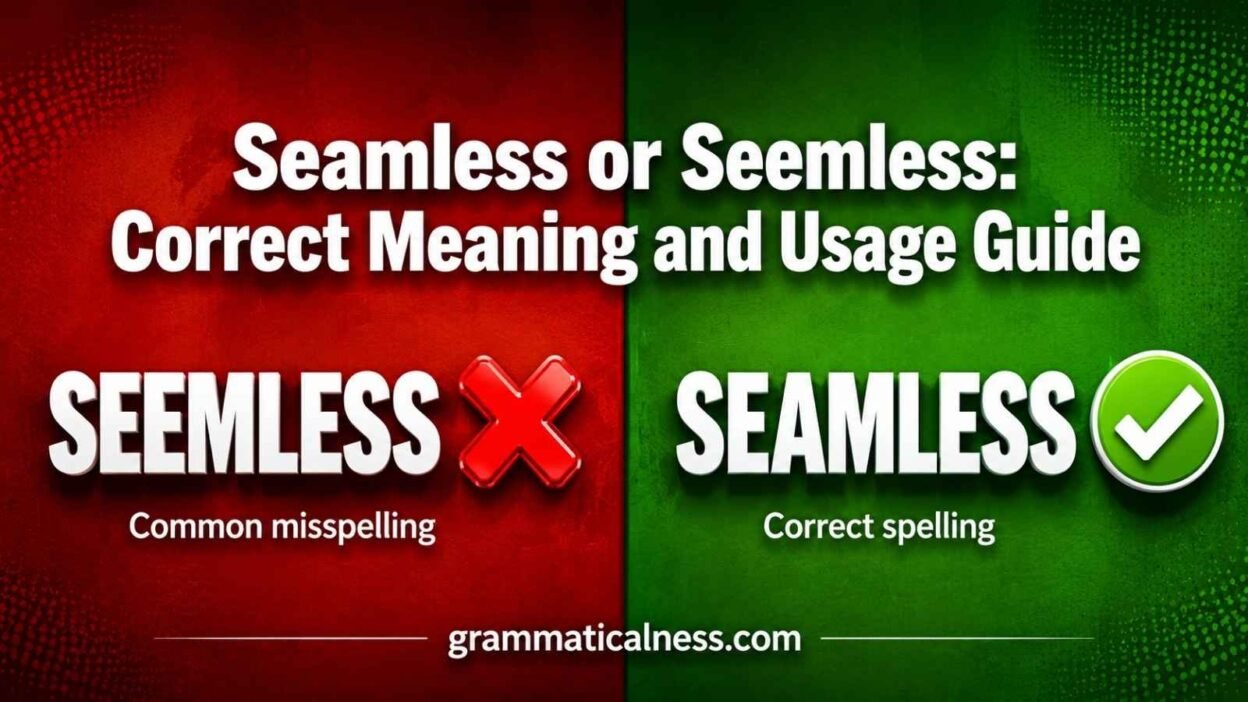
Seamless or seemless is a common word-choice problem because both forms sound natural when spoken. In modern American English, however, seamless is the correct choice when you mean smooth, continuous, or without visible joins.
Seemless is usually a misspelling. It may look logical because something seamless can “seem” smooth, but the word comes from seam, not seem. A seam is a line where two pieces of fabric or material join. So, something with no seams is seamless.
Quick Answer
Use seamless in standard modern English. It means smooth, continuous, or without seams, breaks, or awkward changes. Seemless is normally a misspelling when writers mean seamless. Although seemless has an old dictionary meaning, it is not the word you should use for a smooth transition, process, design, or experience.
Why People Confuse Them
People confuse seamless and seemless because seam and seem sound the same. That makes the wrong spelling easy to type.
However, the meaning points to seam, not seem. A seam is a stitched or joined line. When something has no visible seam, it is seamless.
The figurative meaning grew from that idea. A seamless transition feels as if two parts join without a visible break. A seamless experience feels smooth from start to finish.
Seemless looks like it should mean “without seeming,” but that is not how the modern word works. In normal writing, it will look like an error.
Key Differences At A Glance
| Context | Best Choice | Why |
| A smooth change | seamless transition | The change has no awkward break. |
| A connected service | seamless experience | The user moves through it easily. |
| Clothing or fabric | seamless leggings | The item has no visible seams. |
| Design or layout | seamless pattern | The pattern repeats without obvious joins. |
| Business writing | seamless process | The process works smoothly. |
| App or software wording | seamless integration | The systems connect without friction. |
| Modern spelling | seamless | This is the standard spelling. |
| Common mistake | not seemless | This spelling usually looks incorrect today. |
Meaning and Usage Difference
Seamless is an adjective. It can describe something literal, such as clothing with no seams.
Correct: “She bought seamless socks for running.”
More often, it describes something figurative. In that use, seamless means smooth, continuous, or connected without awkward interruptions.
Correct: “The checkout process was seamless.”
Correct: “The team made a seamless transition to the new schedule.”
Seemless is not the standard spelling for this meaning. In everyday, school, business, and professional writing, readers will usually see it as a mistake.
Incorrect: “The checkout process was seemless.”
Correct: “The checkout process was seamless.”
The pronunciation also explains the confusion. Seamless is pronounced like SEEM-liss. Because it sounds like “seem,” many writers spell it the wrong way. Still, the spelling must follow seam because the word means “without seams.”
Here is the compact difference:
| Feature | seamless | seemless |
| Standard modern use | Correct adjective | Usually a misspelling |
| Main meaning | Smooth, continuous, without seams or breaks | Not the standard word for this meaning |
| Best context | Transitions, processes, service, clothing, design | Avoid in normal modern writing |
| Reader reaction | Polished and correct | Looks like a spelling error |
Tone, Context, and Formality
Seamless is neutral. You can use it in casual writing, school writing, business writing, product descriptions, and technical contexts.
Seamless
The new app gives customers an easy way to book appointments.
The event staff created a smooth check-in process.
The dress has a finish with no visible seams.
The word often sounds polished, especially in business, design, and customer-service writing. Still, it is not overly formal. It works in everyday sentences too.
Seemless, on the other hand, does not sound more casual or more formal. It simply looks wrong when the intended meaning is “smooth” or “without breaks.”
Wrong: “We want a seemless customer experience.”
Better: “We want a seamless customer experience.”
There is no useful US vs UK difference here. For the normal modern meaning, seamless is the safe standard choice.
Which One Should You Use?
Use seamless whenever you mean smooth, continuous, connected, or without visible seams.
Use it for:
• seamless transition
• seamless experience
• seamless integration
• seamless process
• seamless design
• seamless pattern
• seamless leggings
• seamless service
Avoid seemless in modern writing unless you are discussing the old word itself. For most readers, it will look like a spelling mistake.
Best choice: “The update made the payment process seamless.”
Not recommended: “The update made the payment process seemless.”
A simple memory rule helps: If there are no seams, it is seamless.
When One Choice Sounds Wrong
Seemless sounds possible because it matches the pronunciation. However, it looks wrong in common phrases.
Wrong: “The company promised a seemless migration.”
Correct: “The company promised a seamless migration.”
Wrong: “The video editor created a seemless cut.”
Correct: “The video editor created a seamless cut.”
Wrong: “The hotel offered a seemless guest experience.”
Correct: “The hotel offered a seamless guest experience.”
The correct spelling carries the idea of two parts joining so smoothly that the join is hard to notice. That image works for fabric, video edits, business processes, apps, and conversations.
Common Mistakes (and Quick Fixes)
Common Mistakes With Seamless
A seemless transition should be written as a seamless transition.
When describing an easy customer journey, use seamless experience, not seemless experience.
For systems that work well together, the correct phrase is seamless integration.
In visual or product writing, choose seamless design instead of seemless design.
For a smooth workflow, write seamless process, not seemless process.
The fastest fix is to look for the idea of a join, break, or interruption. If the sentence means “without a visible join or problem,” the word is seamless.
Everyday Examples
Seamless
The store made returns easy and smooth.
Her presentation had a smooth flow.
The two scenes blended into one natural moment.
We need a smooth handoff between the sales team and support team.
The designer used a background pattern with no visible joins.
The company wants an easy onboarding process.
These leggings are comfortable for workouts and have no rough seams.
The new login system creates a smooth user experience.
Incorrect: “The store made returns seemless.”
Correct: “The store made returns seamless.”
Incorrect: “Her presentation had a seemless flow.”
Correct: “Her presentation had a seamless flow.”
Incorrect: “The designer used a seemless background pattern.”
Correct: “The designer used a seamless background pattern.”
Dictionary-Style Word Details
Verb
• seamless: Not commonly used as a verb in standard US English. It is normally an adjective.
• seemless: Not commonly used as a verb in standard US English. Do not use it as a verb when you mean “make smooth” or “connect smoothly.”
Noun
• seamless: Not commonly used as a noun in standard US English. The related noun is seamlessness, which means the quality of being smooth, continuous, or without breaks.
Example: “The seamlessness of the service impressed customers.”
• seemless: Not commonly used as a noun in modern standard US English.
Synonyms
• seamless: Closest plain alternatives include smooth, continuous, unbroken, fluid, cohesive, connected, and uninterrupted. In some contexts, flawless may fit, but it is stronger and not always exact.
Useful opposites include seamed, interrupted, uneven, disjointed, and awkward.
• seemless: No useful modern synonyms apply when it is being used as a misspelling of seamless. If the old meaning is intended, unseemly is the closest plain alternative, but that use is rare and not recommended for normal modern writing.
Example Sentences
Seamless
The office created a smooth process for new employees.
The fabric has a finish with no visible seams.
The transfer from the old phone to the new one went smoothly.
Good editing can make two clips feel naturally connected.
Seemless
This is not the spelling to use for “a seamless process.”
The phrase “seemless transition” should be corrected to “seamless transition.”
Word History
• seamless: The word comes from seam plus -less. A seam is a join or stitched line, especially in fabric. So seamless literally means “without seams.” Over time, it also came to describe anything that feels smooth, connected, or uninterrupted.
• seemless: Some dictionaries preserve seemless as an old word meaning something like “unseemly” or “improper.” However, that is not the modern word people need when they mean smooth, continuous, or without breaks.
Phrases Containing
• seamless: seamless transition, seamless experience, seamless process, seamless integration, seamless design, seamless pattern, seamless service, seamless handoff, seamless finish, seamless flow.
• seemless: Not used in standard modern phrases for the meaning “smooth” or “continuous.” Phrases such as “seemless transition,” “seemless experience,” and “seemless integration” should be corrected to seamless transition, seamless experience, and seamless integration.
FAQs
Is seamless or seemless correct?
Seamless is correct in modern English. Use seamless when something is smooth, continuous, or free from awkward breaks. Seemless is usually a spelling mistake when people mean seamless.
What does seamless mean?
Seamless means smooth, well-connected, or without visible joins. It can describe clothing with no seams, but it is also common in phrases like seamless transition, seamless experience, and seamless process.
Is seemless a real word?
Seemless appears in some dictionaries as an old or rare word, but it is not the normal modern spelling for the meaning “smooth” or “without breaks.” In everyday writing, seemless usually looks incorrect.
Why do people write seemless instead of seamless?
People write seemless because seam and seem sound the same. Since seamless is pronounced like “seem-liss,” the wrong spelling can feel natural. The correct spelling comes from seam, meaning a joined or stitched line.
How do you use seamless in a sentence?
You can use seamless like this: “The app gives users a seamless checkout experience.” You can also write, “The team made a seamless transition to remote work.”
Is seamless formal or informal?
Seamless is neutral. It works in casual, business, academic, and technical writing. It often sounds polished, especially when describing service, design, technology, or a process.
What is the easiest way to remember seamless?
Remember that seamless means “without seams.” If something has no visible break, join, or interruption, use seamless. The spelling is based on seam, not seem.
Conclusion
The correct modern choice is seamless. Use it when something is smooth, continuous, joined cleanly, or free from awkward breaks.
Seemless is usually a misspelling when writers mean seamless. The memory trick is simple: the word comes from seam, not seem. If a process, design, transition, or experience has no visible “seams,” it is seamless.
Seamless is correct in modern English. Use seamless when something is smooth, continuous, or free from awkward breaks. Seemless is usually a spelling mistake when people mean seamless.
Seamless means smooth, well-connected, or without visible joins. It can describe clothing with no seams, but it is also common in phrases like seamless transition, seamless experience, and seamless process.
Seemless appears in some dictionaries as an old or rare word, but it is not the normal modern spelling for the meaning “smooth” or “without breaks.” In everyday writing, seemless usually looks incorrect.
People write seemless because seam and seem sound the same. Since seamless is pronounced like “seem-liss,” the wrong spelling can feel natural. The correct spelling comes from seam, meaning a joined or stitched line.
You can use seamless like this: “The app gives users a seamless checkout experience.” You can also write, “The team made a seamless transition to remote work.”
Seamless is neutral. It works in casual, business, academic, and technical writing. It often sounds polished, especially when describing service, design, technology, or a process.
Remember that seamless means “without seams.” If something has no visible break, join, or interruption, use seamless. The spelling is based on seam, not seem.