
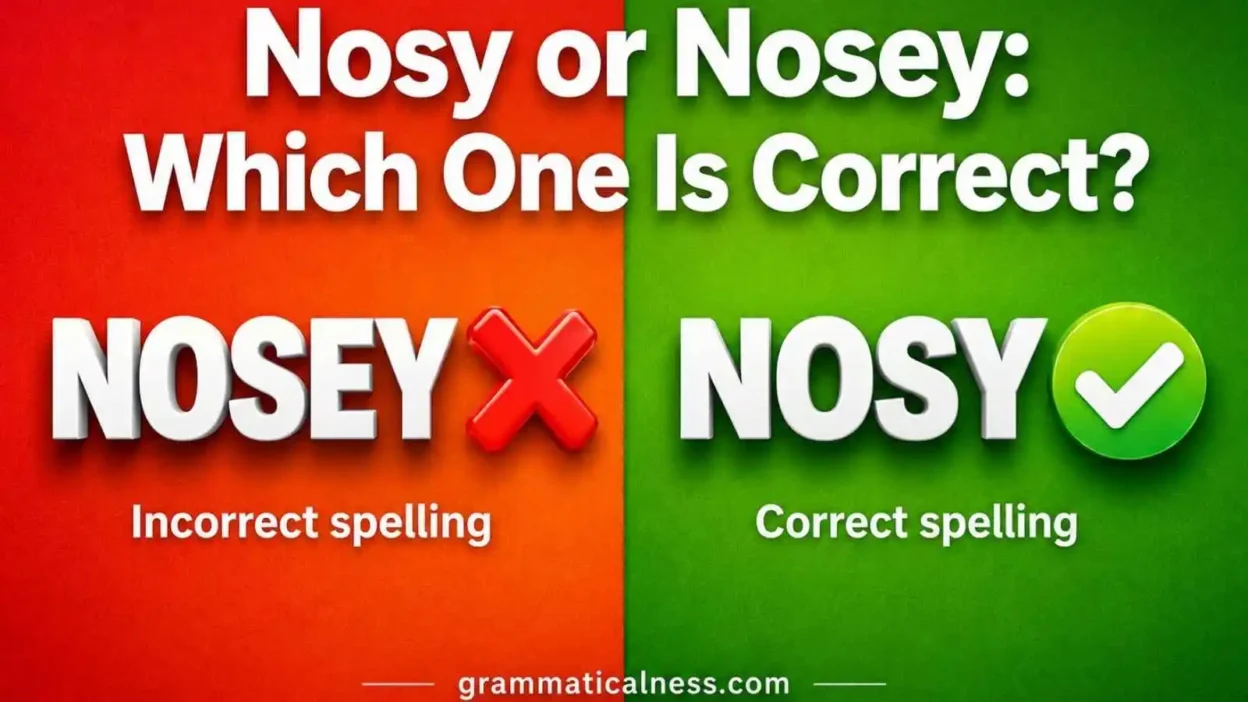
Nosy is the better choice in American English. Use nosy when you mean “too curious about other people’s private business.”
Nosey is not a different word with a different meaning. It is a variant spelling of nosy. You may see it in casual writing, older writing, or some non-US contexts, but it is not the spelling most US readers expect.
So the simple answer is: write nosy in US English.
Quick Answer
Use nosy for standard American writing.
Use nosey only when you have a clear reason to use the variant spelling, such as copying someone’s exact wording, writing dialogue, or matching a source that already uses it.
Both forms mean the same thing: overly interested in matters that are not your concern.
Examples:
Correct for US writing:
“She’s not trying to be nosy; she just wants to help.”
Less standard in US writing:
“She’s not trying to be nosey; she just wants to help.”
Why People Confuse Them
The confusion makes sense. The word is connected to nose, and English often adds -y to nouns to make adjectives.
That pattern can make nosey look natural.
But the standard spelling drops the e: nosy. The same spelling pattern appears in the related forms nosier, nosiest, nosily, and nosiness.
The meaning does not change when the spelling changes. The real choice is about which spelling looks standard to your reader.
Key Differences At A Glance
| Context | Best Choice | Why |
|---|---|---|
| US school paper | nosy | Standard American spelling |
| Work email | nosy | Looks cleaner and more professional |
| News or formal article | nosy | Expected spelling in edited US writing |
| Casual text message | nosy | Still the safer spelling |
| Dialogue showing a character’s style | nosey | Possible if the spelling is intentional |
| Quoting someone who wrote “nosey” | nosey | Keep the original spelling |
| Mixed or international audience | nosy | Broadly recognized and safe |
| Dictionary lookup | nosy | Usually treated as the main form |
Meaning and Usage Difference
There is no real meaning difference between nosy and nosey.
Both describe a person who asks too many personal questions, watches too closely, or gets involved in private matters.
Nosy is the standard spelling.
Nosey is a variant spelling.
The word is usually an adjective.
Examples:
“She has a nosy neighbor who watches every delivery.”
“Don’t be nosy about his divorce.”
“That question felt a little nosy.”
The word often has a negative tone. It suggests that the curiosity is unwanted or intrusive.
It can also be used lightly among friends:
“Not to be nosy, but did you get the job?”
That sentence softens the word, but it still admits the question may be personal.
Tone, Context, and Formality
In American English, nosy fits almost every context.
It works in casual speech, work writing, school writing, and edited writing.
Nosey has the same meaning, but it can look less polished to US readers. Some readers may think it is a misspelling, even though dictionaries may list it as a variant.
Compact comparison:
• Nosy: standard, expected, clean, best for US readers
• Nosey: variant spelling, less common in US writing, best only when intentional
• Meaning: same
• Grammar: same adjective role
• Tone: usually informal and mildly negative
• Pronunciation: the same in everyday use, like “NOH-zee”
Pronunciation is not a major reason to choose one spelling. The spelling choice matters more than the sound.
Which One Should You Use?
Use nosy unless you have a special reason not to.
That advice covers most US situations:
Use nosy in emails.
Use nosy in essays.
Use nosy in articles.
Use nosy in text messages.
Use nosy in captions and comments.
Use nosey only if you are preserving a quote, writing a character’s voice, or matching a publication style that already uses it.
For a US audience, nosy is the confident default.
When One Choice Sounds Wrong
Nosey may sound or look wrong in US writing because readers expect nosy.
For example:
Awkward in US writing:
“Our nosey manager keeps asking about everyone’s weekend plans.”
Better:
“Our nosy manager keeps asking about everyone’s weekend plans.”
The first sentence is understandable, but the spelling may distract the reader.
Nosy rarely causes that problem. It is the safer spelling because it is the main form readers are more likely to recognize.
Common Mistakes (and Quick Fixes)
Mistake 1: Treating nosy and nosey as different meanings.
Wrong idea:
“Nosy means curious, but nosey means rude.”
Quick fix:
They mean the same thing. The difference is spelling preference.
Mistake 2: Using nosey in formal US writing.
Less polished:
“The report describes nosey behavior by the landlord.”
Better:
“The report describes nosy behavior by the landlord.”
Mistake 3: Mixing both spellings in one piece.
Inconsistent:
“The nosy neighbor was too nosey about the package.”
Better:
“The nosy neighbor was too nosy about the package.”
Mistake 4: Spelling related forms with the extra e.
Less standard:
“noseyness”
“noseily”
Better:
“nosiness”
“nosily”
Everyday Examples
“Stop being so nosy about my messages.”
“I don’t want to sound nosy, but are you moving?”
“The kids got nosy when they saw the birthday gifts.”
“My aunt is sweet, but she can be nosy at family dinners.”
“The reporter asked a nosy question about the actor’s breakup.”
“He peeked over the fence like a nosy neighbor.”
“I know this sounds nosy, but did your interview go well?”
“She ignored the nosy comments and changed the subject.”
“You’re not being helpful. You’re being nosy.”
“The group chat got nosy after Mia posted the photo.”
Dictionary-Style Word Details
Verb
• nosy: Not commonly used as a verb in standard US English. Use phrases like “pry,” “snoop,” or “ask nosy questions” instead.
Example: “He kept asking nosy questions.”
• nosey: Not commonly used as a verb in standard US English. It is mainly a variant spelling of the adjective.
Example: “She sounded nosey” is possible, but “She nosied into it” is not a normal US choice.
Noun
• nosy: Mainly an adjective. It can appear in noun-like phrases in some contexts, but standard everyday US writing usually uses it before a noun or after a linking verb.
Example: “That was a nosy thing to ask.”
• nosey: Mainly a variant adjective. It is not the normal noun form in standard US English.
Example: “The nosey neighbor” is understandable, but “nosy neighbor” is the expected US spelling.
Synonyms
• nosy: closest plain alternatives: prying, intrusive, meddlesome, snooping, overly curious.
Helpful opposite: respectful of privacy.
• nosey: closest plain alternatives are the same because the meaning is the same: prying, intrusive, meddlesome, snooping, overly curious.
Helpful opposite: respectful of privacy.
Do not use curious as an exact synonym in every case. A curious person may simply want to learn. A nosy person crosses a personal boundary.
Example Sentences
• nosy: “My coworker asked a nosy question about my salary.”
• nosy: “The landlord seemed nosy about who visited the apartment.”
• nosy: “Not to be nosy, but why did you leave early?”
• nosy: “The nosiest person in the office somehow knows everything.”
• nosey: “The character was written as a nosey neighbor who watched everyone.”
• nosey: “The note used the spelling nosey, so the editor left it in the quote.”
• nosey: “Some readers will understand nosey, but nosy is smoother for US writing.”
• nosey: “If you use nosey, be consistent and know why you chose it.”
Word History
• nosy: The word is tied to the idea of putting one’s nose into other people’s business. That connection is clear in modern meaning, but a detailed origin story is not needed to choose the spelling.
• nosey: This spelling keeps the e from nose, which is why it looks natural to many writers. Still, the standard US spelling is nosy.
No exact first-use date is needed here. The important point for modern US readers is current spelling preference, not a long history claim.
Phrases Containing
• nosy:
“nosy neighbor”
“nosy question”
“nosy coworker”
“nosy reporter”
“nosy about someone’s business”
“don’t be nosy”
• nosey:
“nosey neighbor” may appear as a variant.
“nosey parker” is a set phrase some readers may recognize, especially outside everyday US usage.
For US writing, the most useful phrases use nosy.
If you’ve ever confused nosy vs nosey, you might also be making similar spelling mistakes with words like mistakenly and mistakingly — here’s the correct usage explained clearly.
FAQs
Both nosy and nosey are accepted spellings, but nosy is the standard and more common form in American English. It describes someone who is overly curious about other people’s private matters or personal business.
Nosy is generally preferred in American English. You are more likely to see it in dictionaries, news writing, books, and everyday communication. Nosey is still understandable and accepted, but it is less common in the United States.
Nosy means excessively interested in information that does not concern you. For example, a nosy neighbor might ask personal questions about your relationships, finances, or daily activities without being invited to do so.
No. Nosey is not necessarily a misspelling. It is an accepted variant of nosy, although it appears less frequently. For formal American writing, nosy is usually the safer and more widely recognized choice.
You can use nosy as an adjective before a noun or after a linking verb. For example: “The nosy coworker kept asking about everyone’s salaries.” You could also write, “I did not want to seem nosy, so I avoided asking personal questions.”
Usually, nosy has a negative meaning because it suggests unwanted curiosity or interference in someone else’s affairs. However, people sometimes use it jokingly or casually, as in, “I’m just being nosy—what did she say?” The tone and situation determine how harsh the word sounds.
Conclusion
For American English, choose nosy.
Nosey is a variant spelling, not a separate meaning. It may appear in casual writing or in certain set phrases, but it is not the best default for a US audience.
Use nosy when you want your writing to look clear, standard, and natural:
“She was being nosy.”
That one spelling will work in almost every modern US context.