
The words sheath or sheathe often confuse writers because they look nearly identical and appear in similar contexts. However, their roles in sentences are not the same, and using the wrong one can make writing feel incorrect.
At first, both words seem interchangeable, especially when describing tools, swords, or protective covers. Still, the difference becomes clear once you understand how each functions in grammar.
In this guide, you’ll see exactly how each word works, when to use them, and how to avoid common errors in everyday writing.
Quick Answer
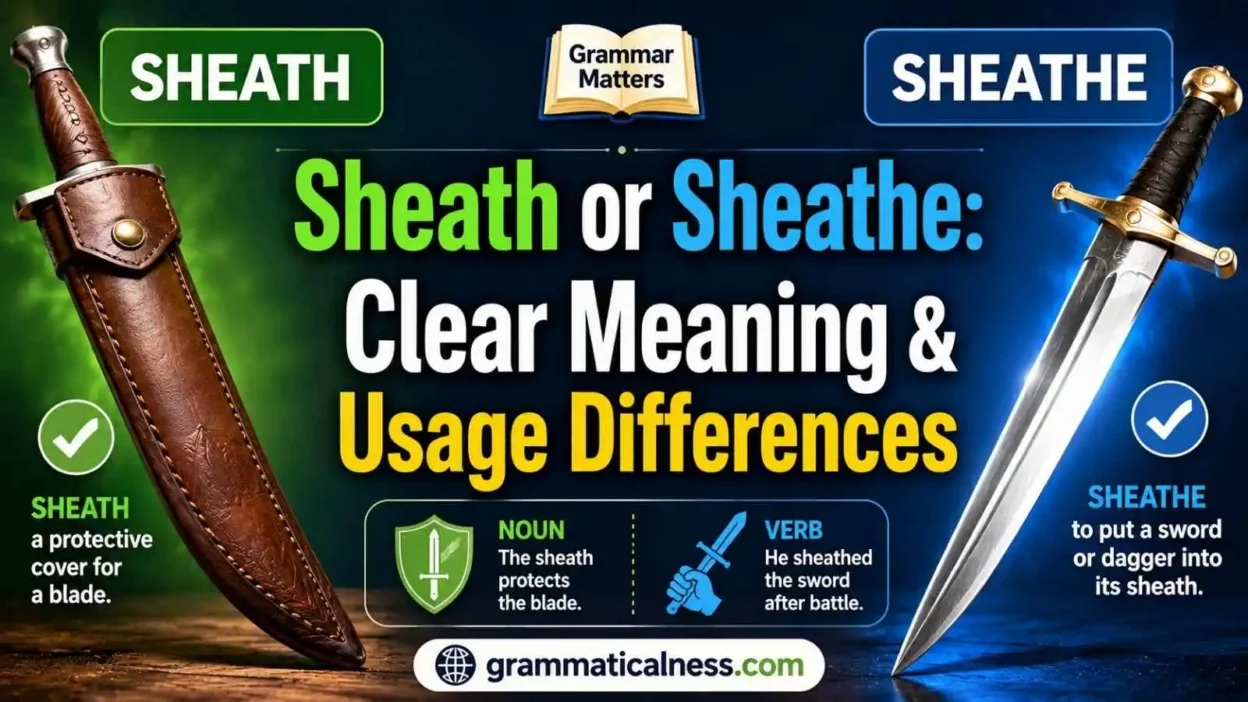
To put it simply, sheath is a noun, while sheathe is a verb.
In other words, sheath refers to the cover itself, and sheathe describes the action of putting something into that cover.
So, you either use a sheath, or you sheathe something.
Why People Confuse Them
Because the words share the same root idea of covering or protection, confusion happens naturally.
Additionally, both words appear in similar settings, such as weapons, tools, or protective layers. As a result, writers often assume they can be used interchangeably.
To make things trickier, the spelling difference is small, and the pronunciation sounds very close in spoken English.
Key Differences At A Glance
| Context | Best Choice | Why |
| Referring to a cover or case | Sheath | It names the object itself |
| Describing the action of covering | Sheathe | It expresses an action |
| Talking about tools or weapons | Sheath | It identifies the protective holder |
| Describing movement or usage | Sheathe | It shows what someone does |
Meaning and Usage Difference
Sheath refers to something that holds or covers an object. It is commonly used for knives, swords, cables, or protective layers.
On the other hand, sheathe refers to the act of placing something into a sheath or covering it.
Because of this relationship, the words often appear together, but they serve different grammatical roles.
Tone, Context, and Formality
In most cases, both words are neutral and acceptable in everyday and formal English.
However, sheath tends to appear in descriptive or technical contexts, especially when naming physical objects.
Meanwhile, sheathe is more action-driven and is frequently used in storytelling, instructions, or descriptive movement.
Which One Should You Use?
The correct choice depends on whether you need a noun or a verb.
If you are naming the object, choose sheath.
If you are describing an action, choose sheathe.
For example:
- He placed the knife in its sheath.
- She carefully sheathed the blade before leaving.
When One Choice Sounds Wrong
Sometimes, incorrect usage stands out immediately because it breaks natural grammar patterns.
For instance:
- ❌ He sheath the sword.
- ✔️ He sheathed the sword.
Similarly:
- ❌ The warrior pulled the sheathe from his belt.
- ✔️ The warrior pulled the sheath from his belt.
Because of this, identifying whether you need a noun or verb is essential.
Common Mistakes (and Quick Fixes)
One common mistake is using sheath as a verb. In such cases, simply switch to sheathe.
Another frequent error is treating sheathe as a noun, which should instead be replaced with sheath.
In addition, writers sometimes mix both forms in the same sentence without checking grammar structure, which leads to confusion.
Everyday Examples
- The chef placed the knife back into its sheath after cutting vegetables.
- After the training, the soldier sheathed his weapon carefully.
- The electrical wire has a protective plastic sheath around it.
- Before leaving the stage, the performer sheathed the prop sword.
- The hiking knife comes with a durable leather sheath for safety.
Dictionary-Style Word Details
Verb
- Sheath: Not commonly used as a verb in standard English.
- Sheathe: To place something into a protective cover or to enclose it.
Noun
- Sheath: A protective cover or case for a blade, cable, or similar object.
- Sheathe: Not used as a noun in standard English.
Synonyms
- Sheath: cover, case, holder (closest plain alternatives)
- Sheathe: cover, enclose, insert (closest plain alternatives)
Example Sentences
- Sheath: The dagger remained in its sheath during the ceremony.
- Sheathe: He sheathed his sword before stepping inside.
Word History
Both words come from the same idea of covering or protection. Over time, usage separated into two forms: one for the object and one for the action. However, detailed historical development varies across sources, and exact early distinctions are not always clearly documented.
Phrases Containing
- sheath knife
- protective sheath
- blade sheath
- sheathe a sword
- sheathe a weapon
FAQs
1. What is the main difference between sheath and sheathe?
Sheath is a noun meaning a cover or case.
Sheathe is a verb meaning to put something into a sheath or to cover it.
2. Is it “sheath a sword” or “sheathe a sword”?
Correct usage is “sheathe a sword.”
Because you are describing an action, you need the verb form.
3. Can “sheath” be used as a verb?
In standard modern English, sheath is not normally used as a verb.
The correct verb form is sheathe.
4. What does “sheathed” mean?
Sheathed is the past tense and past participle of sheathe.
It means something has already been placed into a cover.
Example:
- He sheathed the knife after use.
5. Is “sheath” ever used in plural form?
Yes. The plural is sheaths.
Example:
- The tools came with protective sheaths.
6. Are sheath and sheathe interchangeable?
No. They are closely related but not interchangeable:
- Sheath = thing (cover)
- Sheathe = action (to cover or insert)
7. Why do people confuse sheath and sheathe?
Because:
- They look almost identical
- They come from the same idea (covering something)
- They are often used in the same context (weapons, tools, cables)
8. What is a simple way to remember the difference?
Think:
- Sheath = object (noun)
- Sheathe = action (verb ending in “e” = do something)
If you want, I can also give you a quick memory trick or quiz to lock it in fast.
Conclusion
The difference between sheath and sheathe is simple once you lock in the roles: one names the cover, and the other describes the action of using it.
If you’re referring to the object, use sheath. If you’re describing what someone does with it, use sheathe. Getting this right makes your writing clearer and more natural.