
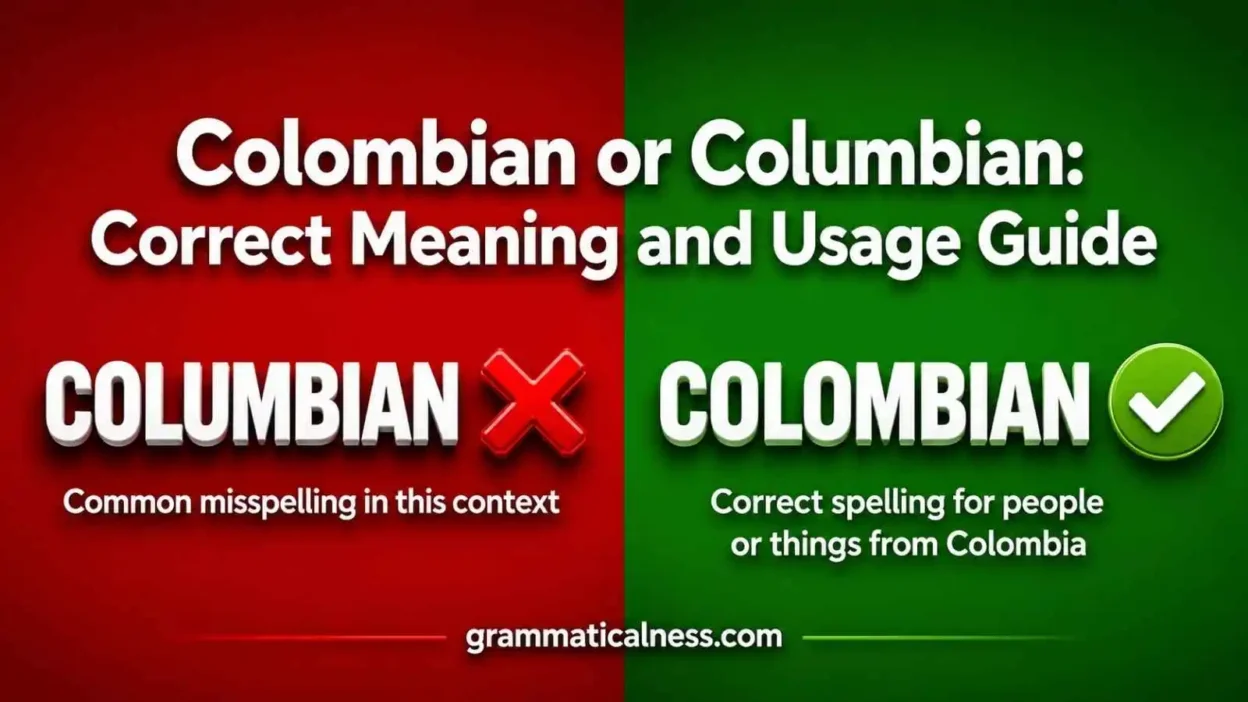
Colombian or Columbian is a common word-choice problem because the two words look and sound very similar. However, they do not mean the same thing.
Use Colombian when you mean Colombia, the South American country. Use Columbian when you mean Columbia, Christopher Columbus, or fixed terms such as pre-Columbian and British Columbian.
In everyday writing, the most common mistake is using Columbian when the correct word is Colombian. For example, coffee from Colombia is Colombian coffee, not Columbian coffee.
Quick Answer
Use Colombian for people, culture, food, products, places, or anything connected to Colombia.
Use Columbian only for things connected to Columbia, Christopher Columbus, or established terms such as British Columbian, pre-Columbian, and the Columbian Exchange.
Correct: Colombian coffee
Correct: pre-Columbian art
Why People Confuse Them
People confuse Colombian and Columbian because only one vowel changes. As a result, the words look almost identical at a glance.
Another reason is that Columbia appears often in American English. Readers may see it in names such as Columbia University, the District of Columbia, the Columbia River, and Columbia, South Carolina. Because of that familiarity, Columbian can look right even when the sentence is about Colombia.
Still, the difference matters. Colombia is the country. Therefore, people and things from that country are Colombian. Columbia is a different name used in places, institutions, and historical terms. So, when the reference is Columbia, the related form is usually Columbian.
Key Differences At A Glance
| Context | Best Choice | Why |
| A person from Colombia | Colombian | It describes nationality or origin from Colombia. |
| Coffee from Colombia | Colombian | The product comes from the country Colombia. |
| Food, music, culture, or Spanish from Colombia | Colombian | It refers to Colombia or Colombian people. |
| Columbia University | Columbian | It relates to the name Columbia, not Colombia. |
| British Columbia | Columbian | A person from British Columbia can be called British Columbian. |
| History before Columbus reached the Americas | pre-Columbian | This fixed term relates to Columbus. |
| Columbia River | Columbian | It refers to a Columbia-named place or region. |
| The South American country | Colombian | The correct country name is Colombia. |
Meaning and Usage Difference
Colombian means “from Colombia” or “related to Colombia.” It can describe a person, product, culture, city, business, accent, dish, team, artist, or event connected to the country.
Examples:
Colombian
She is a writer from Colombia.
We bought coffee beans grown in Colombia.
The festival featured music from Colombia.
By contrast, Columbian means “related to Columbia” or “related to Christopher Columbus.” It appears in place-based names, historical terms, and established phrases.
Examples:
Columbian
The class studied art from before Columbus’s arrival in the Americas.
He is a filmmaker from British Columbia.
The lecture explained the Columbian Exchange.
Although the words are close in spelling, they point to different things. Colombian points to Colombia. Meanwhile, Columbian points to Columbia or Columbus.
| Feature | Colombian | Columbian |
| Main reference | Colombia | Columbia or Columbus |
| Common role | Adjective and noun | Adjective and noun |
| Common use | Nationality, food, culture, travel | History, names, places, fixed terms |
| Common mistake | Often misspelled as Columbian | Often misused for Colombia |
Tone, Context, and Formality
This is not a formal-versus-informal choice. Instead, it is a meaning choice.
Colombian is correct in both casual and formal writing when the topic is Colombia. You can use it in news writing, school papers, travel content, restaurant menus, business profiles, and everyday conversation.
The restaurant serves food from Colombia.
A company from Colombia opened a US office.
Her family is Colombian American.
On the other hand, Columbian is correct when the topic is Columbia, Columbus, or a fixed historical phrase. It is not “fancier” than Colombian. It simply refers to something else.
The museum displayed pre-Columbian pottery.
She is an athlete from British Columbia.
The essay discussed the Columbian Exchange.
So, do not choose Columbian to sound more polished. Choose it only when the meaning actually calls for it.
Which One Should You Use?
Use Colombian when you are writing about:
Colombia
A Colombian person
Colombian coffee
Colombian food
Colombian Spanish
Colombian music
Colombian culture
A Colombian athlete
A Colombian company
A Colombian city, team, or festival
Use Columbian when you are writing about:
Columbia University
British Columbia
A British Columbian person
The Columbia River
Christopher Columbus
The Columbian Exchange
Pre-Columbian history
A place, title, group, or institution officially named Columbia
In short, the easiest rule is this: Colombia takes Colombian. Columbia takes Columbian.
When One Choice Sounds Wrong
Columbian sounds wrong when the meaning is clearly about Colombia.
Incorrect: We drank Columbian coffee.
Correct: We drank Colombian coffee.
Incorrect: She is a Columbian singer from Bogotá.
Correct: She is a Colombian singer from Bogotá.
Incorrect: The restaurant serves Columbian arepas.
Correct: The restaurant serves Colombian arepas.
However, Colombian sounds wrong when the phrase is tied to Columbia or Columbus.
Incorrect: She is a Colombian from Vancouver, British Columbia.
Correct: She is a British Columbian from Vancouver.
Incorrect: The class studied pre-Colombian history.
Correct: The class studied pre-Columbian history.
Incorrect: He works at Colombian University in New York.
Correct: He works at Columbia University in New York.
Because the two words are tied to different names, one letter can change the whole meaning.
Common Mistakes (and Quick Fixes)
A common mistake is using Columbian for coffee, food, or products from Colombia.
Wrong: Columbian coffee
Right: Colombian coffee
Another mistake is using Columbian as the nationality for someone from Colombia.
Wrong: My teacher is Columbian.
Right: My teacher is Colombian.
Writers also make the opposite mistake with historical terms. For instance, pre-Columbian should not become pre-Colombian.
Wrong: pre-Colombian art
Right: pre-Columbian art
The same pattern applies to the Columbian Exchange. Since that phrase refers to Columbus, the correct form is Columbian, not Colombian.
Wrong: the Colombian Exchange
Right: the Columbian Exchange
Finally, check the base name. If the base word is Colombia, use Colombian. If the base word is Columbia, use Columbian.
Everyday Examples
Colombian
My neighbor is from Colombia.
She speaks the Spanish used in Colombia with her family.
We tried empanadas from Colombia at a street fair.
The store sells coffee beans grown in Colombia.
A cyclist from Colombia won the race.
The documentary follows artists from Colombia.
Columbian
The exhibit included pottery from before Columbus’s arrival in the Americas.
He grew up in a coastal town in British Columbia.
The class discussed the Columbian Exchange.
The newspaper is called The Columbian.
The article mentioned the Columbia River region.
Columbia University is not spelled Colombia University.
Together, these examples show the main rule clearly. Colombian belongs with Colombia. Columbian belongs with Columbia or Columbus.
Dictionary-Style Word Details
Verb
Colombian: Not used as a verb in standard American English. You would not say “to Colombian” something.
Columbian: Not commonly used as a verb in standard American English. It is mainly used as an adjective or noun.
Noun
Colombian: A Colombian is a person from Colombia or a person of Colombian origin.
Example: She is a Colombian living in Miami.
Columbian: A Columbian can refer to a person connected with a place called Columbia, though this use depends on the specific place or name. The form is also seen in established labels such as British Columbian.
Example: He is a British Columbian from Victoria.
Synonyms
Colombian: Exact synonyms are limited because the word identifies a specific national origin. Closest plain alternatives include from Colombia, of Colombian origin, and related to Colombia.
Columbian: Exact synonyms are also limited because the word depends on the name Columbia or Columbus. Closest plain alternatives include related to Columbia, from British Columbia, or related to Columbus, depending on the sentence.
Clear antonyms do not work well for either word because both words identify origin or connection, not opposite qualities.
Example Sentences
Colombian
The chef prepared a dinner from Colombia for the event.
Her family owns a bakery with recipes from Colombia in Queens.
The article praised coffee growers from Colombia.
A student from Colombia joined our class this semester.
Columbian
The museum displayed pre-Columbian sculptures.
He grew up in a coastal town in British Columbia.
The class discussed the Columbian Exchange.
The book covered several historical references connected to Columbus-era history.
Word History
Colombian: The word comes from Colombia, the country name. In modern English, it is the standard word for people and things connected to Colombia.
Columbian: The word comes from Columbia, a name linked with Christopher Columbus and used in many place names, institutions, and historical terms.
Although both words have a broader historical connection to Columbus, modern usage separates them clearly. For current writing, the spelling should match the name you mean.
Phrases Containing
Colombian: Colombian coffee, Colombian food, Colombian Spanish, Colombian culture, Colombian music, Colombian citizen, Colombian American, Colombian flowers.
Columbian: pre-Columbian, British Columbian, Columbian Exchange, Columbian Exposition, Columbian Orator, Columbia River, Columbia-related.
FAQs
Is Colombian or Columbian correct?
Both words are correct, but they are not used in the same way. Use Colombian when you mean Colombia, the South American country, or anything connected to it. Use Columbian when you mean Columbia, Columbus, British Columbia, or fixed terms such as pre-Columbian.
Is it Colombian coffee or Columbian coffee?
The correct phrase is Colombian coffee. Coffee from Colombia should always use Colombian because it refers to the country Colombia. Although many people write “Columbian coffee” by mistake, that spelling does not match the country name.
What does Colombian mean?
Colombian means from Colombia or related to Colombia. It can describe people, food, music, culture, products, companies, cities, and traditions. For example, you can say Colombian food, Colombian Spanish, a Colombian singer, or a Colombian company.
What does Columbian mean?
Columbian means related to Columbia or Christopher Columbus. It appears in names and historical phrases, such as British Columbian, pre-Columbian art, and the Columbian Exchange. Therefore, it is a real word, but it is not the correct word for people or things from Colombia.
Why do people confuse Colombian and Columbian?
People confuse them because the spellings are almost identical. Also, Columbia appears in many familiar names, including Columbia University, the Columbia River, and the District of Columbia. Because of that, Columbian may look natural even when Colombian is correct.
Is a person from Colombia Colombian or Columbian?
A person from Colombia is Colombian. For example, you should write, “She is Colombian,” or “He is a Colombian artist.” Use Columbian only when the person is connected to a place or name that uses Columbia, such as British Columbian.
Conclusion
Use Colombian for Colombia and for people, culture, food, music, products, and places connected to that country.
Use Columbian for Columbia, Columbus, British Columbia, the Columbia River, and fixed historical terms such as pre-Columbian and the Columbian Exchange.
The rule is simple and reliable: Colombia means Colombian. Columbia means Columbian.
Both words are correct, but they are not used in the same way. Use Colombian when you mean Colombia, the South American country, or anything connected to it. Use Columbian when you mean Columbia, Columbus, British Columbia, or fixed terms such as pre-Columbian.
The correct phrase is Colombian coffee. Coffee from Colombia should always use Colombian because it refers to the country Colombia. Although many people write “Columbian coffee” by mistake, that spelling does not match the country name.
Colombian means from Colombia or related to Colombia. It can describe people, food, music, culture, products, companies, cities, and traditions. For example, you can say Colombian food, Colombian Spanish, a Colombian singer, or a Colombian company.
Columbian means related to Columbia or Christopher Columbus. It appears in names and historical phrases, such as British Columbian, pre-Columbian art, and the Columbian Exchange. Therefore, it is a real word, but it is not the correct word for people or things from Colombia.
People confuse them because the spellings are almost identical. Also, Columbia appears in many familiar names, including Columbia University, the Columbia River, and the District of Columbia. Because of that, Columbian may look natural even when Colombian is correct.
A person from Colombia is Colombian. For example, you should write, “She is Colombian,” or “He is a Colombian artist.” Use Columbian only when the person is connected to a place or name that uses Columbia, such as British Columbian.