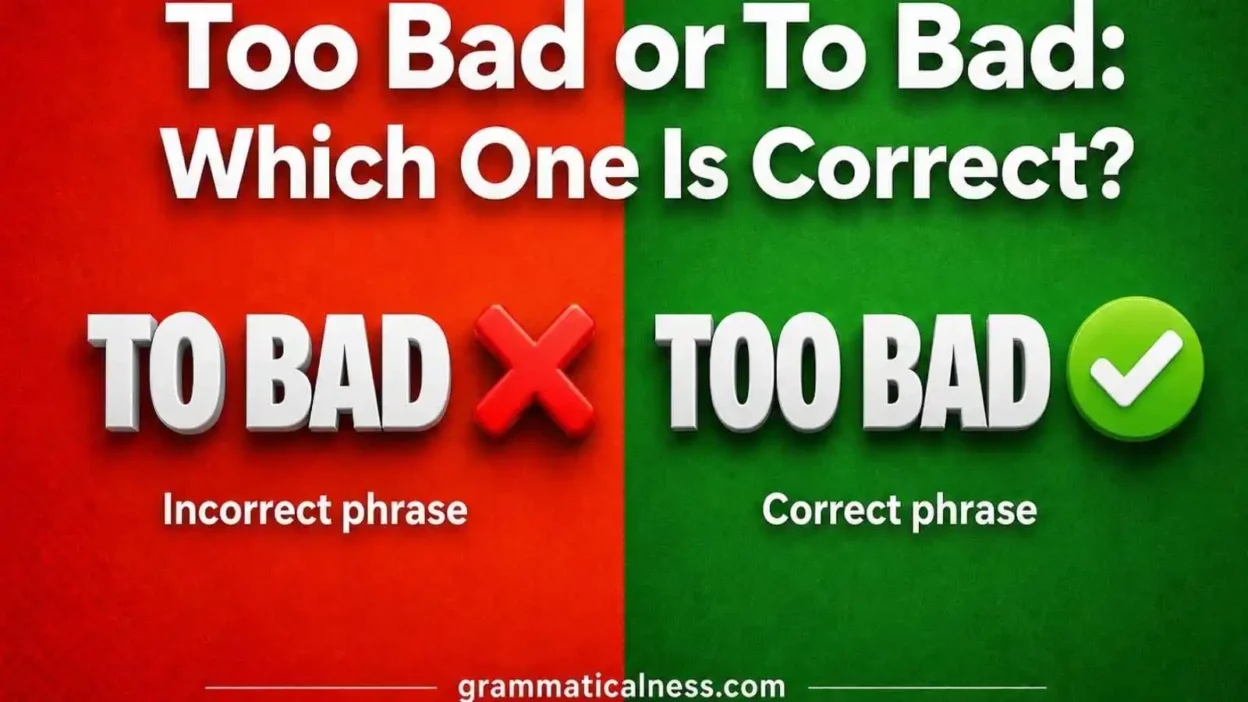
The correct choice is too bad when you mean “that’s unfortunate,” “that’s a shame,” or “more bad than expected.”
To bad is usually wrong in that meaning.
Use too bad in sentences like:
“That’s too bad.”
“Too bad you missed the sale.”
“It’s too bad the game was canceled.”
The phrase to bad can appear only in a different structure, such as “from good to bad.” In that sentence, to shows movement from one state to another. It is not the same phrase as too bad.
Quick Answer
Use too bad when you are reacting to something disappointing or unfortunate.
Correct: Too bad we missed the train.
Incorrect: To bad we missed the train.
Use to bad only when to belongs to a larger phrase:
Correct: The situation went from good to bad.
That is not the common expression too bad. It is a different sentence pattern.
Why People Confuse Them
People confuse too bad and to bad because to and too sound the same.
The difference is in meaning and grammar.
Too can mean “very,” “more than wanted,” or “also.” In too bad, it works with the adjective bad.
To often points toward a place, person, goal, or change. It does not normally sit before bad by itself in the expression “that’s too bad.”
So the mistake is easy to hear but easy to fix in writing.
If you also get confused by commonly mixed-up English phrases, check out our clear guide on “take effect” vs. “take affect” to avoid another frequent grammar mistake.
Key Differences At A Glance
| Context | Best Choice | Why |
| Reacting to bad news | too bad | It means “that’s unfortunate” or “I’m sorry to hear that.” |
| Saying something is worse than wanted | too bad | “Too” can intensify an adjective. |
| Showing a change in condition | to bad | It can work in a larger structure like “from good to bad.” |
| Writing a text or email reply | too bad | This is the standard phrase. |
| Saying you do not care | too bad | Tone can make it sound dismissive. |
| Writing “That’s ___” | too bad | “That’s to bad” is not standard. |
Meaning and Usage Difference
Too bad is the normal phrase. It can mean that something is sad, disappointing, or unfortunate.
Examples:
“Too bad the concert sold out.”
“It’s too bad she couldn’t join us.”
“That’s too bad. I hope tomorrow goes better.”
It can also mean something is worse than wanted:
“The damage was too bad to repair.”
In that sentence, too means the amount or degree is beyond what works.
To bad is not the right choice for those meanings. You would not write:
“To bad the concert sold out.”
“That’s to bad.”
“The damage was to bad to repair.”
Those sentences need too bad.
Still, to bad can be correct when to is part of another structure:
“The mood changed from good to bad.”
“The review went from fair to bad after the final section.”
Here, to does not mean “very.” It shows a move toward the condition bad.
Compact comparison:
- too bad: standard phrase for disappointment, sympathy, or excessive badness
- to bad: usually wrong unless to belongs to a larger phrase like “from good to bad”
- quick test: if you can mean “very bad,” “unfortunate,” or “that’s a shame,” choose too bad
Tone, Context, and Formality
Too bad is common in everyday US English. It works in texts, conversation, casual emails, and many workplace messages.
It can sound kind:
“That’s too bad. Let me know if I can help.”
It can sound neutral:
“Too bad the office is closed today.”
It can also sound cold or dismissive:
“Too bad. You had your chance.”
Tone matters. The words are the same, but the feeling changes with context.
For more formal writing, you may prefer unfortunately, regrettably, or it is unfortunate that. Those choices sound more polished in reports, letters, and serious notices.
Which One Should You Use?
Use too bad almost every time you are choosing between these two.
Choose too bad when you mean:
- that is unfortunate
- that is disappointing
- that is a shame
- more bad than acceptable
- so bad that something cannot happen
Choose to bad only when the sentence has a clear structure before it, usually a change or range:
“The weather turned from pleasant to bad.”
“Her luck went from bad to worse.”
Do not use to bad as a stand-alone phrase.
When One Choice Sounds Wrong
To bad sounds wrong when it tries to replace too bad.
Wrong: “To bad you can’t come.”
Right: “Too bad you can’t come.”
Wrong: “That’s to bad.”
Right: “That’s too bad.”
Wrong: “The leak was to bad to ignore.”
Right: “The leak was too bad to ignore.”
But to bad can sound right when to connects two states:
Right: “The day went from good to bad after lunch.”
In that sentence, the real phrase is from good to bad, not to bad by itself.
Common Mistakes (and Quick Fixes)
Mistake: “To bad I missed your call.”
Fix: “Too bad I missed your call.”
Mistake: “That’s to bad about your car.”
Fix: “That’s too bad about your car.”
Mistake: “The storm was to bad to drive through.”
Fix: “The storm was too bad to drive through.”
Mistake: “It went from good too bad.”
Fix: “It went from good to bad.”
That last one is the opposite problem. When you mean movement from one state to another, use to, not too.
Everyday Examples
“Too bad we already ordered dinner.”
“That’s too bad about your flight delay.”
“Too bad the tickets sold out so fast.”
“It’s too bad your phone broke right before the trip.”
“The Wi-Fi was too bad for a video call.”
“The traffic was too bad to make it on time.”
“The movie started strong, then went from good to bad.”
“My mood went from okay to bad after that meeting.”
“Too bad you missed the group photo.”
“That’s too bad, but we can try again next week.”
Dictionary-Style Word Details
Verb
• too bad: Not commonly used as a verb in standard US English. It is a phrase built from too and bad, often used as an idiom or adjective phrase.
• to bad: Not commonly used as a verb in standard US English. It is usually an error when someone means too bad.
Noun
• too bad: Not commonly used as a noun. In normal use, it works as a short phrase or expression.
• to bad: Not commonly used as a noun. It can appear only when to leads into the adjective bad in a larger sentence pattern.
Synonyms
• too bad: Closest plain alternatives include unfortunate, a shame, disappointing, and regrettable.
Useful opposites may include fortunate, good, or lucky, depending on the sentence.
• to bad: No true synonyms as a stand-alone phrase, because it is not the standard expression. In a phrase like from good to bad, the idea is a change toward a worse state.
Example Sentences
• too bad: “Too bad we missed the early showing.”
• too bad: “It’s too bad that the meeting was moved.”
• too bad: “The cut was too bad to fix with a small bandage.”
• to bad: “The situation went from good to bad in one afternoon.”
• to bad: “His attitude shifted from helpful to bad after the argument.”
Word History
• too bad: The phrase comes from ordinary English words: too, meaning an excessive degree or also, and bad, meaning not good. It is widely treated as an idiom in modern dictionaries.
• to bad: There is no separate standard word history for to bad as a fixed phrase. When it appears correctly, to is simply doing its normal job in a larger sentence structure.
Phrases Containing
• too bad: that’s too bad, it’s too bad, too bad for you, too bad to fix, too bad to ignore
• to bad: from good to bad, from fair to bad, go from okay to bad
FAQs
“Too bad” is the correct phrase in standard English. It can mean something is unfortunate, disappointing, or excessive in a negative way. “To bad” is usually incorrect because “to” does not express the meaning of excess or degree.
“Too bad” commonly means “unfortunate” or “what a pity.” For example, “It’s too bad you missed the concert” expresses disappointment about what happened. It can also describe something that is excessively bad, depending on the sentence.
“To” is mainly used as a preposition or as part of an infinitive, as in “to school” or “to learn.” In the phrase “too bad,” the word “too” is an adverb meaning “excessively” or adding emphasis. Therefore, “to bad” does not normally fit the intended grammar.
Yes, sometimes. The tone depends on the context and how it is said. Saying “That’s too bad” can show genuine sympathy. However, saying “Too bad!” after refusing someone’s request may sound dismissive, sarcastic, or unsympathetic.
Not always. “Too bad” usually uses the adjective “bad” to describe a situation or condition. “Too badly” uses the adverb “badly” to describe how an action happens, as in “The car was too badly damaged to repair.”
Remember that “too” can mean “more than necessary” or add emphasis. Since the phrase describes something as unfortunate or excessively bad, “too bad” is the correct spelling. Use “to” when showing direction or forming an infinitive, not in this expression.
Conclusion
Use too bad when you mean something is unfortunate, disappointing, or worse than acceptable.
Use to bad only when to belongs to a larger phrase, such as from good to bad.
The easiest rule is this: if the phrase could mean “that’s a shame” or “very bad,” write too bad.