

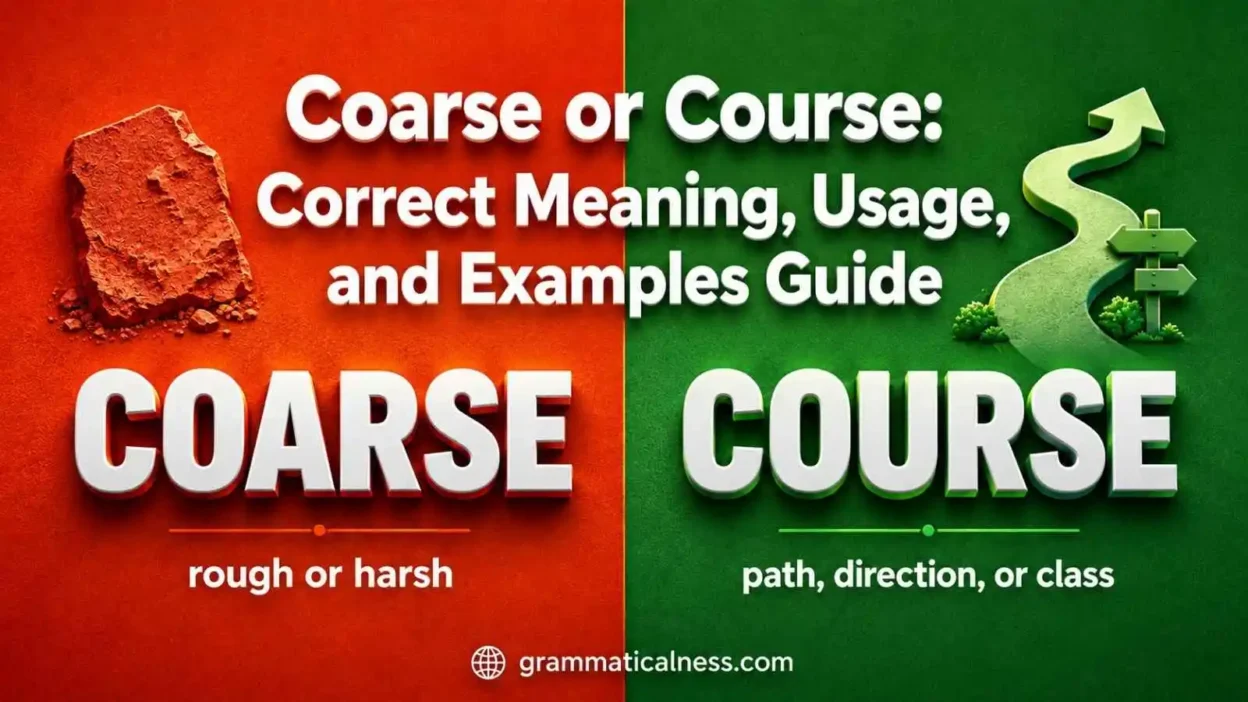
Coarse and course are both correct words, but they do not mean the same thing. Use coarse when you mean rough, not fine, rude, or lacking polish. Use course when you mean a class, path, route, meal part, process, or direction.
The confusion is easy to understand because the words sound the same. They also look similar, with only one letter making the visible difference. Still, that one letter changes the word’s role in a sentence.
A simple way to start is this: coarse describes a quality, while course usually names a thing, path, plan, or action.
Quick Answer
Use coarse as an adjective. It describes something rough, large-grained, harsh, rude, or not refined.
Use course mostly as a noun. It can mean a class, route, direction, part of a meal, plan, or process. It can also work as a verb meaning to move or flow quickly.
Correct examples:
The sweater felt coarse against my skin.
I signed up for a writing course.
We changed course after the storm warning.
Tears coursed down her face.
The phrase is of course, not of coarse, when you mean “certainly” or “yes.”
Why People Confuse Them
People confuse coarse and course because they are homophones. That means they sound alike but have different spellings and meanings.
In everyday speech, you cannot hear the spelling difference. When someone says “course,” it may sound like “coarse.” The meaning only becomes clear from context.
Writing is where the mistake shows up. A sentence like “I took a math coarse” looks wrong because a class is a course, not coarse. A sentence like “The towel was course” also looks wrong because a rough texture is coarse, not course.
The best fix is to ask what the word is doing. Is it describing a noun? Choose coarse. Is it naming a class, path, meal part, or process? Choose course.
Key Differences At A Glance
| Feature | coarse | course |
| Main role | Adjective | Noun; sometimes verb |
| Core meaning | Rough, rude, harsh, not fine | Class, path, route, process, meal part |
| Sound | Same as course | Same as coarse |
| Common phrase | coarse salt, coarse hair | of course, course of action |
| Example | coarse sand | online course |
The biggest difference is grammatical. Coarse describes something. Course usually names something.
That means coarse fits before nouns such as salt, sand, hair, cloth, language, and humor. Course fits with nouns and phrases about school, movement, meals, medicine, and decisions.
Meaning and Usage Difference
Coarse means rough in texture, made of larger particles, rude in speech, or lacking refinement. It often describes things you can touch, such as coarse fabric, coarse hair, or coarse sand. It can also describe behavior or language, as in coarse jokes or coarse manners.
Course has several common meanings. A course can mean different things depending on the context. In school, it refers to a class or series of lessons. For movement, it means a route or direction. During a meal, it describes one part of the meal, such as the main course. When talking about events, course can mean the way something develops over time.
The pronunciation is the same for both words: it sounds like kors, rhyming with force and horse. Because the sound does not help, meaning and sentence role matter most.
Tone, Context, and Formality
Coarse can sound neutral or negative, depending on context. In coarse salt or coarse sand, it simply means large-grained or rough. In coarse language, coarse humor, or coarse behavior, it sounds negative because it suggests rudeness or poor taste.
Course is usually neutral. A college course, training course, golf course, or course of treatment does not sound rude or informal. The phrase of course is common in both speech and writing. It can sound friendly, polite, obvious, or even impatient, depending on tone.
Neither word is mainly a US-versus-UK issue in this comparison. The important difference is meaning and grammar, not national style.
Which One Should You Use?
| Context | Best Choice | Why |
| Rough texture | coarse | It describes how something feels. |
| Large pieces or grains | coarse | It means not fine or not small. |
| Rude speech or humor | coarse | It describes language or behavior. |
| School class | course | It names a class or study unit. |
| Route or direction | course | It names a path or way forward. |
| Part of a meal | course | It names one serving stage. |
| Meaning “certainly” | of course | This is the standard phrase. |
| Flowing or moving quickly | course | It can work as a verb. |
Choose coarse when the word answers “What kind?” Choose course when the word names a thing, plan, route, class, or movement.
When One Choice Sounds Wrong
Coarse sounds wrong when you are talking about school or direction.
Wrong: I enrolled in a history coarse.
Right: I enrolled in a history course.
Wrong: The plane changed coarse.
Right: The plane changed course.
Course sounds wrong when you are describing roughness or rudeness.
Wrong: The beach had course sand.
Right: The beach had coarse sand.
Wrong: He made a course joke at dinner.
Right: He made a coarse joke at dinner.
The mistake often happens because both words sound the same. In writing, the sentence role reveals the right choice.
Common Mistakes (and Quick Fixes)
The most common mistake is writing of coarse when the intended meaning is of course.
Wrong: Of coarse, I can help.
Right: Of course, I can help.
Another common mistake is using course for texture.
Wrong: This sweater feels course.
Right: This sweater feels coarse.
Writers also sometimes use coarse for classes.
Wrong: She is taking a business coarse.
Right: She is taking a business course.
Quick fix: replace the word with a plain meaning. If rough works, use coarse. If class, route, plan, or stage works, use course.
Everyday Examples
The dog’s coarse coat picked up leaves from the yard.
Use coarse sea salt, not fine table salt, for the topping.
His coarse comment made the room uncomfortable.
The old towel felt coarse after years of washing.
I need one more science course to graduate.
The road course runs through the hills.
We served soup as the first course.
The doctor said the infection should run its course.
Of course, you can call me after work.
The river changed course after the heavy rain.
Dictionary-Style Word Details
Verb
coarse: Not commonly used as a verb in standard US English. In normal writing, use coarse as an adjective.
course: Can be used as a verb meaning to move, run, or flow quickly. This use is more descriptive than everyday.
Example: Rainwater coursed through the street after the storm.
Noun
coarse: Not commonly used as a noun in standard US English. It normally describes a noun.
Example: coarse sand, coarse cloth, coarse language
course: Commonly used as a noun. It can mean a class, route, direction, meal part, process, or plan.
Example: She signed up for a photography course.
Synonyms
coarse: Closest plain alternatives include rough, grainy, harsh, crude, rude, and vulgar, depending on context. Clear opposites include fine, smooth, soft, polite, and refined.
course: Closest plain alternatives include class, route, path, direction, plan, process, and stage, depending on context. A single exact antonym does not fit all meanings.
Example Sentences
The chef sprinkled coarse salt over the roasted potatoes.
The fabric felt too coarse for a baby blanket.
Please avoid using coarse language in the meeting.
I’m taking an online design course this summer.
Despite the wind, the boat stayed on course.
Dessert was the final course of the meal.
Word History
coarse: The history of coarse is connected to older forms of English, and some dictionary histories connect it with course. That connection does not make the modern words interchangeable.
course: The history of course is tied to ideas of running, movement, order, and direction. Modern English keeps those ideas in phrases such as course of action, watercourse, and run its course.
The safe takeaway is simple: history may explain why the words look and sound alike, but modern meaning decides the correct choice.
Phrases Containing
coarse: coarse salt, coarse sand, coarse hair, coarse fabric, coarse language, coarse humor, coarse-grained
course: of course, course of action, course of study, golf course, main course, three-course meal, run its course, stay on course, change course
FAQs
Is it coarse or course?
Both words are correct, but they mean different things. Use coarse when you mean rough, rude, harsh, or not fine. Use course when you mean a class, path, route, meal part, process, or direction. For example, write coarse sand but English course.
Is it “of course” or “of coarse”?
The correct phrase is of course. It means “certainly,” “yes,” or “naturally.” Of coarse is almost always wrong because coarse means rough or rude. Correct example: Of course, I can help you.
What does coarse mean?
Coarse is usually an adjective. It describes something rough, thick, grainy, rude, or lacking polish. You can say coarse salt, coarse hair, coarse fabric, or coarse language. In each case, the word describes a quality.
What does course mean?
Course is most often a noun. It can mean a class, a path, a route, part of a meal, or the way something develops. Examples include college course, golf course, main course, and course of action.
Are coarse and course pronounced the same?
Yes. Coarse and course are pronounced the same in standard English. They both sound like kors, rhyming with force. Because they sound alike, you need to choose the correct spelling based on meaning.
How can I remember the difference?
Use this simple trick: coarse describes rough things, while course points to a class, path, or plan. If you can replace the word with rough, choose coarse. If you mean class, route, or direction, choose course.
Conclusion
Coarse and course sound the same, but they serve different jobs. Use coarse when you describe something rough, large-grained, rude, or not refined. Use course when you mean a class, path, route, meal part, process, plan, or movement.
The easiest memory check is this: coarse describes; course names or moves.
Write coarse salt, coarse hair, and coarse language. Write online course, golf course, main course, course of action, and of course.
Both words are correct, but they mean different things. Use coarse when you mean rough, rude, harsh, or not fine. Use course when you mean a class, path, route, meal part, process, or direction. For example, write coarse sand but English course.
The correct phrase is of course. It means “certainly,” “yes,” or “naturally.” Of coarse is almost always wrong because coarse means rough or rude. Correct example: Of course, I can help you.
Coarse is usually an adjective. It describes something rough, thick, grainy, rude, or lacking polish. You can say coarse salt, coarse hair, coarse fabric, or coarse language. In each case, the word describes a quality.
Course is most often a noun. It can mean a class, a path, a route, part of a meal, or the way something develops. Examples include college course, golf course, main course, and course of action.
Yes. Coarse and course are pronounced the same in standard English. They both sound like kors, rhyming with force. Because they sound alike, you need to choose the correct spelling based on meaning.
Use this simple trick: coarse describes rough things, while course points to a class, path, or plan. If you can replace the word with rough, choose coarse. If you mean class, route, or direction, choose course.