


Optimize and optimise are two spellings of the same verb. They have the same meaning, follow the same grammar, and are pronounced the same way.
The choice depends mainly on the variety of English you are using. American English strongly favors optimize, while many British, Australian, and New Zealand writers use optimise.
However, the distinction is not completely absolute. Some British publishers follow a spelling system that also uses optimize. Your audience and required style should therefore guide the choice.
Quick Answer
Use optimize for an American audience. It is the standard spelling in US English.
Use optimise when following a British-style system that prefers -ise endings.
Both words mean to improve, adjust, or arrange something so that it works as effectively as possible. Neither spelling changes the meaning.
For most US writing:
We need to optimize the checkout process.
For British-style writing:
We need to optimise the checkout process.
Why People Confuse Them

The words are confusing because only one letter changes. They also sound exactly alike when spoken.
Writers may encounter optimize in American business documents, software instructions, and academic papers. Meanwhile, British websites and publications may use optimise in the same situations.
Automatic spelling settings can add to the confusion. A document set to US English may mark optimise as an error. The same document set to British English may accept it or suggest it instead.
Another complication is that British practice is not fully uniform. Although optimise is common, some British editorial systems prefer optimize. Therefore, the z spelling is not exclusively American.
Key Differences At A Glance
| Context | Best Choice | Why |
| US school or college writing | optimize | It follows standard American spelling. |
| US business communication | optimize | American readers expect the z form. |
| British publication using -ise endings | optimise | It matches that publication’s spelling system. |
| British publication using Oxford-style spelling | optimize | This system keeps the z in many such verbs. |
| Australian or New Zealand writing | Follow the required local style | The s form is common, but house rules should decide. |
| International organization | Follow its editorial guide | Consistency matters more than personal preference. |
| Quoted interface text or official name | Preserve the original spelling | Exact wording should not be silently changed. |
A compact comparison:
- optimize: Standard and expected in American English; also accepted in some British editorial styles.
- optimise: Common in British-style English that favors -ise endings.
- both: Verbs with the same meaning, pronunciation, tense pattern, and level of formality.
Meaning and Usage Difference
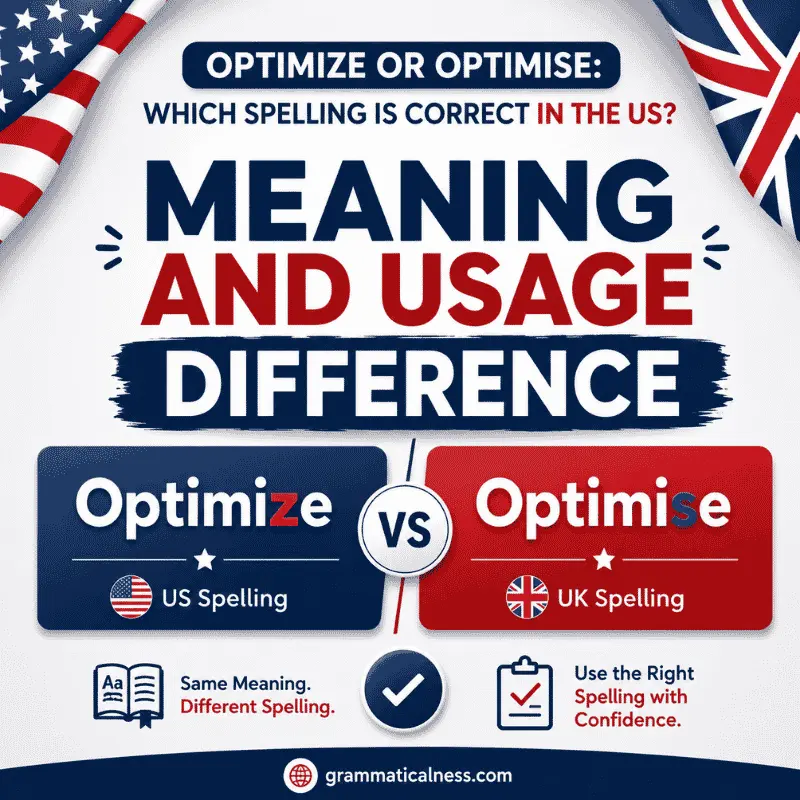
There is no difference in basic meaning.
Both verbs mean to make something as effective, efficient, useful, or suitable as possible. They often describe improvements to systems, schedules, resources, designs, performance, and processes.
For example:
- Engineers optimize or optimise a design to reduce waste.
- A manager may optimize or optimise a weekly schedule.
- A developer may optimize or optimise a page for faster loading.
- A family may optimize or optimise its monthly budget.
The words do not always mean “make perfect.” In real situations, improvement often involves limits and trade-offs. A company might optimize delivery speed without choosing the most expensive option.
Grammatically, both forms are normally transitive verbs, so they are usually followed by an object:
- optimize the process
- optimise energy use
- optimize performance
- optimise the schedule
They can also appear in passive constructions:
- The process was optimized for speed.
- The process was optimised for speed.
Tone, Context, and Formality
Both spellings have the same tone. They are neutral to somewhat formal and frequently appear in business, engineering, computing, mathematics, research, planning, and management.
In relaxed conversation, a simpler verb may sound more natural:
- Formal: We need to optimize the workflow.
- More casual: We need to improve how the work gets done.
The spelling itself signals regional style rather than greater formality. Optimise is not more sophisticated than optimize, and optimize is not more technical than optimise.
Pronunciation does not help readers choose between them because both end with the same “mize” sound. The distinction appears only in writing.
Which One Should You Use?
For a US audience, choose optimize.
That recommendation applies to American school assignments, workplace documents, articles, reports, instructions, and customer communication. The spelling optimise will usually be understood, but it can look imported or inconsistent in otherwise American writing.
For a British audience, check the expected style. Many organizations use optimise, but some follow the Oxford-style -ize convention and therefore use optimize.
When no style is specified, consider the surrounding spelling. A document that uses colour, centre, and organise will normally look more consistent with optimise. A document using color, center, and organize should use optimize.
Once you choose a system, keep all related forms consistent:
- optimize, optimized, optimizing
- optimise, optimised, optimising
The related noun should follow the same pattern as well.
When One Choice Sounds Wrong

Optimise may look wrong in US writing because the -ise ending does not match normal American practice.
For example:
Our US support team will optimise the new customer portal.
The sentence is understandable, but optimize is the expected American choice.
On the other hand, optimize may look out of place in a British document that consistently uses -ise forms:
The council will organise the project and optimize its resources.
Here, optimise would create a more consistent spelling pattern.
Still, the z form is not inherently incorrect in British English. It can be correct when the publication follows Oxford-style spelling.
A spelling may also seem inconsistent when the base verb and its related forms do not match:
We will optimize the system after the initial optimisation review.
Choose one spelling system unless an official title or quotation requires the other.
Common Mistakes (and Quick Fixes)
Mistake 1: Calling one spelling universally incorrect
Both spellings are standard. The difference concerns regional and editorial preference.
Quick fix: Identify the intended audience before choosing.
Mistake 2: Using optimise in ordinary US copy
American readers expect optimize.
Quick fix: Use the z spelling throughout US-focused material.
Mistake 3: Mixing related forms
A writer may use optimize in one paragraph and optimised in the next.
Quick fix: Match the endings across the entire word family.
Mistake 4: Assuming optimize means make flawless
Optimization usually means finding the best practical result under specific conditions.
Quick fix: State the goal clearly, such as speed, cost, quality, or reliability.
Mistake 5: Treating the two spellings as different actions
The spelling does not create a difference in meaning.
Quick fix: Choose according to language style, not according to the type of improvement.
Everyday Examples
American English
- We need to optimize the delivery route before Friday.
- Maya optimized her morning routine to save time.
- The company is optimizing its inventory system.
- This setting helps optimize battery life.
- Our coach adjusted the lineup to optimize the team’s defense.
- The clinic optimized its appointment schedule.
- Please optimize the image before adding it to the page.
- They want to optimize the office layout for hybrid work.
British-style English
- We need to optimise the delivery route before Friday.
- Maya optimised her morning routine to save time.
- The company is optimising its inventory system.
- This setting helps optimise battery life.
- Our coach adjusted the lineup to optimise the team’s defence.
- The clinic optimised its appointment schedule.
- Please optimise the image before adding it to the page.
- They want to optimise the office layout for hybrid work.
These pairs describe exactly the same actions. Only the regional spelling system changes.
Dictionary-Style Word Details
Verb
- optimize: A standard American English verb meaning to make something work as effectively, efficiently, or successfully as possible. Common forms are optimizes, optimized, and optimizing.
- optimise: The corresponding -ise spelling used in many forms of British-style English. Common forms are optimises, optimised, and optimising.
Both are usually transitive:
- We optimized the schedule.
- We optimised the schedule.
Noun
Neither optimize nor optimise is commonly used as a noun in standard English. They are verbs.
Their related nouns are optimization in American and Oxford-style spelling and optimisation in British-style writing that uses -ise endings.
- US: The optimization reduced loading time.
- British style: The optimisation reduced loading time.
Synonyms
Because the two spellings have the same meaning, they share the same closest plain alternatives:
- improve
- enhance
- refine
- make more efficient
- make better suited
- get the best use from
Maximize may fit when the goal is to reach the highest possible amount. However, it is not an exact replacement in every sentence because optimization may involve balancing several competing goals.
No single antonym fits every context. Closest opposites include:
- worsen
- impair
- reduce efficiency
- make less effective
Example Sentences
- optimize: The store changed its layout to optimize customer flow.
- optimise: The store changed its layout to optimise customer flow.
- optimize: We optimized the schedule around employee availability.
- optimise: We optimised the schedule around employee availability.
- optimize: The update should optimize performance on older phones.
- optimise: The update should optimise performance on older phones.
Each pair has the same meaning. The spelling changes only to match the selected English variety.
Word History
Both spellings belong to the same word family connected with optimum, which refers to the best or most favorable result under given conditions.
The endings -ize and -ise reflect different spelling traditions rather than different origins or meanings. American English consistently uses optimize. British English commonly uses optimise, although Oxford-style spelling retains optimize.
Therefore, the z spelling should not be treated as a recent invention or as exclusively valid in the United States.
Phrases Containing
Common phrases with optimize include:
- optimize performance
- optimize resources
- optimize for speed
- optimize energy use
- optimize the process
- optimize a schedule
- optimize the customer experience
- optimize battery life
The same phrases can use optimise in a matching British-style document:
- optimise performance
- optimise resources
- optimise for speed
- optimise energy use
- optimise the process
- optimise a schedule
- optimise the customer experience
- optimise battery life
FAQs
Is optimize or optimise correct?
Both spellings are correct. Optimize is the standard spelling in American English, while optimise is common in British English and other varieties that prefer -ise endings.
Which spelling should I use in the United States?
Use optimize in US English. It is the expected spelling in American schools, workplaces, publications, and professional documents.
Do optimize and optimise have different meanings?
No. Both verbs mean to improve or arrange something so that it works as effectively or efficiently as possible. The spelling difference does not change the meaning.
Is optimise considered wrong in American English?
It is not universally incorrect, but it is unusual in standard American writing. US readers normally expect optimize, so the s spelling may look inconsistent or foreign in an American document.
Can optimize be used in British English?
Yes. Although many British writers prefer optimise, some British publishers and organizations follow Oxford-style spelling, which uses optimize with a z.
How do you pronounce optimize and optimise?
Both words are pronounced the same way: OP-tuh-mize. The spelling difference is visible only in writing and does not affect pronunciation.
What are the other forms of optimize and optimise?
The American forms are optimizes, optimized, and optimizing. The British-style forms are optimises, optimised, and optimising. Keep the spelling pattern consistent throughout your document.
What is the noun form of optimize or optimise?
The related noun is optimization in American English. British-style writing that uses the s spelling normally uses optimisation. Neither optimize nor optimise is commonly used as a noun.
Conclusion
Both optimize and optimise are correct spellings of the same verb. They have identical meanings, grammatical roles, and pronunciations.
Use optimize for American English. Choose optimise when following a British-style system that prefers -ise endings. However, remember that some British publishers also accept or prefer optimize.
The safest approach is simple: identify your audience, follow the required editorial style, and keep the spelling consistent throughout the document.
Both spellings are correct. Optimize is the standard spelling in American English, while optimise is common in British English and other varieties that prefer -ise endings.
Use optimize in US English. It is the expected spelling in American schools, workplaces, publications, and professional documents.
No. Both verbs mean to improve or arrange something so that it works as effectively or efficiently as possible. The spelling difference does not change the meaning.
It is not universally incorrect, but it is unusual in standard American writing. US readers normally expect optimize, so the s spelling may look inconsistent or foreign in an American document.
Yes. Although many British writers prefer optimise, some British publishers and organizations follow Oxford-style spelling, which uses optimize with a z.
Both words are pronounced the same way: OP-tuh-mize. The spelling difference is visible only in writing and does not affect pronunciation.
The American forms are optimizes, optimized, and optimizing. The British-style forms are optimises, optimised, and optimising. Keep the spelling pattern consistent throughout your document.
The related noun is optimization in American English. British-style writing that uses the s spelling normally uses optimisation. Neither optimize nor optimise is commonly used as a noun.