
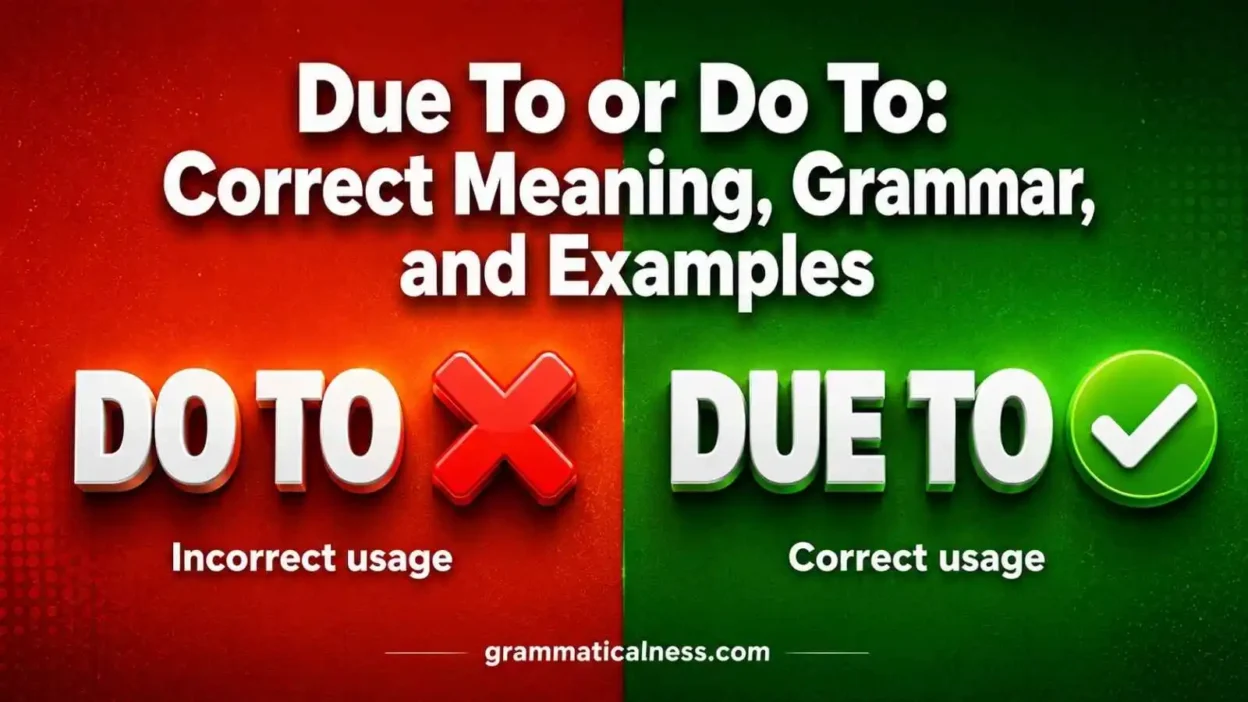
“Due to” and “do to” are easy to mix up because they sound almost the same in American English. On the page, however, they do very different jobs.
The phrase due to explains a cause or reason. By contrast, do to is only correct when do is the verb and to starts the next part of the sentence.
This difference matters in emails, school papers, reports, notices, and everyday messages. One phrase explains why something happened. The other describes an action someone performs or plans to perform.
Quick Answer
Use due to when you mean because of, caused by, or as a result of.
Correct:
The game was canceled due to heavy rain.
Do not use do to to mean because of.
Incorrect:
The game was canceled do to heavy rain.
However, do to can appear correctly when do is the main verb.
Correct:
What can we do to help?
For cause and reason, write due to. For action, use do to only when the sentence truly needs the verb do.
Why People Confuse Them
Many people confuse due to and do to because the phrases sound alike. In everyday American speech, due often sounds like “doo.”
That sound match makes the spelling easy to miss. A spell-checker may not always help because do and to are both real words.
The phrase due to the fact that also causes mistakes. When people hear it quickly, they may write do to the fact that, but that spelling is not correct.
Key Differences At A Glance
| Feature | due to | do to |
| Main role | Explains cause or reason | Uses do as a verb before to |
| Meaning | because of, caused by | perform an action in order to, or perform an action toward |
| Correct for cause? | Yes | No |
| Example | Closed due to snow | What can we do to help? |
| Common error | Usually used correctly for cause | Wrong when used for “because of” |
These phrases are not interchangeable. Due to explains cause, while do to belongs in action-based sentence patterns.
Meaning and Usage Difference
Due to means something happened because of something else. It is usually followed by a noun or noun phrase.
Examples:
The flight was delayed due to weather.
The store closed early due to a power outage.
Her success was partly due to years of practice.
In each sentence, due to points to the reason: weather, a power outage, or years of practice.
Do to does not mean because of. Instead, it is correct only when do is the main verb and to begins the next part of the sentence.
Examples:
What did you do to the settings?
We need to know what to do to fix the problem.
Tell me what I can do to make this easier.
Here, do means perform, take action, or cause something by action. The word to does not create a cause phrase.
Tone, Context, and Formality
Due to works in both everyday and formal writing. You can use it in school notices, office emails, reports, and short updates.
Examples:
Due to traffic, I’ll be ten minutes late.
The meeting was moved due to a scheduling conflict.
In casual speech, because of may sound more natural than due to.
Natural:
I was late because of traffic.
More formal:
I was late due to traffic.
The phrase do to has no formal use as a cause phrase. It should appear only when the sentence needs the verb do.
Which One Should You Use?
| Context | Best Choice | Why |
| Explaining a cause | due to | It means because of or caused by |
| Giving a reason for a delay | due to | It points to why something happened |
| Asking about an action | do to | The verb do is part of the question |
| Describing what someone can perform | do to | It shows action, not cause |
| Writing “due to the fact that” | due to | Do to the fact that is incorrect |
| Casual writing | because of or due to | Because of may sound more natural |
| Formal notice | due to | It is clear and standard |
For most cause-and-effect sentences, due to is the correct choice. When the sentence is about what someone can do, did do, or should do, do to may be correct.
When One Choice Sounds Wrong
Choose due to when the phrase answers why?
The picnic was postponed due to rain.
Why was it postponed? Rain.
The report was late due to a printer issue.
Why was it late? A printer issue.
Choose do to when the sentence asks or explains what action?
What can we do to solve this?
That means, “What action can we take?”
What did you do to the laptop?
The question asks about an action someone took.
A simple test can help. Replace the phrase with because of. If because of fits, use due to.
The delay happened due to traffic.
The delay happened because of traffic.
Now compare that with this sentence:
What can we do to help?
You cannot say, “What can we because of help?” Since that makes no sense, do to is the right pattern there.
Common Mistakes (and Quick Fixes)
Here are the most common errors people make with due to and do to.
Incorrect:
The office is closed do to maintenance.
Correct:
The office is closed due to maintenance.
Another common error:
We missed the deadline do to a file issue.
Better version:
We missed the deadline due to a file issue.
Watch this one too:
She stayed home do to the flu.
Corrected sentence:
She stayed home due to the flu.
Sometimes the error goes the other way:
Incorrect:
What can we due to help?
Correct:
What can we do to help?
One more example:
Incorrect:
I don’t know what he due to the account.
Correct:
I don’t know what he did to the account.
The biggest fix is to read the sentence for meaning. If you mean cause, write due to. If you mean action, use do, did, or done as the verb the sentence needs.
Everyday Examples
Here are natural examples of due to:
The concert was canceled due to lightning.
I’m running late due to traffic on I-95.
The app crashed due to a server problem.
Our delivery is delayed due to high demand.
The school trip was moved indoors due to rain.
Now compare those with correct uses of do to:
What should we do to prepare for the meeting?
Tell me what you did to your phone screen.
I’ll do what I can to help.
There is nothing more we can do to speed this up.
Show me what you want me to do to fix it.
Avoid these incorrect cause phrases:
The concert was canceled do to lightning.
I’m running late do to traffic.
The app crashed do to a server problem.
Our delivery is delayed do to high demand.
Dictionary-Style Word Details
Verb
• due to: Not commonly used as a verb in standard US English. The phrase due to works as a cause phrase, not as an action word.
• do to: Do is a verb. In do to, the word to begins the next part of the sentence. Example: “What can we do to help?”
Noun
• due to: The phrase due to is not commonly used as a noun. The word due can appear in noun uses such as dues, meaning payments or obligations, but that is separate from the phrase due to.
• do to: Do to is not a noun phrase. The word do can be a noun in special uses, such as the musical note do, but that does not help with this word-choice issue.
Synonyms
• due to: Closest plain alternatives include because of, caused by, as a result of, owing to, and on account of. These are not always identical in tone, but they often fit cause-and-reason sentences.
• do to: There is no true synonym for do to as a cause phrase because it does not mean because of. In action sentences, alternatives depend on the meaning. Words such as perform, fix, help, change, or affect may fit.
Clear antonyms do not work well for either phrase in this comparison. It is better to choose the correct structure than to look for an opposite.
Example Sentences
• Due to: The road was closed due to flooding.
• Her promotion was due to strong performance and steady leadership.
• Because of a family emergency, I need to reschedule.
• Do to: What can I do to make this right?
• Tell me what you did to the document.
• We need a plan for what to do to reduce costs.
Word History
• due to: The phrase comes from due, a word connected with what is owed, expected, proper, or caused by something. In modern writing, due to is widely used to explain cause.
• do to: This is not a single cause phrase. It comes from the normal verb do followed by to in the next part of a sentence.
The histories do not make the phrases interchangeable. In actual writing, meaning decides the correct choice.
Phrases Containing
• due to: due to rain, due to illness, due to traffic, due to lack of funding, due to the fact that, due to circumstances beyond our control.
• do to: do to help, do to fix it, do to improve results, what did you do to it, nothing we can do to change it.
Notice the pattern. Due to points to a reason. Do to points to an action.
FAQs
Use due to when you mean because of or caused by.
Correct:
The delay was due to traffic.
Do not use do to for a cause or reason.
Incorrect:
The delay was do to traffic.
Due to means because of, caused by, or as a result of.
Examples:
The store closed early due to bad weather.
The flight was delayed due to a mechanical issue.
Her success was due to hard work.
Yes, you can start a sentence with due to when it clearly explains the reason for the main idea.
Correct:
Due to heavy rain, the game was postponed.
For casual writing, because of may sound more natural.
Natural:
Because of heavy rain, the game was postponed.
Do is an action verb. It does not mean because of. That is why do to traffic, do to illness, and do to weather are wrong.
Correct:
We were late due to traffic.
Incorrect:
We were late do to traffic.
Use this simple test: replace the phrase with because of.
If because of works, use due to.
Example:
The event was canceled due to snow.
The event was canceled because of snow.
If because of does not work, the sentence probably needs the verb do.
Example:
What can we do to fix this?
“What can we because of fix this?” does not work.
Conclusion
The correct choice depends on meaning.
Use due to when you mean because of or caused by. This phrase explains the reason something happened.
Use do to only when do is the verb and to begins the next part of the sentence.
Correct:
The delay was due to traffic.
Also correct:
What can we do to help?
Incorrect:
The delay was do to traffic.
Once you ask whether the sentence is about a cause or an action, the answer becomes clear.