
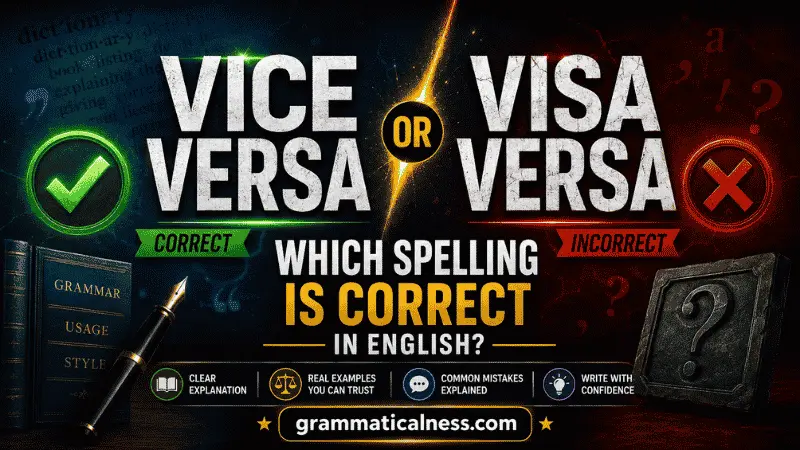
The choice between vice versa or visa versa has one clear answer: vice versa is the correct expression. Visa versa is a common misspelling, not an accepted alternative.
The confusion usually begins in speech. One recognized pronunciation of vice versa adds a light vowel sound after vice, so the phrase may sound like “vice-uh versa.” Some listeners then write the familiar-looking word visa. However, pronunciation does not change the established spelling.
Use vice versa when a statement remains true after its main people, things, directions, or relationships are reversed. Avoid the phrase when the reversed statement would be false or unclear.
Quick Answer
Vice versa is correct. Visa versa is incorrect in standard American English.
Vice versa is an adverbial phrase meaning “the other way around,” “with the relationship reversed,” or “in the opposite order.” For example, “Parents learn from children, and vice versa” means children also learn from parents.
Write the expression as two words. Do not replace vice with visa, join the words, or add a hyphen.
Why People Confuse Them
People often confuse the spellings because vice versa does not always sound exactly as a reader expects. Common pronunciations can sound like “vice VER-suh” or “vice-uh VER-suh.” The second version may lead someone to hear visa as the first word.
The familiar word visa also looks natural on the page. Still, it refers to travel authorization in its ordinary use and does not belong in this expression.
This mistake shows why spelling a borrowed phrase only by sound can be risky. The spoken form may vary slightly, while the written form stays fixed.
Key Differences At A Glance
- Correctness: Vice versa is standard; visa versa is a misspelling.
- Meaning: Vice versa expresses a reversed order or relationship; visa versa has no standard meaning as a phrase.
- Grammar: Vice versa functions adverbially; visa versa has no accepted grammatical role in this use.
- Writing form: Use two separate words without a hyphen.
- Pronunciation: More than one pronunciation is recognized, but every standard pronunciation keeps the spelling vice versa.
Meaning and Usage Difference
Vice versa tells the reader to reverse the key parts of the statement. In “The phone can send files to the laptop and vice versa,” the phrase means the laptop can also send files to the phone.
The expression does not always mean a simple opposite. It usually means that the same relationship, action, or order also works in reverse. That distinction matters. “All squares are rectangles, but not vice versa” means that not all rectangles are squares.
Visa versa does not carry a separate meaning. It is merely an incorrect written form of vice versa. Therefore, the two forms are not interchangeable choices.
Grammatically, vice versa works as an adverb or adverbial phrase. It modifies the previous idea by telling the reader to reverse its arrangement.
Tone, Context, and Formality
Vice versa is standard in formal and informal English. It appears naturally in school assignments, workplace messages, reports, articles, and conversation.
Its Latin origin does not make it overly formal. Ordinary writing does not require italics or quotation marks.
The phrase can sound concise and polished when the reversed meaning is obvious. When the sentence contains several people, actions, or conditions, spelling out the reverse statement may be clearer.
Visa versa looks careless in edited writing. Informal context does not make the spelling standard, although readers may still understand the intended meaning.
Punctuation depends on sentence structure. A comma often appears before “and vice versa” when the phrase closes a statement, but no rule requires a comma before every use.
Which One Should You Use?
| Context | Best Choice | Why |
| School or academic writing | vice versa | It is the established spelling. |
| Business email or report | vice versa | It is correct and widely understood. |
| Casual text message | vice versa | Informality does not change the spelling. |
| Reversing two clear items | vice versa | It avoids repeating the full statement. |
| A reversal that may confuse readers | Rewrite fully | Clear wording is better than a vague shortcut. |
| Any use of visa versa | Correct it | The form is a misspelling. |
Choose vice versa whenever the reversed relationship is both true and easy to identify. If the reader might not know which elements should switch places, write the second statement in full.
When One Choice Sounds Wrong
Visa versa sounds plausible because it resembles one pronunciation of the correct phrase, but it is wrong in standard writing.
Even vice versa can sound wrong when the logic does not reverse cleanly. Consider this sentence:
“Maria gave Noah a birthday card, and vice versa.”
This wording says Noah also gave Maria a birthday card. Use it only when that happened.
Now consider:
“Maria gave Noah a blue birthday card, and vice versa.”
The reverse may be unclear. Did Noah give Maria a blue card, or did every detail change? A complete second clause would remove the uncertainty.
Common Mistakes (and Quick Fixes)
Mistake: Writing visa versa.
Fix: Replace it with vice versa.
Mistake: Writing vice-versa.
Fix: Use two words without a hyphen.
Mistake: Writing viceversa.
Fix: Insert a space: vice versa.
Mistake: Italicizing the phrase only because it came from Latin.
Fix: Use regular type in ordinary English sentences.
Mistake: Using the phrase when only one direction is true.
Fix: Check the reversed statement before keeping vice versa.
Mistake: Assuming a comma is always required.
Fix: Punctuate according to the full sentence and use a comma when it improves structure or clarity.
Everyday Examples
- The desktop version syncs with the mobile app, and vice versa.
- Good managers listen to employees, and vice versa.
- You can move the meeting from Tuesday to Thursday or vice versa.
- The blue cable connects to the left port, not vice versa.
- The phone can connect to the laptop, and vice versa.
- The store accepts online returns in person, but not vice versa.
- My sister recommends books to me, and vice versa.
- Change the rows into columns and vice versa.
In each correct example, the reader can identify what reverses. None requires the misspelling visa versa.
Dictionary-Style Word Details
Verb
- Vice versa: Not commonly used as a verb in standard American English. It functions adverbially.
- Visa versa: Not a standard verb. In this comparison, it is an incorrect spelling.
Noun
- Vice versa: Not normally used as a noun when it means “the other way around.”
- Visa versa: Not a standard noun or accepted name for the expression.
Synonyms
- Vice versa: Closest plain alternatives include the other way around, in reverse, in the opposite order, and conversely. The best substitute depends on the sentence.
- Visa versa: It has no synonyms in this use because it is not a standard expression.
A single exact antonym does not fit every use. In many sentences, “in the stated order only” or “not the other way around” expresses the contrasting idea more clearly.
Example Sentences
- Vice versa: “The new software can import the old files, and vice versa.”
- Vice versa: “The main office can contact the branch directly, and vice versa.”
- Visa versa: “The new software can import the old files, and visa versa.” This spelling is incorrect.
- Visa versa: “The offices can share records, and visa versa.” Replace it with vice versa.
Word History
- Vice versa: English adopted the expression from Latin. Its parts relate to a change of position or order, which matches its current meaning of a reversed relationship.
- Visa versa: This form has no separate standard history as an English expression. It is best understood as a sound-based misspelling of vice versa.
Phrases Containing
- Vice versa: Common patterns include and vice versa, or vice versa, and not vice versa.
- Visa versa: No standard English phrases use this spelling. Correct any such occurrence to vice versa.
FAQs
Vice versa is correct in standard American English. Visa versa is a misspelling and should not appear in edited writing. The correct phrase means that a statement also works with the people, things, or order reversed.
People often write visa versa because one accepted pronunciation adds a light vowel sound after vice. That pronunciation can sound like “visa” in quick speech. The sound may explain the mistake, but it does not change the spelling.
Yes, vice versa works in formal, academic, business, and everyday writing. It is established in English and normally needs neither italics nor quotation marks. Use it only when the reversed relationship is clear and logically true.
Not always. Punctuation depends on the sentence structure and the pause needed for clarity. A comma often appears before “and vice versa” at the end of a sentence, but the phrase does not require one in every construction.
Vice versa is written as two separate words. Do not write it as viceversa, vice-versa, or visa versa in standard English. The familiar two-word form is the safest choice in school, workplace, and published writing.
Use it only when readers can identify exactly what changes places or direction. If the reversed statement becomes false, unclear, or absurd, rewrite the sentence. Stating both directions fully is often better than forcing vice versa into a vague claim.
Conclusion
Use vice versa, not visa versa. The correct two-word phrase means that an action, order, or relationship also works in reverse.
Remember that pronunciation can include a light extra vowel sound, but spelling does not change. Before using the phrase, reverse the main parts of your sentence mentally.
If the new statement remains true and clear, vice versa is the right choice. If it becomes confusing, write the full reverse statement instead.