The choice between its or it’s causes trouble because the two forms look almost identical. They sound the same, and only one apostrophe separates them. However, that small mark changes the grammar completely.
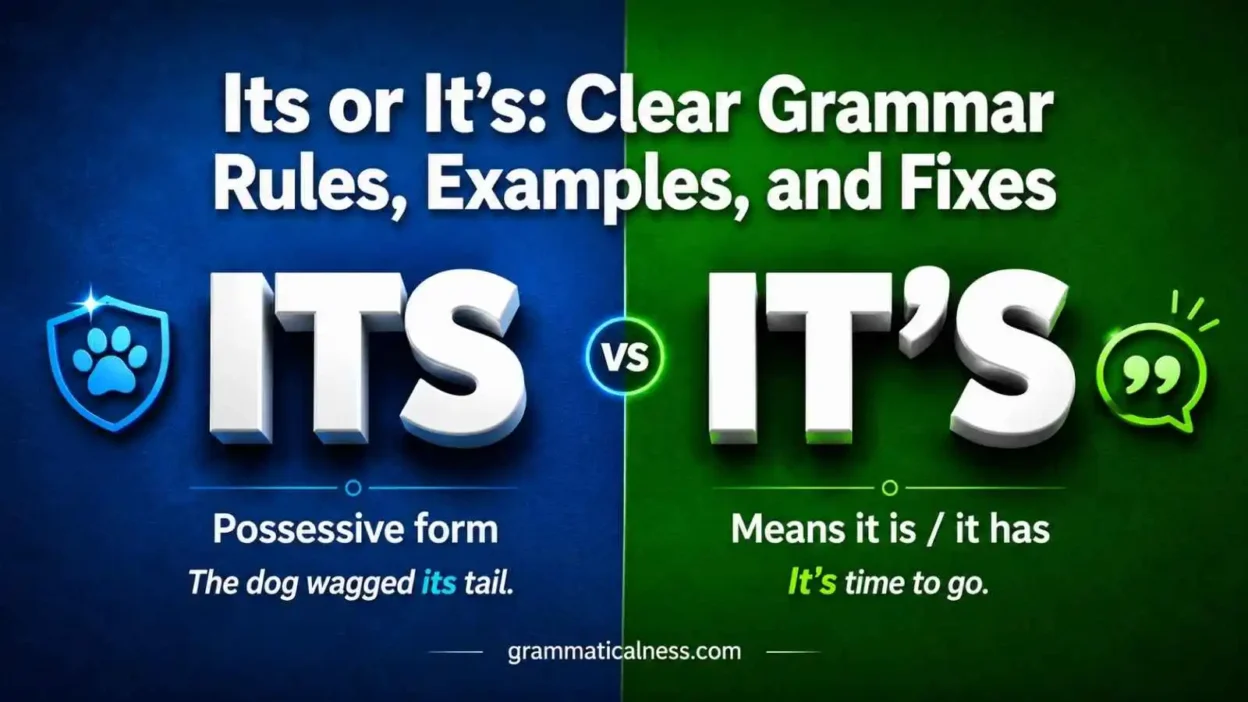
Use its when you mean “belonging to it.” Use it’s when you mean “it is” or “it has.” In other words, its shows possession, while it’s is a shortened form of two words.
This mistake is common because apostrophes often show ownership in English. For example, “the dog’s leash” means the leash belongs to the dog. However, it’s does not work that way. The apostrophe in it’s marks missing letters, not ownership.
Quick Answer
Its is the possessive form. It means something belongs to, relates to, or is part of “it.”
It’s is a contraction. It means it is or it has.
For example, write: The phone lost its signal.
Also write: It’s losing signal again.
A simple test helps every time. Replace the word with it is or it has. If the sentence still makes sense, choose it’s. If it sounds wrong, choose its.
Why People Confuse Them
Writers often confuse these words because apostrophes usually feel connected to possession. You see forms like “Sarah’s car,” “the company’s logo,” and “the teacher’s desk.” Therefore, “it’s collar” may look correct at first.
However, standard English uses its without an apostrophe for possession. This form works more like his, her, and their. None of those words needs an apostrophe to show ownership.
By contrast, it’s is a contraction. The apostrophe shows that letters have been removed. For instance, it’s raining means it is raining. Similarly, it’s been busy means it has been busy.
Because both forms sound the same, pronunciation will not help much. Instead, you need to check the meaning of the sentence.
Key Differences At A Glance
| Feature | its | it’s |
| Main use | Shows possession or connection | Short form of “it is” or “it has” |
| Apostrophe | No apostrophe | Has an apostrophe |
| Grammar role | Possessive form | Contraction |
| Simple test | Means “belonging to it” | Means “it is” or “it has” |
| Example | The cat cleaned its paws. | It’s getting late. |
In short, its points to ownership or connection. Meanwhile, it’s replaces two words.
Meaning and Usage Difference
Its shows that something belongs to or relates to a thing, animal, place, group, or idea already mentioned.
For example: The restaurant changed its menu.
Here, the menu belongs to or is connected with the restaurant.
It’s means it is or it has.
For example: It’s open until 9 p.m.
This means: It is open until 9 p.m.
Another example is: It’s been a long week.
In that sentence, the meaning is: It has been a long week.
Although the words sound alike, their jobs are different. Its works as a possessive form. On the other hand, it’s works as a contraction.
Tone, Context, and Formality
Its is neutral. You can use it in texts, school essays, business emails, product descriptions, reports, and everyday writing.
It’s is also standard. However, because it is a contraction, it often sounds more conversational. That makes it natural in emails, blog posts, captions, dialogue, and casual explanations.
In very formal writing, the full form may sound stronger. For example, it is may feel more polished than it’s in legal, academic, or official writing. Still, it’s is not wrong when the contraction fits the tone.
Compare these sentences:
Casual: It’s important to update the file today.
More formal: It is important to update the file today.
Notice that this tone difference applies only to it’s. The possessive form its does not have a more formal version.
Which One Should You Use?
Use this table when you are unsure.
| Context | Best Choice | Why |
| Something belongs to a thing | its | Shows possession |
| Something is true right now | it’s | Means “it is” |
| Something has happened | it’s | Means “it has” |
| Before “own” | its | “Its own” shows possession |
| Before a noun like “color” or “price” | its | The noun belongs to something |
| Before an adjective like “ready” | it’s | Means “it is ready” |
| Before “been” | it’s | Means “it has been” |
| In very formal writing | it is / it has | The full form may sound more polished |
When in doubt, expand the contraction. If it is or it has fits, use it’s. Otherwise, use its.
When One Choice Sounds Wrong
It’s sounds wrong when the sentence needs possession.
Wrong: The laptop lost it’s charger.
Correct: The laptop lost its charger.
The charger belongs to or is connected with the laptop. As a result, the possessive form is needed. “The laptop lost it is charger” does not make sense.
Its sounds wrong when the sentence needs a subject and verb.
Wrong: Its getting cold outside.
Correct: It’s getting cold outside.
Here, the meaning is “it is getting cold.” Therefore, the contraction it’s is correct.
A helpful clue is the word that comes next. If the next word is a noun, its may be the right choice. If the next word is an adjective, “been,” or an -ing verb, it’s often fits better.
Common Mistakes (and Quick Fixes)
Mistake: Its been a while.
Better: It’s been a while.
Reason: The meaning is “it has been.”
Mistake: The store changed it’s hours.
Better: The store changed its hours.
Reason: The hours belong to the store.
Mistake: Its not fair.
Better: It’s not fair.
Reason: The meaning is “it is not fair.”
Mistake: The dog chased it’s tail.
Better: The dog chased its tail.
Reason: The tail belongs to the dog.
Mistake: The app closed after it’s update.
Better: The app closed after its update.
Reason: The update belongs to or relates to the app.
To fix the mistake quickly, expand it’s into it is or it has. If the full phrase does not fit, remove the apostrophe.
Everyday Examples
The team celebrated its first win of the season.
Meanwhile, it’s the team’s first win of the season.
The car made a strange noise after its oil change.
Later, it’s making that same noise again.
The puppy found its toy under the couch.
Luckily, it’s still in good condition.
The company updated its privacy policy.
Also, it’s posted a summary for customers.
The museum is known for its modern design.
Because of that, it’s popular with architecture fans.
The phone needs its battery replaced.
Unfortunately, it’s been acting up all morning.
These examples show the pattern clearly. Its usually connects to a noun, while it’s usually begins a statement that could use it is or it has.
Dictionary-Style Word Details
Verb
Its: This form is not used as a verb in standard US English. Instead, it works as a possessive form connected to the pronoun it.
It’s: This form is not a verb by itself. However, it contains a verb inside the contraction because it means it is or it has.
For example, it’s ready means it is ready.
Similarly, it’s changed means it has changed.
Noun
Its: This form is not commonly used as a noun. In normal writing, it appears before a noun to show possession or connection.
Example: The bird spread its wings.
It’s: This form is not a noun either. Instead, it is a contraction made from a pronoun and a verb.
Example: It’s too late to call.
Synonyms
Its: There is no exact one-word synonym that works in every sentence. The closest plain alternatives are belonging to it, of it, and its own.
Example: The machine reached its limit.
Plain alternative: The machine reached its own limit.
It’s: The closest plain alternatives are it is and it has.
Example: It’s raining.
Plain alternative: It is raining.
Example: It’s been helpful.
Plain alternative: It has been helpful.
Clear antonyms do not really fit this pair. After all, these are grammar forms, not opposite meanings.
Example Sentences
Its: The school changed its schedule for Friday.
Its: The coffee shop is famous for its cold brew.
Its: The phone case lost its grip after a few months.
Its: The bird returned to its nest.
It’s: It’s almost time for dinner.
It’s: It’s been a busy morning.
It’s: It’s hard to read that small print.
It’s: It’s going to rain after lunch.
Although the sentence pairs look similar, the meaning decides the correct form.
Word History
Its: This form developed as the possessive form of it. Today, it is the standard choice for possession in modern US English.
It’s: This form developed as a contraction. The apostrophe marks missing letters from it is or it has.
Older writing may not always match today’s standard rule. However, modern readers expect its for possession and it’s for the contraction.
Phrases Containing
Its: Common phrases include its own, on its own, at its best, in its place, lose its way, and reach its limit.
Example: The puppy sleeps on its own now.
Another example: The city is beautiful at its best in spring.
It’s: Common phrases include it’s okay, it’s time, it’s been, it’s possible, it’s clear, and it’s going to.
Example: It’s time to leave.
Another example: It’s been a long day.
FAQs
Both forms are correct, but they mean different things. Its shows possession, as in “The dog wagged its tail.” It’s means it is or it has, as in “It’s raining” or “It’s been a long day.”
Use its when something belongs to or relates to a thing, animal, place, idea, or group. For example, “The company changed its logo” is correct because the logo belongs to the company.
Use it’s when you can replace it with it is or it has. For example, “It’s cold outside” means “It is cold outside.” Also, “It’s been helpful” means “It has been helpful.”
No, it’s is not the possessive form in standard English. Even though it has an apostrophe, it means it is or it has. For possession, use its without an apostrophe.
Its own is correct. The phrase shows possession, so it needs its without an apostrophe. For example, “The puppy sleeps in its own bed” is correct.
It’s been is correct because it means it has been. For example, “It’s been a busy week” means “It has been a busy week.” The form its been is incorrect.
Its does not have an apostrophe because it works like other possessive words such as his, her, and their. These words already show possession without using an apostrophe.
No, its and it’s are pronounced the same. Because they sound alike, you cannot rely on pronunciation. Instead, check the meaning of the sentence.
Conclusion
The difference between its and it’s is simple once you test the sentence. If you can replace the word with it is or it has, choose it’s. If that replacement sounds wrong, choose its.
Use its for possession: The dog wagged its tail.
Use it’s for a contraction: It’s happy.
The apostrophe may look like an ownership mark, but in it’s, it marks missing letters. Therefore, the best shortcut is this: it’s always means it is or it has. For possession, the correct choice is always its.