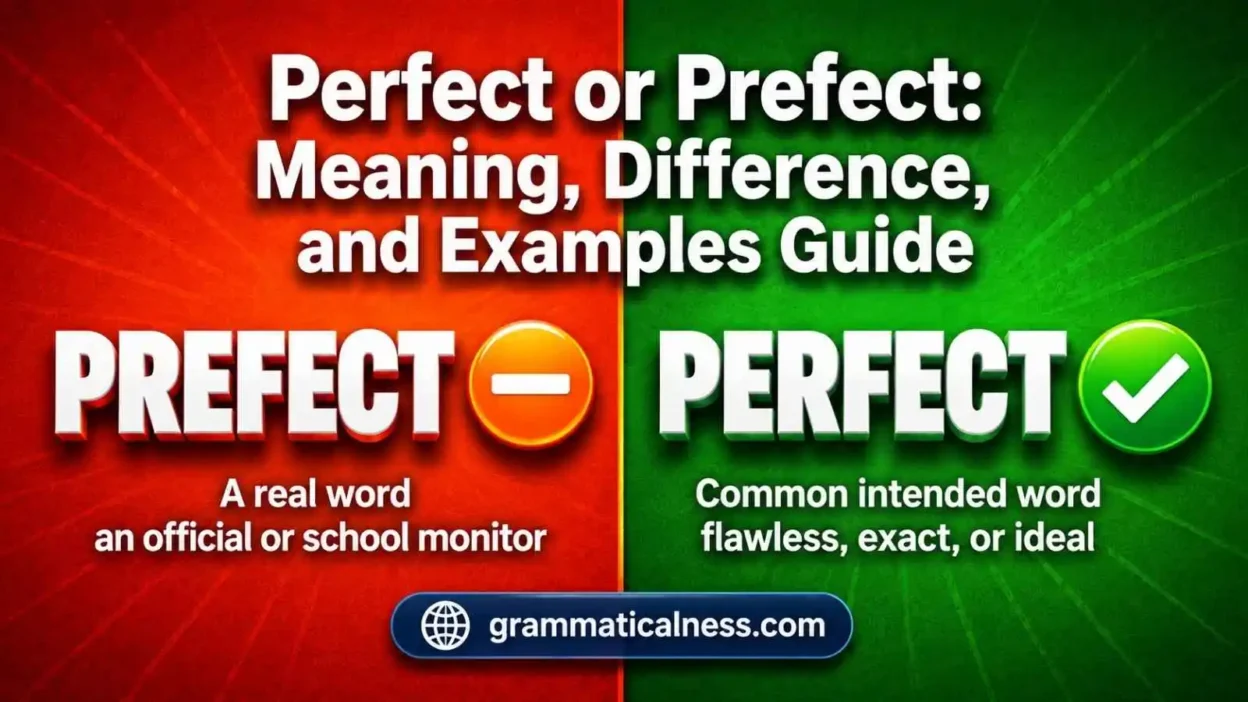
Perfect or prefect is confusing because the words look almost the same. They are both real words, but they do not mean the same thing.
Use perfect when you mean flawless, ideal, complete, or exactly right for a situation.
Use prefect when you mean a person with authority, often a student leader in some schools or an official in some government systems.
The correct choice depends on meaning, not just spelling.
Quick Answer
Perfect is usually the correct word when you are describing a thing, person, plan, score, day, fit, timing, or result.
Prefect is correct only when you are naming a role or title for a person in charge of something.
Write:
The weather is perfect for a picnic.
Write:
She was chosen as a school prefect.
Do not use prefect when you simply mean “very good.” Do not use perfect when you mean a student leader or official.
Why People Confuse Them
The words differ by only one letter. That makes the mistake easy to miss.
They also sound somewhat alike at a glance, especially when someone reads quickly. But they have different meanings and different jobs in a sentence.
Perfect is common in everyday US English. You might use it in texts, work emails, reviews, school papers, and casual speech.
Prefect is much less common in US English. Many Americans mainly see it in books, schools outside the US, government contexts, or titles from other countries.
Key Differences At A Glance
Compact comparison:
• perfect = describes something flawless, complete, ideal, or exactly right
• prefect = names a person with authority or a special leadership role
• perfect can be an adjective, verb, or grammar noun
• prefect is normally a noun
• perfect is common in US everyday writing
• prefect is more specific and less common in US everyday writing
Meaning and Usage Difference
Perfect means free from fault, as good as possible, complete, or exactly suitable.
Examples:
The apartment is perfect for two people.
Her answer was perfect.
We need to perfect the design before launch.
In grammar, the perfect can also refer to a verb form, as in the present perfect.
Prefect means a person who has authority or responsibility. In school contexts, a prefect may be an older student chosen to help with duties or discipline. In some countries, a prefect can also be a public official.
Examples:
The prefect helped organize the assembly.
The regional prefect spoke at the meeting.
Pronunciation can help. As an adjective, perfect is usually said like PER-fikt. As a verb, it is often said like per-FEKT. Prefect is usually said like PREE-fekt.
Tone, Context, and Formality
Perfect is neutral and very common. It works in casual and formal writing.
You can say:
That time works perfectly.
Your draft is not perfect yet, but it is strong.
This is a perfect example of clear planning.
Prefect sounds more formal or role-specific in US English. It is not a normal replacement for “leader,” “manager,” “monitor,” or “official” unless that title is truly being used.
In a US school, words like “class president,” “student leader,” or “hall monitor” may be more familiar. Still, prefect is correct when the school or setting uses that title.
Which One Should You Use?
| Context | Best Choice | Why |
| Describing something flawless | perfect | It means without faults or defects. |
| Saying something is exactly right | perfect | It fits the situation well. |
| Talking about improving a skill | perfect | As a verb, it means to make better or complete. |
| Naming a student with school duties | prefect | It names a leadership role. |
| Naming an official in some countries | prefect | It can be an official title. |
| Writing a normal US text or email | perfect | Most everyday uses need this word. |
Most of the time, you probably want perfect. Use prefect only when the sentence is about a person’s role or title.
When One Choice Sounds Wrong
Prefect sounds wrong when you are describing quality.
Wrong: This pizza is prefect.
Correct: This pizza is perfect.
Wrong: Your timing was prefect.
Correct: Your timing was perfect.
Perfect sounds wrong when you mean a title.
Wrong: The school perfect checked the attendance list.
Correct: The school prefect checked the attendance list.
Wrong: The perfect of the region issued a notice.
Correct: The prefect of the region issued a notice.
Common Mistakes (and Quick Fixes)
Mistake 1: Using prefect for “excellent.”
Wrong: That dress looks prefect.
Fix: That dress looks perfect.
Mistake 2: Using perfect for a school role.
Wrong: He became a perfect in his final year.
Fix: He became a prefect in his final year.
Mistake 3: Forgetting that perfect can be a verb.
Correct: The team worked all week to perfect the routine.
Mistake 4: Treating prefect as a general compliment.
Wrong: You are so prefect.
Fix: You are so perfect.
Everyday Examples
The coffee was perfect this morning.
That blue shirt is perfect for the interview.
No plan is perfect, but this one is practical.
She wants to perfect her public speaking before the contest.
The coach helped him perfect his jump shot.
The school prefect welcomed new students at the door.
A senior prefect helped younger students find their classrooms.
The prefect met with local officials after the storm.
That is the perfect time to call.
He is a prefect, not just a volunteer helper.
Dictionary-Style Word Details
Verb
• perfect: Commonly used as a verb meaning to make something better, complete, or as good as possible. Example: She practiced every day to perfect her routine.
• prefect: Not commonly used as a verb in standard US English. Use it as a noun.
Noun
• perfect: Used as a noun mainly in grammar, as in “the perfect” or “the present perfect.” It can also appear in set expressions, such as “the perfect is the enemy of the good.”
• prefect: A noun meaning a person with authority, such as a student leader in some schools or an official in certain government systems.
Synonyms
• perfect: Closest plain alternatives include flawless, ideal, complete, exact, polished, and faultless. Helpful opposites include imperfect, flawed, incomplete, and faulty.
• prefect: Closest plain alternatives depend on context. For a school role, student leader or monitor may fit. For an official role, administrator or official may fit. Exact synonyms are limited because prefect is often a specific title.
Example Sentences
• perfect: The room was quiet, bright, and perfect for studying.
• perfect: We need one more rehearsal to perfect the opening scene.
• perfect: The present perfect uses “have” or “has” with a past participle.
• prefect: The prefect reminded everyone where to line up.
• prefect: She served as head prefect during her final year.
• prefect: The prefect attended the public safety meeting.
Word History
• perfect: The older meaning is tied to completion and being fully made or finished. That sense still helps explain why perfect can mean complete, flawless, or brought to a high standard.
• prefect: The older meaning is tied to being placed in charge. That idea still fits the modern meaning of a person who holds authority or responsibility.
The history helps, but you do not need it to choose the right word. The daily rule is simple: quality takes perfect; a role or title takes prefect.
Phrases Containing
• perfect: practice makes perfect, perfect timing, perfect fit, perfect score, picture-perfect, present perfect, past perfect.
• prefect: school prefect, head prefect, senior prefect, prefect of police, regional prefect.
FAQs
Is it perfect or prefect?
Use perfect when you mean flawless, ideal, complete, or exactly right. Use prefect when you mean a person with authority, such as a student leader or official.
Is prefect a spelling mistake?
No. Prefect is a real word, but it has a different meaning from perfect. The mistake happens when someone writes prefect but means perfect.
What does perfect mean?
Perfect means without faults, exactly right, complete, or ideal for a situation.
Example:
That dress is perfect for the wedding.
What does prefect mean?
Prefect means a person with authority or responsibility. It often refers to a student leader in some schools or an official in certain government systems.
Example:
The school prefect helped younger students find their classrooms.
Which word is more common in US English?
Perfect is much more common in everyday US English. Prefect is correct, but it is used only in specific role or title contexts.
Can perfect be a verb?
Yes. Perfect can be a verb meaning to improve something until it is as good as possible.
Example:
She practiced every day to perfect her speech.
Can prefect be an adjective?
No, prefect is normally a noun. It names a person or position, not a quality.
What is the easiest way to remember the difference?
Use perfect for quality. Use prefect for a person in charge.
Perfect = excellent or exactly right.
Prefect = leader or official.
Conclusion
Choose perfect when you mean flawless, ideal, complete, or exactly right.
Choose prefect when you mean a person with authority, such as a student leader or official.
Most everyday US sentences need perfect. Use prefect only when the sentence clearly names a role or title.