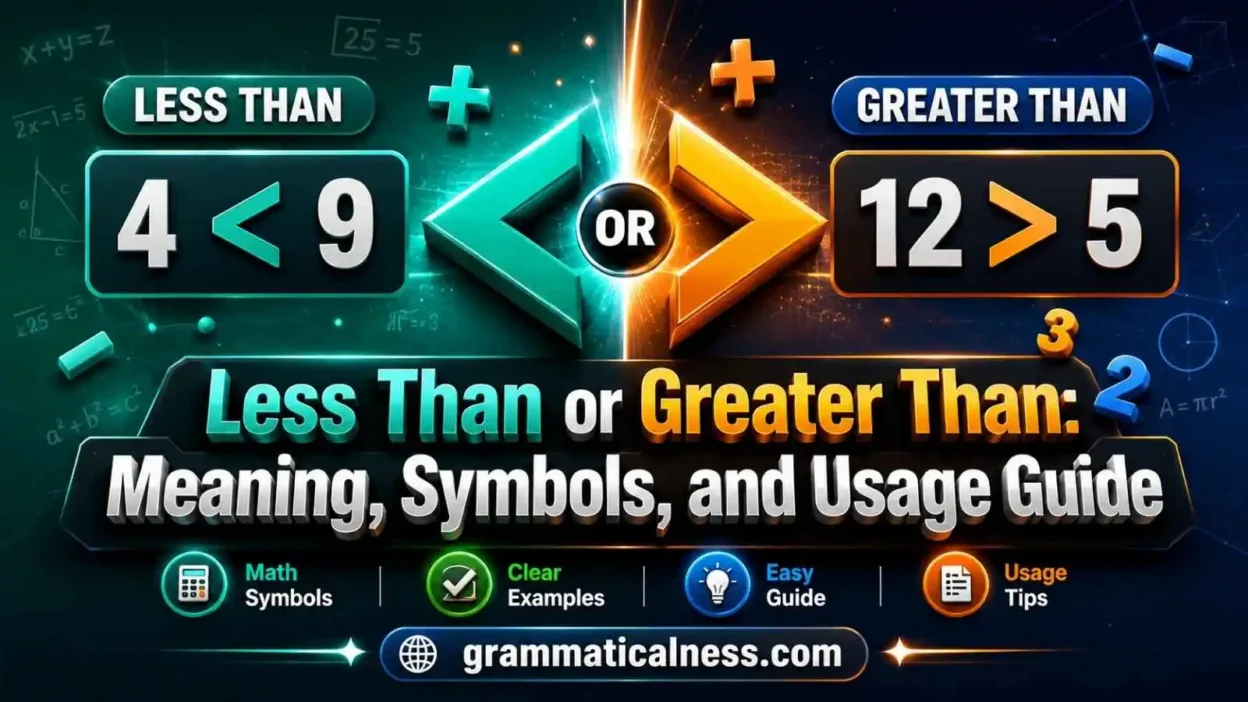
Both less than and greater than are correct, but they express opposite comparisons. Use less than when the first value is smaller. Use greater than when the first value is larger.
The symbols follow the same rule. The less-than sign is <, while the greater-than sign is >. In either symbol, the narrow point faces the smaller value, and the open side faces the larger value.
These phrases also appear outside math. You may compare prices, ages, temperatures, distances, percentages, time, or performance. The correct choice always depends on which value is lower and which is higher.
Quick Answer
Use less than for a smaller number, amount, degree, or value: 6 is less than 10, written 6 < 10.
Use greater than for a larger number, amount, degree, or value: 10 is greater than 6, written 10 > 6.
The symbols exclude equality. When the stated value may also be equal, use less than or equal to or greater than or equal to.
Why People Confuse Them
The symbols look almost identical because one is the reverse of the other. Readers may remember the shape but forget which direction it should face.
Sentence order adds another challenge. The same relationship can be written in two correct ways:
3 < 8 means “3 is less than 8.”
8 > 3 means “8 is greater than 3.”
Both statements describe the same comparison from opposite directions. The reliable method is to identify the smaller value first. The narrow point must face it.
People also confuse mathematical wording with ordinary conversation. A report may say “a value greater than 50,” while a casual sentence usually says “more than 50 people.” The meaning overlaps, but the most natural wording can depend on context.
Key Differences At A Glance
- Less than: shows that the first value is smaller; its symbol is <.
- Greater than: shows that the first value is larger; its symbol is >.
- Both phrases: create a strict comparison, so the two values are not equal.
- Symbol reminder: the point faces the smaller value, and the open side faces the larger value.
Meaning and Usage Difference
Less than means lower, smaller, or not as much as the comparison point. It works with exact numbers, measured amounts, and degrees.
Examples include less than $40, less than five miles, and less than expected.
Greater than means higher, larger, or more than the comparison point. It often appears in math, data, instructions, limits, and technical descriptions.
Examples include greater than 90 degrees, greater than zero, and a score greater than 80.
Grammatically, both expressions work as comparative phrases. They connect one value or quality to a second value introduced by than. Neither expression normally acts as a standalone verb.
A useful distinction appears with countable items. In polished everyday prose, fewer than 20 customers often sounds more natural than less than 20 customers. Likewise, more than 20 customers usually sounds more natural than greater than 20 customers. However, less than remains natural with measurements, money, time, distance, percentages, and totals treated as single amounts.
For a clear math refresher, Khan Academy’s comparison symbols review explains how <, >, and = show whether one number is less than, greater than, or equal to another.
Tone, Context, and Formality
In mathematics, science, finance, data reporting, and formal instructions, both phrases sound neutral and precise. A requirement such as “The pressure must remain greater than 30 psi” clearly states a measurable limit.
In everyday conversation, less than remains common: “The drive took less than an hour.” It can also describe degree: “The service was less than ideal.”
Greater than often sounds more technical when it appears before a number in ordinary prose. A person will usually say “more than 100 guests attended,” not “greater than 100 guests attended.” The second version is understandable, but it sounds like a report or calculation.
Neither phrase is automatically more formal than the other. Their tone depends mainly on the sentence. Mathematical comparisons sound precise, while idiomatic phrases such as less than thrilled sound conversational.
Which One Should You Use?
| Context | Best Choice | Why |
| The first number is smaller | less than | It shows a lower value: 4 < 7 |
| The first number is larger | greater than | It shows a higher value: 7 > 4 |
| Equality is possible | less than or equal to / greater than or equal to | The symbols < and > alone exclude equality |
| A measured amount is below a limit | less than | Natural with time, money, distance, and percentages |
| A measured value is above a limit | greater than | Clear and precise in math, reports, and requirements |
| Individual countable items in everyday prose | fewer than / more than | These choices usually sound more natural with people or separate objects |
Start with the value on the left. Ask whether it is smaller or larger than the value on the right. Then choose the phrase that states that relationship directly.
When One Choice Sounds Wrong
Less than sounds wrong when the first value is actually larger. For example, “12 is less than 7” gives a false comparison.
Greater than sounds wrong when the first value is smaller. “4 is greater than 9” reverses the real relationship.
Either phrase is incomplete when equality must be allowed. A rule that accepts scores of 80 and above should not say “greater than 80,” because that wording excludes 80. It should say “greater than or equal to 80.”
Some ordinary sentences also sound unnatural even when readers can understand them. “Greater than 30 employees attended” is stiff. “More than 30 employees attended” is smoother. Similarly, “less than 10 chairs remained” is common in speech, but “fewer than 10 chairs remained” is often preferred in edited prose.
Finally, the idiomatic use of less than does not create a matching use for greater than. “The result was less than perfect” is natural. “The result was greater than perfect” usually sounds exaggerated or logically unclear unless the writer has defined a special scale.
Common Mistakes (and Quick Fixes)
A common mistake is choosing the sign by its open side without checking both values. Fix it by finding the smaller value first; the point must face that value.
Another mistake is reading the symbol from right to left while keeping the original phrase. For 2 < 6, read from left to right as “2 is less than 6.” When you reverse the order, change the phrase too: “6 is greater than 2.”
Writers also forget that < and > exclude equality. Add the horizontal line only when the boundary value counts: ≤ means less than or equal to, and ≥ means greater than or equal to.
In nontechnical writing, avoid forcing mathematical phrasing onto countable nouns. Replace “greater than 50 applicants” with “more than 50 applicants” when a natural sentence matters more than a formal data label.
Do not assume negative numbers change the basic rule. On a number line, the value farther left is smaller. Therefore, −8 < −3, and −3 > −8.
Everyday Examples
The jacket costs less than $75.
Today’s high will be greater than 90°F.
The commute takes less than 30 minutes.
The account balance must remain greater than zero.
Her phone battery dropped to less than 15 percent.
The package weighs greater than five pounds, so the higher shipping rate applies.
The child is less than 48 inches tall.
The final score was greater than the team’s season average.
The store had fewer than 20 copies left, which sounds more natural than “less than 20 copies” in careful prose.
More than 200 residents attended, which sounds more natural than “greater than 200 residents” in everyday writing.
Dictionary-Style Word Details
Verb
Less than: Not commonly used as a verb in standard US English. It functions as a comparative phrase, as in “Five is less than nine.”
Greater than: Not commonly used as a verb in standard US English. It functions as a comparative phrase, as in “Nine is greater than five.”
Noun
Less than: Not commonly used as a standalone noun. In mathematics, the phrase can name a relation, and less-than sign is a noun phrase referring to <.
Greater than: Not commonly used as a standalone noun. In mathematics, the phrase can name a relation, and greater-than sign is a noun phrase referring to >.
Synonyms
Less than: Closest plain alternatives include below, under, and lower than. With individual countable items, fewer than may be the better choice.
Greater than: Closest plain alternatives include above, over, higher than, and more than. The best alternative depends on whether the sentence compares a measurement, amount, rank, or count.
In direct numerical comparisons, less than and greater than act as opposites.
Example Sentences
Less than:
“Delivery took less than two days.”
“The temperature stayed less than 32°F.”
“Seven is less than eleven.”
Greater than:
“The total was greater than our original estimate.”
“The value must be greater than zero.”
“Eleven is greater than seven.”
Word History
Less than: The phrase combines less, the comparative form connected with a smaller amount or degree, and than, which introduces the comparison point.
Greater than: The phrase combines greater, the comparative form of great, and than, which introduces the comparison point.
The symbols < and > later became standard ways to write these opposite mathematical relations. Their mirrored shapes help show the same comparison from different directions.
Phrases Containing
Less than: less than expected, less than ideal, less than zero, less than or equal to, no less than
Greater than: greater than expected, greater than zero, greater than or equal to, greater than the sum of its parts
FAQs
What is the difference between less than and greater than?
Less than shows that the first value is smaller than the second. Greater than shows that the first value is larger.
Example:
5 is less than 9.
9 is greater than 5.
Which symbol means less than?
The less-than symbol is <.
Example:
4 < 10 means “4 is less than 10.”
The pointed end faces the smaller number.
Which symbol means greater than?
The greater-than symbol is >.
Example:
12 > 7 means “12 is greater than 7.”
The open side faces the larger number.
Does less than include the stated number?
No. Less than 20 means any value below 20, but it does not include 20.
Use less than or equal to 20 when 20 also qualifies.
Does greater than include the stated number?
No. Greater than 50 means any value above 50, but it excludes 50.
Use greater than or equal to 50 when the value 50 also qualifies.
Should I use less than or fewer than?
Use fewer than with separate countable items in careful writing.
Example:
Fewer than 10 students attended.
Use less than with amounts, time, money, distance, and measurements.
Example:
The trip took less than two hours.
Is greater than the same as more than?
They often express a similar idea, but their usage differs. Greater than sounds natural in math, measurements, and formal comparisons. More than usually sounds smoother with people, objects, and everyday quantities.
Example:
The value is greater than 100.
More than 100 people attended.
Conclusion
Use less than when the first value is smaller and greater than when the first value is larger. In symbols, write < for less than and > for greater than. The point always faces the smaller value.
Remember that these are strict comparisons, so they do not include equality. Add “or equal to” when the boundary value counts.
In everyday prose, wording may shift slightly. Fewer than often works better with separate countable items, while more than usually sounds more natural than greater than with people or objects. For measurements, limits, math, and data, less than and greater than remain clear and precise.
Less than shows that the first value is smaller than the second. Greater than shows that the first value is larger.
Example:
5 is less than 9.
9 is greater than 5
The less-than symbol is <.
Example:
4 < 10 means “4 is less than 10.”
The pointed end faces the smaller number.
The greater-than symbol is >.
Example:
12 > 7 means “12 is greater than 7.”
The open side faces the larger number.
No. Less than 20 means any value below 20, but it does not include 20.
Use less than or equal to 20 when 20 also qualifies.
No. Greater than 50 means any value above 50, but it excludes 50.
Use greater than or equal to 50 when the value 50 also qualifies.
Use fewer than with separate countable items in careful writing.
Example:
Fewer than 10 students attended.
Use less than with amounts, time, money, distance, and measurements.
Example:
The trip took less than two hours.
They often express a similar idea, but their usage differs. Greater than sounds natural in math, measurements, and formal comparisons. More than usually sounds smoother with people, objects, and everyday quantities.
Example:
The value is greater than 100.
More than 100 people attended.