
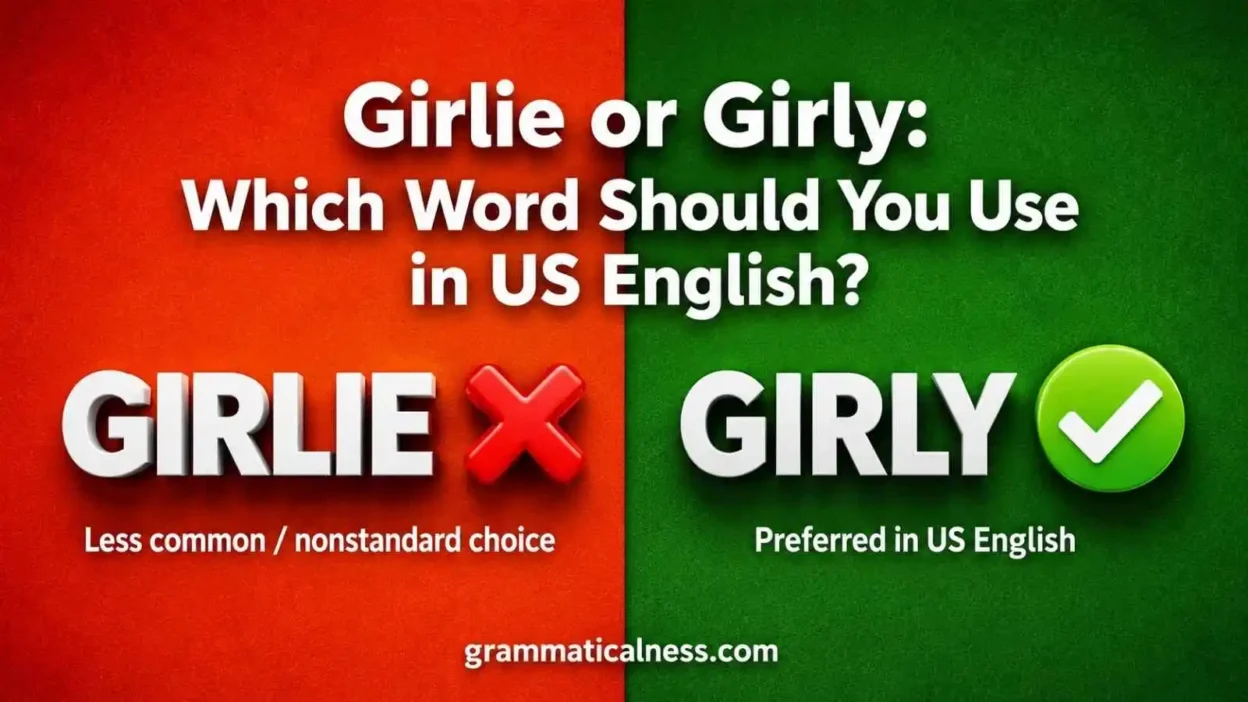
Both girlie and girly are real words, but they are not always the best choice in the same setting.
For most modern US writing, girly is the safer everyday adjective. Use it when you mean “typical of girls,” “feminine in style,” or “soft and playful in a traditionally feminine way.”
Girlie is less common and more marked. It can work as an alternate adjective, but it often feels informal, old-fashioned, playful, or tied to certain set phrases.
Quick Answer
Use girly for most normal descriptions.
Use girlie only when you want a very casual tone, a playful address, or a set phrase such as girlie magazine or girlie show.
A simple example:
Correct for everyday use: The room has a girly style.
Less natural for everyday use: The room has a girlie style.
Both words are pronounced the same: GUR-lee. The choice is about spelling, tone, and context, not sound.
Why People Confuse Them
People confuse girlie and girly because they look almost the same and sound exactly alike.
They also overlap in meaning. Both can describe something linked with girls, young women, or traditional femininity.
The problem is tone. Girly sounds more normal in current US writing. Girlie draws more attention to itself. It may sound cute in a text, dated in an article, or wrong in a serious setting.
That is why the best choice depends less on grammar and more on the situation.
Key Differences At A Glance
Compact comparison:
• girlie: real word, but more informal, more noticeable, and often limited to casual address or set phrases.
• girly: the better default adjective for everyday US English.
• girlie: can sound playful between close friends, but awkward or dismissive in the wrong setting.
• girly: can also sound stereotyping if used carelessly, especially about people.
Meaning and Usage Difference
Girly usually works as an adjective. It describes a style, look, voice, room, outfit, hobby, or mood that people connect with traditional femininity.
Examples include girly dress, girly room, girly colors, and girly style.
Girlie can also be an adjective, but it is less neutral. It often feels older, more playful, or more loaded. In some fixed uses, such as girlie magazine, it has an adult-publication meaning.
That does not mean girlie is always bad. In casual speech, someone might write, “Hey girlie,” or “I’m out with the girlies.” But that is friendly, informal wording. It is not the best choice for polished writing.
Tone, Context, and Formality
Neither word is formal.
Girly is informal but common. It can work in lifestyle writing, fashion writing, captions, casual emails, and everyday conversation.
Girlie is even more casual. It can sound cute in a message to a friend, but it can also sound childish, old-fashioned, or dismissive.
Be careful when using either word for a person. Saying “She likes girly clothes” may be fine if the tone is kind. Saying “Stop being so girly” can sound insulting.
In professional writing, choose a clearer word when possible. Feminine, soft, delicate, frilly, or playful may fit better, depending on the meaning.
Which One Should You Use?
| Context | Best Choice | Why |
| Describing a room, outfit, color palette, or design | girly | It is the normal modern adjective. |
| Writing for a US audience in a clear, casual style | girly | It sounds more current and less marked. |
| Texting a close friend with “Hey, ___” | girlie | It can work as playful address. |
| Referring to an adult-publication phrase | girlie | This spelling is common in that set phrase. |
| Writing a workplace email | neither | A clearer word is usually better. |
| Describing a person’s whole identity | use care | Both words can sound limiting. |
The safest rule is this: choose girly unless you have a clear reason to use girlie.
When One Choice Sounds Wrong
Girlie can sound wrong when you only need a plain adjective.
Awkward: She bought a girlie phone case.
Better: She bought a girly phone case.
Girly can sound wrong when the phrase is a fixed or older expression that usually uses girlie.
Less expected: a girly magazine
More expected: a girlie magazine
The biggest mistake is using girlie just because it looks cuter. That spelling can change the tone more than you expect.
Common Mistakes (and Quick Fixes)
Mistake: Using girlie as the default adjective.
Fix: Use girly for normal descriptions.
Mistake: Calling women “girlies” in a serious setting.
Fix: Use women, friends, team, or the person’s name.
Mistake: Treating girly as a formal word.
Fix: Use feminine, soft, delicate, or a more exact adjective when the writing needs a polished tone.
Mistake: Using either word as an insult.
Fix: Say what you actually mean. For example, use soft, decorative, playful, or frilly instead of turning femininity into a put-down.
Everyday Examples
She chose a girly floral wallpaper for the guest room.
The brand has a soft, girly look without feeling childish.
I’m in a girly mood today, so I’m wearing pink and pearls.
“Hey, girlie, are you still coming to brunch?” works in a close, friendly text.
The phrase girlie magazine has a narrow, older adult-publication meaning.
Do not write, “The report looks too girlie.” In a work setting, say, “The design may feel too playful for this audience.”
Do not write, “Ask the girlies in accounting.” Say, “Ask the accounting team.”
Dictionary-Style Word Details
Verb
• girlie: Not commonly used as a verb in standard US English.
• girly: Not commonly used as a verb in standard US English.
Noun
• girlie: Can appear as a casual noun or form of address for a girl or woman, but it is very informal and can sound dismissive.
• girly: Rare as a standard noun. The plural girlies appears in casual speech or social captions, but it is not a polished choice.
Synonyms
• girlie: Closest plain alternatives depend on use. For adjective use, try girlish, feminine, or frilly. For casual address, use the person’s name or friend.
• girly: Closest plain alternatives include feminine, girlish, frilly, soft, and playful, depending on the sentence.
Antonyms are not exact. In style contexts, masculine or boyish may work, but only when the contrast is truly about style or presentation.
Example Sentences
• girlie: “Hey, girlie, I saved you a seat,” she texted.
• girlie: The old movie mentioned a girlie show.
• girly: Her apartment has a bright, girly style.
• girly: He joked about the girly ringtone, but the comment sounded rude.
Word History
• girlie: Built from girl with an ending that can make a word feel informal, cute, or familiar. Its history is not needed to choose it correctly today.
• girly: Also built from girl, with the common -y adjective ending. In modern US writing, it is the more natural spelling for everyday adjective use.
Do not claim that one form was recently invented. Both forms have dictionary support.
Phrases Containing
• girlie: girlie magazine, girlie show, hey girlie, the girlies
• girly: girly girl, girly style, girly dress, girly room, girly colors
FAQs
Is “girlie” or “girly” correct?
Both are correct words. For most modern US writing, girly is the better default choice.
Is “girlie” a real word?
Yes. Girlie is a real word, but it is more limited in use. It often sounds casual, playful, old-fashioned, or tied to set phrases.
Should I write “girly girl” or “girlie girl”?
Write girly girl. That is the normal phrase for someone with a strongly feminine style or taste.
Is “girlie” rude?
It can be. Between close friends, girlie may sound warm or playful. In professional or serious settings, it can sound childish or dismissive, especially when used for adult women.
Conclusion
The best everyday choice is girly.
Use girly when you need a normal adjective for a feminine, soft, playful, or traditionally girl-associated style.
Use girlie only with care. It is real, but it is more informal and more noticeable. It can work in playful address or set phrases, but it can sound awkward, dated, or dismissive in serious writing.