
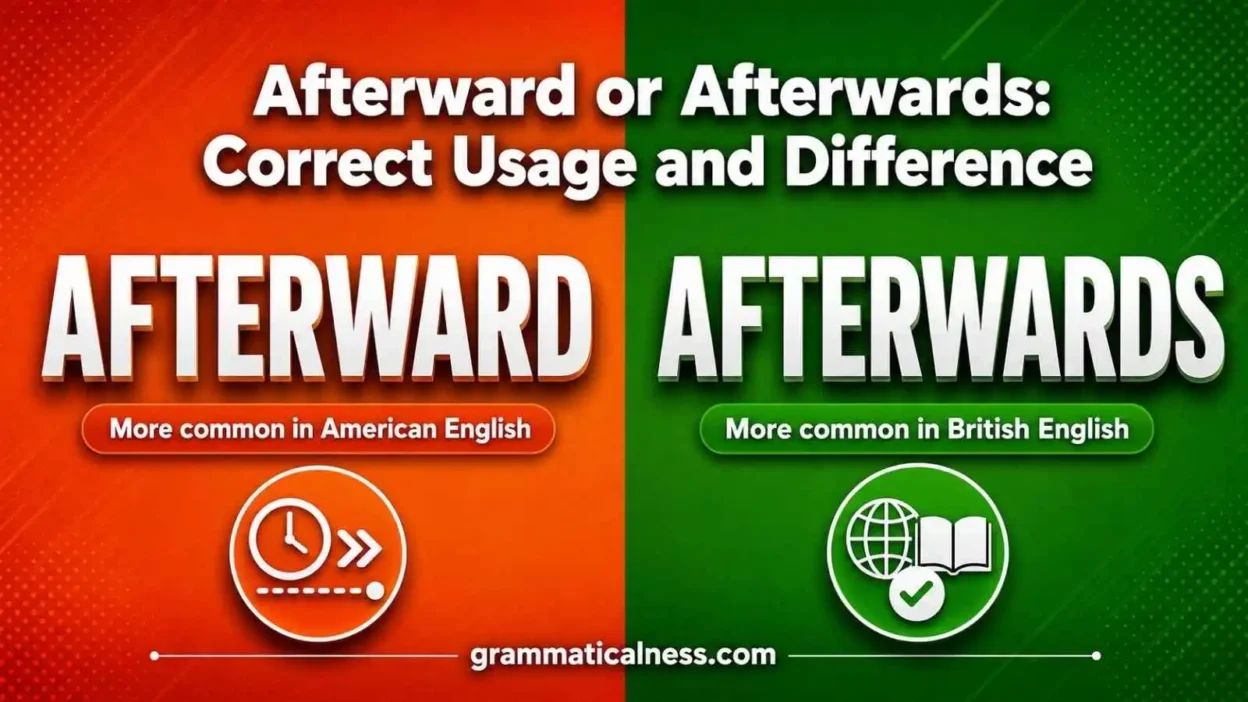
Both afterward and afterwards are correct. They mean “later” or “after that.” The real difference is not meaning. It is mostly about regional style and audience expectation.
For a US audience, afterward is usually the better choice. Afterwards is also standard English, but it is more common in British-style writing. In American writing, it can sound less typical, especially in school, business, news, and polished online content.
Quick Answer
Use afterward for standard American English. Use afterwards when you are writing for a British or international audience that expects that form. Both words are adverbs, and both mean “later” or “after that.” The safest US choice is afterward.
Why People Confuse Them
People confuse afterward and afterwards because the words look almost the same. The only spelling difference is the final s.
They also work the same way in a sentence. Each word tells when something happens.
Correct:
We finished dinner and watched a movie afterward.
Also correct:
We finished dinner and watched a movie afterwards.
The confusion grows because American readers often see both forms online. British, Canadian, Australian, and international writing may use afterwards more often, while US writing usually favors afterward.
Key Differences At A Glance
| Context | Best Choice | Why |
| Standard US writing | afterward | It is the usual American form. |
| British-style writing | afterwards | It is common in British English. |
| School or business writing in the US | afterward | It sounds cleaner and more expected for American readers. |
| Casual conversation | either one | Both are understandable and correct. |
| One document or article | choose one form | Consistency makes the writing look intentional. |
| Referring to a book section | neither | These words mean “later,” not a section at the end of a book. |
Meaning and Usage Difference
The meaning is the same.
Afterward means later, after that, or at a later time.
Example:
The meeting ended at noon, and we talked afterward.
Afterwards means the same thing as afterward.
Example:
The meeting ended at noon, and we talked afterwards.
Both afterward and afterwards are adverbs. Both words describe when an action happens. They are adverbs, not nouns, because they do not name a person, place, thing, or idea. They also do not need an object after them.
Compact comparison:
- afterward: standard and natural for most US writing
- afterwards: standard too, but more common in British-style usage
- both: mean “later” or “after that”
- neither: works as a noun or verb in normal US English
Tone, Context, and Formality
Neither word is more formal because of meaning. Afterward is not more serious, and afterwards is not automatically casual.
The tone difference comes from audience. In American English, afterward usually feels more natural. In British-style writing, afterwards often feels more natural.
For a US blog, school paper, email, article, or business page, choose afterward. It will not distract American readers.
For a UK audience, afterwards may fit better. Still, afterward is not impossible there. The choice is mostly a style habit, not a hard grammar rule.
Which One Should You Use?
Use afterward if you write for readers in the United States.
That choice is clear, standard, and simple. It also fits formal and casual writing.
Use afterwards if your audience expects British-style English, or if you are quoting text that already uses that form.
Once you choose one, stay consistent. Do not switch between afterward and afterwards in the same article unless you have a clear reason.
Better for US writing:
We grabbed coffee afterward.
Less typical for US writing, but still correct:
We grabbed coffee afterwards.
When One Choice Sounds Wrong
Afterwards does not usually sound wrong because of grammar. It may only sound less American in edited US writing.
Example:
The team reviewed the report afterwards.
That sentence is correct. For a US audience, though, many editors would prefer:
The team reviewed the report afterward.
The real grammar problem happens when either word is used where after is needed before a noun.
Incorrect:
We met afterward lunch.
Correct:
We met after lunch.
Incorrect:
She called afterwards the meeting.
Correct:
She called after the meeting.
Correct:
She called afterward.
Common Mistakes (and Quick Fixes)
Mistake 1: Treating afterwards as wrong in the US.
Fix: It is not wrong. It is just less typical in American writing.
Mistake 2: Switching forms in one article.
Fix: Pick one form and use it consistently.
Mistake 3: Using either word before a noun.
Fix: Use after before a noun phrase.
Incorrect:
We left afterward dinner.
Correct:
We left after dinner.
Mistake 4: Using these words for a book-ending section.
Fix: Afterward and afterwards mean later in time. Use the separate book-related word only when you mean a closing section in a book.
Mistake 5: Adding the final s because it sounds “more complete.”
Fix: For US writing, the shorter form afterward is usually the better choice.
Everyday Examples
I sent the invoice afterward.
She apologized afterward.
We went for a walk afterward.
The kids cleaned up afterward.
He looked nervous before the interview but relaxed afterward.
We can talk afterward if you have time.
The storm passed, and the streets dried quickly afterward.
They signed the papers and celebrated afterward.
I saved the receipt and checked the total afterward.
The movie ended late, so we went straight home afterward.
British-style example:
They had dinner first and took a walk afterwards.
International-style example:
The guests arrived early and stayed for coffee afterwards.
US-style rewrite:
The guests arrived early and stayed for coffee afterward.
Dictionary-Style Word Details
Verb
afterward: Not commonly used as a verb in standard US English. It is an adverb.
afterwards: Not commonly used as a verb in standard US English. It is also an adverb.
Noun
afterward: Not commonly used as a noun. Do not write “an afterward” when you mean a later event.
afterwards: Not commonly used as a noun. Do not write “the afterwards” in standard English.
Synonyms
afterward: Closest plain alternatives include later, then, after that, subsequently, and thereafter.
afterwards: The same alternatives apply: later, then, after that, subsequently, and thereafter.
Useful opposites include before, earlier, previously, and beforehand.
Example Sentences
Examples With Afterward
Finish the form now, and we can review it afterward.
The room was quiet afterward.
She missed the call but replied shortly afterward.
Examples With Afterwards
They ate lunch and went shopping afterwards.
He felt better afterwards.
We stayed for a few minutes afterwards.
Word History
afterward: The word comes from older English forms connected with after and the -ward ending, which points in a direction or toward a later point.
afterwards: This form developed with the added -s, a pattern also seen in other direction and time words. Today, the final s does not create a new meaning.
Phrases Containing
afterward:
- shortly afterward
- soon afterward
- long afterward
- not long afterward
- years afterward
- immediately afterward
afterwards:
- shortly afterwards
- soon afterwards
- long afterwards
- not long afterwards
- years afterwards
- immediately afterwards
FAQs
Is afterward or afterwards correct?
Both afterward and afterwards are correct. They mean “later” or “after that.” The main difference is style. In American English, afterward is usually preferred. In British-style English, afterwards is more common.
Which form should I use in American English?
Use afterward in American English. It sounds natural in school writing, business emails, articles, essays, and everyday sentences. Afterwards is still understood, but it may sound less typical to US readers.
Is afterwards wrong in the United States?
No, afterwards is not wrong in the United States. It is a standard English word. However, American writers usually choose afterward, especially in edited or formal writing.
Do afterward and afterwards mean the same thing?
Yes. Both words mean the same thing. They refer to something that happens later. For example, “We ate dinner afterward” and “We ate dinner afterwards” have the same meaning.
Can I use afterward at the beginning of a sentence?
Yes. Afterward can start a sentence when it refers to something that happened later. Example: “Afterward, we discussed the plan.” Add a comma after it when the sentence continues.
Should I write shortly afterward or shortly afterwards?
For American English, write shortly afterward. For British-style English, shortly afterwards is also natural. Both phrases mean “a short time later.”
Is afterward the same as after?
No. After can come before a noun or event, as in “after lunch.” Afterward stands alone as an adverb. Write “We talked after lunch” or “We talked afterward,” not “We talked afterward lunch.”
What is the easiest rule to remember?
Use afterward for US writing. Use afterwards if your audience expects British-style English. Both are correct, but consistency matters.
Conclusion
Afterward and afterwards are both correct adverbs. They mean the same thing: later or after that. The important difference is audience, not grammar.
For American English, choose afterward. For British-style writing, afterwards may sound more natural. In any polished piece, pick one form and keep it consistent from start to finish.
Both afterward and afterwards are correct. They mean “later” or “after that.” The main difference is style. In American English, afterward is usually preferred. In British-style English, afterwards is more common.
Use afterward in American English. It sounds natural in school writing, business emails, articles, essays, and everyday sentences. Afterwards is still understood, but it may sound less typical to US readers.
No, afterwards is not wrong in the United States. It is a standard English word. However, American writers usually choose afterward, especially in edited or formal writing.
Yes. Both words mean the same thing. They refer to something that happens later. For example, “We ate dinner afterward” and “We ate dinner afterwards” have the same meaning.
Yes. Afterward can start a sentence when it refers to something that happened later. Example: “Afterward, we discussed the plan.” Add a comma after it when the sentence continues.
For American English, write shortly afterward. For British-style English, shortly afterwards is also natural. Both phrases mean “a short time later.”
No. After can come before a noun or event, as in “after lunch.” Afterward stands alone as an adverb. Write “We talked after lunch” or “We talked afterward,” not “We talked afterward lunch.”
Use afterward for US writing. Use afterwards if your audience expects British-style English. Both are correct, but consistency matters.