

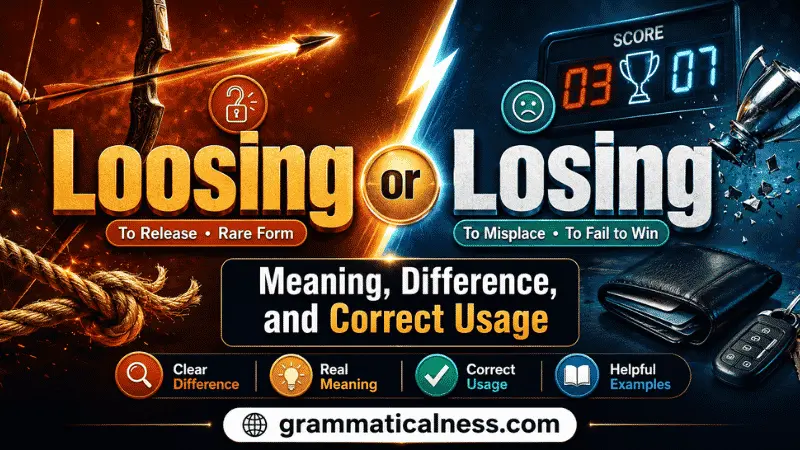
Loosing and losing are both real English words, but they do not mean the same thing.
In most everyday situations involving loss, defeat, misplaced items, reduced amounts, or failure to keep something, losing is correct.
Loosing comes from the verb loose and means releasing, setting free, unfastening, or letting something fly. It is valid English, but it is much less common in everyday American usage.
The easiest way to choose correctly is to identify the base verb: lose → losing and loose → loosing.
Quick Answer
Use losing when someone is failing to keep something, being defeated, misplacing something, or experiencing a reduction.
- “Our team is losing.”
- “I keep losing my keys.”
- “She is losing patience.”
Use loosing only when the intended verb is loose, meaning to release, free, untie, or let fly.
- “The archers were loosing arrows.”
So, losing weight, losing money, and losing your mind are correct. Writing loosing in those expressions is an error.
Why People Confuse Them
The words differ by only one letter: loosing has two consecutive o’s, while losing has one.
The confusion also starts with their base words, loose and lose. Those words look similar but have different meanings and pronunciations.
Another problem is that people may assume adding -ing to lose produces loosing. It does not. The final silent e is dropped:
lose + ing → losing
By contrast:
loose + ing → loosing
Recognizing the base verb solves most of the confusion.
Key Differences At A Glance
- losing: From lose. It refers to no longer having something, failing to keep it, being defeated, or becoming reduced.
- loosing: From loose. It refers to releasing, freeing, unfastening, or letting something fly.
The words are therefore not interchangeable.
Meaning and Usage Difference
Losing is the present participle and gerund form of lose.
You can be losing a game, losing money, losing weight, losing confidence, losing your phone, or losing control. In each case, something is no longer being kept, maintained, possessed, or successfully held.
Loosing is the corresponding -ing form of the verb loose.
As a verb, loose can mean to release something from restraint, set something free, untie it, or let a projectile fly. For example, an archer may be described as loosing an arrow.
Pronunciation also helps separate them:
losing sounds like LOO-zing, with a z sound.
loosing sounds like LOO-sing, with an s sound.
That sound difference reflects the pronunciation of their base verbs, lose and loose.
Tone, Context, and Formality
Losing is neutral and extremely natural in both conversation and formal writing. It appears in everyday contexts involving sports, money, possessions, emotions, health, business, and relationships.
Loosing is standard English, but its verb sense is much less common in ordinary modern American conversation.
It may appear in descriptions of archery, weapons, animals being released, restraints being removed, or more literary descriptions of something being unleashed.
In many everyday situations, Americans are more likely to say releasing, unleashing, untieing/ untying, or loosening, depending on the intended action.
Importantly, loosing and loosening are not automatically identical. Loosening usually emphasizes making something less tight, firm, or restricted. Loosing often emphasizes releasing or setting something free.
Which One Should You Use?
Use this context guide:
| Context | Best Choice | Why |
| Failing to win a game | losing | It comes from lose, meaning to be defeated |
| Misplacing your keys | losing | You are failing to keep possession of them |
| Becoming lighter in weight | losing | The amount of weight is decreasing |
| Running out of patience | losing | You are failing to maintain your patience |
| Money decreasing or disappearing | losing | You are suffering a loss |
| Releasing an arrow | loosing | The verb loose can mean to let a projectile fly |
| Setting something free | loosing | Loose can function as a verb meaning release |
| Simply making a knot less tight | Usually loosening | This is the more natural modern verb for reducing tightness |
For the large majority of sentences people hesitate over, losing is the intended word.
When One Choice Sounds Wrong
Use losing, not loosing, when the sentence involves loss.
Incorrect: “I’m loosing weight.”
Correct: “I’m losing weight.”
Incorrect: “We are loosing the game.”
Correct: “We are losing the game.”
Incorrect: “She is loosing patience.”
Correct: “She is losing patience.”
The reverse distinction also matters.
If an archer releases arrows, loosing arrows can be correct. Writing losing arrows would instead suggest that the arrows are being misplaced or no longer possessed.
Meaning determines the spelling.
Common Mistakes (and Quick Fixes)
A common error is adding an extra o whenever the writer hears the long “oo” sound.
Remember that lose already has the “oo” sound even though it contains only one o. Its -ing form is therefore losing.
Another mistake is assuming loosing cannot be a word. It can. The problem is using it where losing is required.
A reliable memory rule is:
Loss or defeat → lose → losing
Release or set free → loose → loosing
Also avoid replacing loosening automatically with loosing. If you mean “making less tight,” loosening is often the clearer and more natural choice.
Everyday Examples
“I’m losing track of time.”
“The Lakers were losing at halftime.”
“Be careful about losing your boarding pass.”
“She has been losing confidence after several setbacks.”
“The company is losing customers to a new competitor.”
“He worried about losing access to his account.”
“The archer stood calmly, loosing one arrow after another.”
“The story describes the guards loosing the hounds after the intruder.”
Notice how losing appears naturally in many ordinary situations. Loosing appears only when the underlying idea is releasing or setting something loose.
Dictionary-Style Word Details
Verb
loosing: The present participle of the verb loose. As a verb, loose can mean to release, free from restraint, untie, detach, or let something such as an arrow fly.
Example: “The archers were loosing arrows toward the targets.”
losing: The present participle of the verb lose. It can mean failing to keep something, becoming deprived of it, misplacing it, suffering defeat, or experiencing a reduction.
Example: “The team is losing by ten points.”
Both are verb forms, but they come from different verbs.
Noun
Neither word is primarily a standalone noun in the senses compared here.
However, both -ing forms can work in gerund constructions, where the action functions in a noun-like role.
loosing: “The loosing of the arrows began at dawn.”
This construction is grammatical but uncommon in ordinary modern conversation.
losing: “Losing is never easy.”
Here, losing names the act or experience of losing.
Synonyms
losing — closest plain alternatives, depending on context: misplacing, forfeiting, surrendering, dropping, giving up, being defeated.
Possible opposites include keeping, retaining, gaining, and winning, depending on the meaning.
loosing — closest plain alternatives: releasing, freeing, unleashing, discharging, letting fly.
Possible opposites include restraining, holding, confining, or securing, depending on context.
No single synonym or antonym fits every use of either word.
Example Sentences
loosing: “The riders were loosing the horses from their restraints.”
loosing: “The archers practiced loosing arrows quickly and accurately.”
Losing: “I think I’m losing my keys more often lately.”
Financial loss: “The store is losing money every month.”
In a competition: “We were losing the game until the final quarter.”
Loss of control: “He felt that he was losing control of the situation.”
Word History
losing comes from lose, a very old English verb associated with being deprived of something, failing to keep something, or being lost.
loosing comes from the verb loose, whose history in English includes meanings connected with being free, unbound, released, or not securely fastened.
The words have deeper historical connections within Germanic language history, but modern English treats lose and loose as distinct words with distinct meanings. Their -ing forms must therefore remain distinct as well.
Phrases Containing
Common expressions with losing include:
losing streak, losing battle, losing side, losing proposition, losing patience, and losing touch.
Loosing appears in fewer fixed everyday expressions. Common constructions involve actions such as loosing arrows, loosing a volley, or loosing animals upon someone or into an area.
Because the verb loose is relatively uncommon in everyday conversation, many speakers would use release, unleash, or another clearer verb instead.
FAQs
Both loosing and losing are correct English words, but they have different meanings. Losing comes from lose and refers to failing to keep something, being defeated, misplacing something, or experiencing a reduction. Loosing comes from the verb loose and means releasing, freeing, or letting something fly.
The correct phrase is losing weight. When your body weight decreases, you are losing weight because the verb is lose. Writing loosing weight is incorrect because loosing means releasing or setting something free.
Yes. Loosing is a valid form of the verb loose. It can describe releasing something from restraint or letting something fly. For example, “The archers were loosing arrows” is correct. However, the word is much less common than losing in everyday English.
The correct expression is losing my mind. Here, losing means no longer maintaining control, calmness, or clear thinking. Loosing my mind would not have the intended meaning.
Think of the base verbs: lose → losing and loose → loosing. Use losing for loss, defeat, misplacement, or reduction. Use loosing for releasing, freeing, or letting something go.
Losing is pronounced roughly LOO-zing, with a “z” sound. Loosing is pronounced roughly LOO-sing, with an “s” sound. This pronunciation difference can help you remember that the words come from two different verbs.
Conclusion
The difference between loosing or losing becomes simple once you identify the base verb.
Use losing when you mean failing to keep something, misplacing it, suffering defeat, becoming deprived of something, or experiencing a reduction.
Use loosing when you genuinely mean releasing, freeing, unfastening, or letting something fly.
For everyday phrases such as losing weight, losing money, losing a game, losing patience, and losing your mind, the correct spelling is always losing.
Remember:
lose → losing
loose → loosing
Both forms are valid, but they belong to different verbs and should not be used interchangeably.