
Many people mix up loose and lose because the words look similar. However, they have different meanings and usually play different roles in a sentence.
Knowing the difference helps you avoid one of the most common writing mistakes in English.
Quick Answer
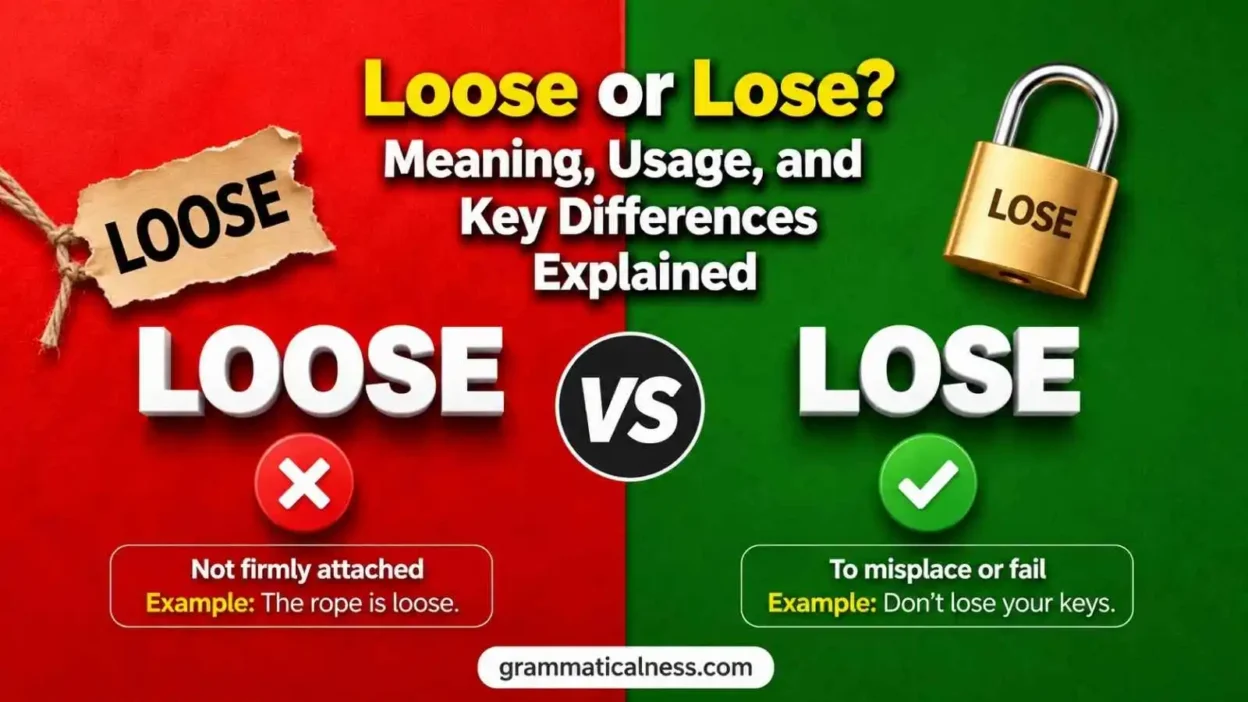
Use lose when you mean to misplace something, fail to win, or no longer have something.
Use loose when you mean not tight, not firmly attached, or free from restraint.
Correct:
- Don’t lose your phone.
- Your shoelaces are loose.
Incorrect:
- Don’t loose your phone.
- Your shoelaces are lose.
Why People Confuse Them
The words are spelled almost the same, differing by only one letter.
Their pronunciations are also similar:
- lose sounds like “looz”
- loose sounds like “loos”
Many people expect the double “o” spelling in loose to match the pronunciation of lose, which leads to spelling mistakes.
The confusion happens much more often in writing than in speech.
Key Differences At A Glance
| Context | Best Choice | Why |
| Misplace your keys | lose | Means to no longer have or find something |
| Fail to win a game | lose | Means suffer defeat |
| A shirt that is too big | loose | Means not tight-fitting |
| A loose screw | loose | Means not securely attached |
| Let an animal run free | loose | Can mean release or set free |
| Drop unwanted pounds | lose | Means get rid of weight |
Meaning and Usage Difference
The biggest difference is grammatical.
Lose is primarily a verb.
Examples:
- I don’t want to lose my wallet.
- Our team might lose tonight.
- She hopes to lose ten pounds.
Loose is most commonly an adjective.
Examples:
- The door handle feels loose.
- He wore a loose sweatshirt.
- One wheel was loose after the repair.
Compact comparison:
| Feature | loose | lose |
| Most common role | Adjective | Verb |
| Main meaning | Not tight or not secured | To misplace, fail to win, or no longer have |
| Pronunciation | “loos” | “looz” |
| Common mistake | Used instead of lose | Misspelled as loose |
Although less common, loose can also be a verb meaning “release” or “set free.”
Example:
- The guards loosed the dogs.
That use is correct but uncommon in everyday American English.
Tone, Context, and Formality
Both words are standard and acceptable in formal and informal writing.
The difference is not about formality. It is about meaning.
Lose appears often in everyday conversation, sports coverage, business writing, and personal communication.
Examples:
- The company could lose customers.
- We can’t afford to lose this contract.
Loose appears when describing physical conditions, clothing, objects, or freedom of movement.
Examples:
- The bolt is loose.
- She prefers loose clothing.
Because the words have different meanings, they are not interchangeable.
Which One Should You Use?
Choose lose if you mean:
- Misplace something
- Fail to win
- Give up something
- No longer have something
Examples:
- Don’t lose your passport.
- We might lose the game.
- He wants to lose weight.
Choose loose if you mean:
- Not tight
- Not firmly attached
- Free or released
Examples:
- The lid feels loose.
- She likes loose jeans.
- A dog was running loose in the neighborhood.
When One Choice Sounds Wrong
These mistakes stand out immediately to many readers.
Wrong:
- I hope we don’t loose tonight.
Correct:
- I hope we don’t lose tonight.
Wrong:
- My jacket is too lose.
Correct:
- My jacket is too loose.
Wrong:
- Be careful not to loose your keys.
Correct:
- Be careful not to lose your keys.
The sentence may still be understandable, but the wrong word changes the meaning.
Common Mistakes (and Quick Fixes)
Mistake: loose weight
Fix: lose weight
Mistake: loose a game
Fix: lose a game
Mistake: lose shoelaces are untied
Fix: shoelaces are loose
Fix: loose screw
A simple memory trick:
- Lose is often connected to losing a game.
- Loose is often the opposite of tight.
Everyday Examples
- If you lose your credit card, call the bank right away.
- We don’t want to lose another customer.
- The team could lose by a single point.
- Your watch band is loose.
- The cabinet door feels loose.
- He prefers loose athletic shorts during summer.
Dictionary-Style Word Details
Verb
loose:
Can function as a verb meaning “to release,” “to free,” or “to let fly.” This use exists in standard English but is uncommon in everyday US conversation.
Example:
- The archers loosed their arrows.
lose:
A very common verb meaning to misplace something, fail to win, become deprived of something, or get rid of something.
Example:
- I don’t want to lose my phone.
Noun
loose:
Not commonly used as a noun in standard US English.
lose:
Not commonly used as a noun in standard US English. The related noun is usually loss.
Synonyms
loose:
Closest plain alternatives include:
- slack
- untied
- unsecured
- free
Possible opposite:
- tight
lose:
Closest plain alternatives depend on context:
- misplace
- forfeit
- surrender
- drop
Possible opposites:
- find
- win
- keep
Example Sentences
loose:
- One of the fence boards is loose.
- Her sweater was intentionally loose.
- A dog got loose from the yard.
lose:
- Don’t lose the receipt.
- They might lose the election.
- She wants to lose a few pounds before the race.
Word History
loose:
The word has roots in older Germanic languages connected to ideas of freedom, release, or lack of restraint.
lose:
The word also comes from older Germanic language roots and has long been associated with being deprived of something or failing to keep it.
The two words are historically related, but their meanings separated long ago.
Phrases Containing
loose:
- loose change
- loose cannon
- hang loose
- all hell breaks loose
- loose ends
lose:
- lose your temper
- lose your mind
- lose track of time
- lose heart
- lose face
- lose sleep over
FAQs
Is it “lose weight” or “loose weight”?
The correct phrase is lose weight.
- ✅ She wants to lose weight before summer.
- ❌ She wants to loose weight before summer.
Here, lose means to get rid of something.
Is it “lose a game” or “loose a game”?
The correct phrase is lose a game.
- ✅ Our team might lose a game this weekend.
- ❌ Our team might loose a game this weekend.
Lose means to fail to win.
Can “loose” be used as a verb?
Yes, but it is uncommon in everyday American English.
As a verb, loose means to release or set free.
Examples:
- The hunters loosed the dogs.
- The soldier loosed an arrow.
Most modern writers and speakers encounter loose far more often as an adjective.
Why do people confuse “loose” and “lose”?
People confuse them because:
- The spellings are very similar.
- The pronunciations are somewhat alike.
- Both words are common in everyday English.
- Typing mistakes can easily turn one into the other.
The confusion is especially common in online writing and social media posts.
How do you pronounce “loose” and “lose”?
- Loose = sounds like “loos”
- Lose = sounds like “looz”
The final s sound in loose becomes a z sound in lose.
Is “loose” the opposite of “tight”?
Yes.
Examples:
- A loose shirt is the opposite of a tight shirt.
- A loose screw is the opposite of a securely tightened screw.
Is “lose” the opposite of “find”?
In many situations, yes.
Examples:
- You can lose your keys.
- Later, you may find your keys.
Depending on context, other opposites of lose can include keep, retain, or win.
Which word is more common: “loose” or “lose”?
Both are common, but they are used in different situations.
- Lose appears frequently when discussing games, competition, possessions, money, or weight.
- Loose appears frequently when describing clothing, objects, fasteners, knots, or things that are not tightly secured.
What is the easiest way to remember the difference?
Think of this simple rule:
- Lose = to misplace, fail to win, or no longer have something.
- Loose = not tight.
Examples:
- Don’t lose your phone.
- Your shoelaces are loose.
Can “loose” and “lose” ever be interchangeable?
No.
They have different meanings and usually different grammatical roles. Replacing one with the other creates an error in standard American English.
- ✅ I don’t want to lose my wallet.
- ❌ I don’t want to loose my wallet.
- ✅ The bolt is loose.
- ❌ The bolt is lose.
Conclusion
The choice is simple once you know the core difference.
Lose is usually a verb that means to misplace something, fail to win, or no longer have something.
Loose is usually an adjective that means not tight, not secure, or free.
If you’re talking about a missing wallet, a lost game, or losing weight, use lose.
If you’re talking about a loose screw, loose clothing, or a loose knot, use loose.