
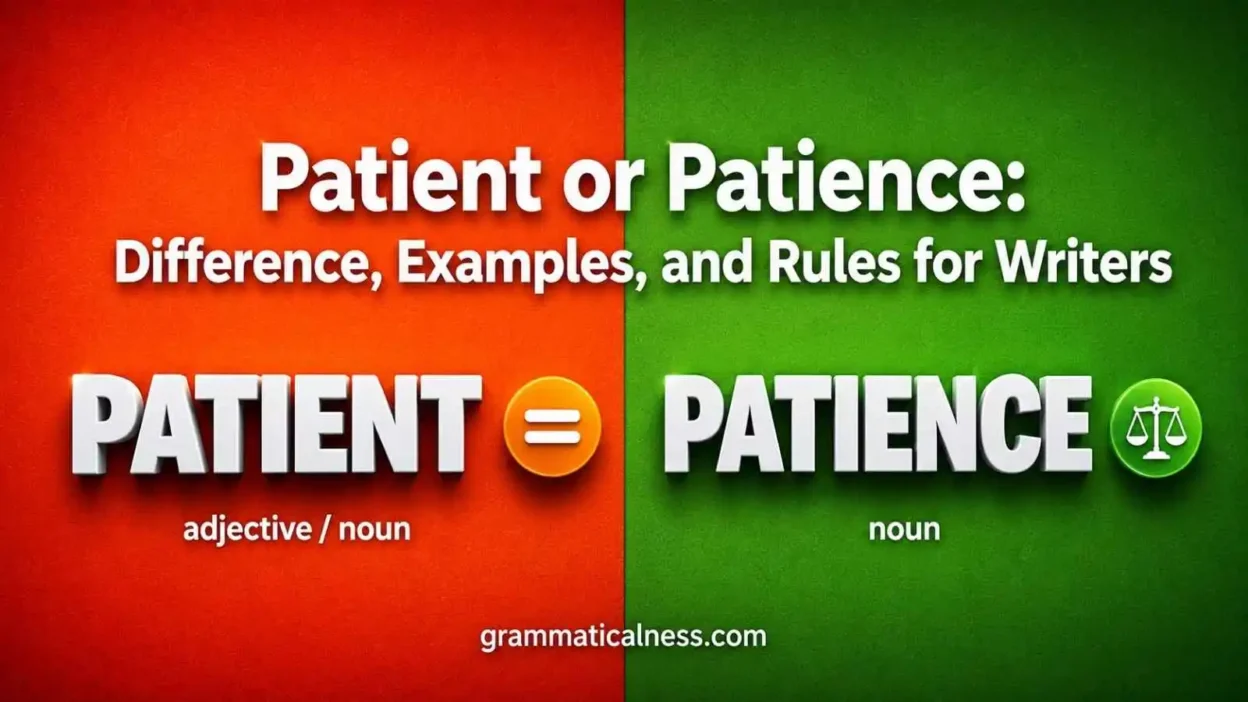
Both patient and patience are correct words, but they are not used the same way.
Use patient when you mean someone who stays calm, or when you mean a person receiving medical care. Use patience when you mean the quality of staying calm during waiting, stress, or difficulty.
The easiest way to remember it is this:
You can be patient.
You can have patience.
Quick Answer
Use patient as an adjective when describing a calm person.
Correct: Please be patient while we update your account.
Correct: She is patient with new employees.
Use patient as a noun when talking about a person receiving medical care.
Correct: The patient waited for the nurse.
Use patience as a noun when talking about the quality or ability to stay calm.
Correct: This job requires patience.
Correct: Thank you for your patience.
So, patient or patience depends on the job the word does in the sentence.
Why People Confuse Them
People confuse patient and patience because they look alike, sound similar, and share a related idea.
A patient person has patience. That connection is useful, but it can also cause mistakes.
The most common errors happen in short phrases:
Wrong: Please be patience.
Correct: Please be patient.
Wrong: I do not have enough patient.
Correct: I do not have enough patience.
There is one more source of confusion: patients, the plural of the medical noun patient, sounds very close to patience in everyday speech. This guide focuses on patient and patience, but that sound-alike is worth noticing.
Key Differences At A Glance
| Context | Best Choice | Why |
|---|---|---|
| Describing a calm person | patient | It works as an adjective. |
| Talking about calmness as a quality | patience | It works as a noun. |
| Talking about someone receiving medical care | patient | It names a person. |
| After “be,” “stay,” or “remain” | patient | These verbs often need an adjective. |
| After “have,” “show,” “need,” or “lose” | patience | These verbs often point to a noun. |
| In “Thank you for your ___” | patience | The phrase thanks someone for the quality of waiting calmly. |
Meaning and Usage Difference
Patient has two main uses.
First, patient can describe a person who stays calm and does not get annoyed quickly.
Example: My manager was patient while I learned the new process.
Second, patient can name a person receiving medical care.
Example: The doctor spoke with the patient after the exam.
Patience is the noun for the quality of being patient. It names the ability to wait, keep trying, or handle frustration calmly.
Example: Learning to drive in city traffic takes patience.
Here is the compact comparison:
| Feature | patient | patience |
| Main grammar role | adjective; also a noun in medical contexts | noun |
| Basic meaning | calm, or a person receiving care | the quality of staying calm |
| Common phrase | be patient | have patience |
| Example | She is patient with kids. | She has patience with kids. |
Pronunciation is worth a quick note. In everyday US English, patient sounds like “PAY-shunt,” and patience sounds like “PAY-shuns.” They are close enough that listeners may not notice the difference right away, so the sentence structure matters.
Tone, Context, and Formality
Both words are standard in US English. The difference is not about casual vs formal writing. It is about grammar and meaning.
Be patient is common in everyday speech, customer service, teaching, parenting, and workplace writing.
Example: Please be patient while the page loads.
Have patience sounds a little more reflective. It focuses on the quality someone needs.
Example: Have patience with yourself while you learn.
Thank you for your patience is common in professional messages. It is polite because it thanks the reader for waiting calmly.
Example: Thank you for your patience while we review your request.
The medical noun patient is neutral and standard in health care.
Example: Each patient must complete the intake form.
Which One Should You Use?
Use patient if the sentence describes someone.
Ask: Can I replace it with “calm” or “understanding”?
Correct: Be patient with your brother.
Test: Be calm with your brother.
Use patience if the sentence names a quality.
Ask: Can I place “have,” “show,” “need,” or “lose” before it?
This project requires patience.
During the delay, she showed patience.
After the third call, he lost patience.
Use patient if the sentence talks about health care.
Ask: Does it mean a person seeing a doctor, nurse, dentist, therapist, or other care provider?
Correct: The patient scheduled a follow-up visit.
When One Choice Sounds Wrong
Some mistakes sound wrong because the word does not fit the grammar of the sentence.
Wrong: Please be patience.
Why it is wrong: Be needs an adjective here.
Correct: Please be patient.
Wrong: You need to have patient.
Why it is wrong: The sentence needs the noun for the quality.
Correct: You need to have patience.
Wrong: Her patient helped her stay calm.
Why it is wrong: This sounds like a medical person receiving care.
Correct: Her patience helped her stay calm.
Wrong: The nurse checked the patience.
Why it is wrong: A nurse checks a person, not the quality of calmness.
Correct: The nurse checked the patient.
Common Mistakes (and Quick Fixes)
Mistake: I am trying to be patience.
Fix: I am trying to be patient.
Reason: Use the adjective after be.
Mistake: Thanks for being patience.
Fix: Thanks for being patient.
Reason: Being needs the adjective patient.
Mistake: Thank you for your patient.
Fix: Thank you for your patience.
Reason: The phrase thanks someone for waiting calmly.
Mistake: This work takes a lot of patient.
Fix: This work takes a lot of patience.
Reason: The sentence talks about a quality, not a person.
Mistake: The doctor has one patience waiting.
Fix: The doctor has one patient waiting.
Reason: The sentence means one person receiving care.
Mistake: She is patience with kids.
Fix: She is patient with kids.
Reason: Is needs an adjective.
Everyday Examples
Here are natural ways to use both words.
Please be patient; I am checking your order now.
Thank you for your patience while we fix the issue.
The patient arrived ten minutes early for the appointment.
Coaching middle school soccer takes patience.
When my dad teaches me how to park, he stays patient.
After waiting on hold for an hour, I lost patience.
The dentist asked the patient to sit back in the chair.
During the hiring process, try to stay patient.
With a difficult customer, she showed real patience.
A good tutor needs patience and clear explanations.
Before leaving, the patient asked for a copy of the test results.
Be patient with yourself; new habits take time.
Dictionary-Style Word Details
Verb
• patient: Not commonly used as a verb in standard US English. Use be patient, stay patient, or remain patient instead.
• patience: Not commonly used as a verb in standard US English. Use have patience, show patience, or practice patience instead.
Noun
• patient: A countable noun meaning a person receiving medical care or treatment.
Example: The patient asked the nurse a question.
• patience: An uncountable noun meaning the ability or quality of staying calm during delay, stress, pain, or difficulty.
Example: The long wait tested my patience.
Synonyms
• patient as an adjective: calm, tolerant, understanding, forbearing, uncomplaining.
Antonym: impatient.
• patient as a medical noun: There is no exact everyday synonym that fits every context. Closest plain alternatives include person receiving care or person being treated.
• patience: calmness, self-control, tolerance, forbearance, endurance.
Antonym: impatience.
These alternatives are not always exact. For example, tolerance can mean patience with a person or situation, but it can also have other meanings. Choose the word that fits the sentence.
Example Sentences
• patient: Please be patient while we find your file.
• patient: She is patient with customers who need extra help.
• patient: The patient filled out the medical history form.
• patient: Each patient received a reminder before the visit.
• patience: Thank you for your patience during the delay.
• patience: I do not have the patience to wait in that line again.
• patience: Training a puppy takes patience.
• patience: Her patience made the meeting less stressful.
Word History
• patient: The word comes through older French and Latin forms connected with enduring or suffering. In modern English, it developed both the calm-person meaning and the medical-person meaning.
• patience: This word is closely related in history and names the quality of enduring delay, difficulty, or irritation calmly.
For today’s writing, the history is less important than the grammar. Patient describes a person or names a person in care. Patience names the quality.
Phrases Containing
• patient: be patient, stay patient, remain patient, patient with someone, patient person, new patient, patient care, patient portal.
• patience: have patience, show patience, lose patience, run out of patience, test someone’s patience, try someone’s patience, thank you for your patience, patience is a virtue.
FAQs
Use patient when describing a calm person or talking about someone receiving medical care. Use patience when talking about the quality of staying calm.
Example:
Please be patient.
Thank you for your patience.
No. Be patience is not correct in standard English. Use be patient because patient is the adjective.
Correct: Please be patient.
Wrong: Please be patience.
Usually, no. Use have patience when you mean someone should stay calm or wait calmly.
Correct: You need to have patience.
Wrong: You need to have patient.
The only time patient works after have is when it means a medical person receiving care.
Example: The doctor has one patient waiting.
Patient can be an adjective meaning calm, or a noun meaning a person receiving medical care. Patience is a noun meaning the ability to stay calm during delay, stress, or difficulty.
Example:
She is patient with kids.
She has patience with kids.
Yes. Patient can be a noun when it means a person receiving medical care.
Example: The patient asked the nurse a question.
It can also be an adjective.
Example: The teacher was patient with the class.
No. Patience is a noun. Use patient when you need an adjective.
Correct: He is patient.
Wrong: He is patience.
The correct phrase is Thank you for your patience.
This means you are thanking someone for waiting calmly or being understanding during a delay.
Use this simple memory trick:
You can be patient.
You can have patience.
If the sentence uses be, choose patient. If the sentence uses have, show, need, or lose, choose patience.
Conclusion
The choice between patient or patience is simple once you check the sentence.
Use patient when you mean a calm person or a person receiving medical care.
Use patience when you mean the quality of staying calm.
Memory tip:
You can be patient.
You can have patience.