
If you’ve ever paused while typing and wondered whether to write sense or sence, you’re not alone. This is one of the most common spelling mix-ups in English. It happens because both versions sound exactly the same when spoken, which makes it easy to second-guess yourself.
The good news is simple: only one of these is correct in standard US English. Once you understand why, you’ll never hesitate again.
Quick Answer
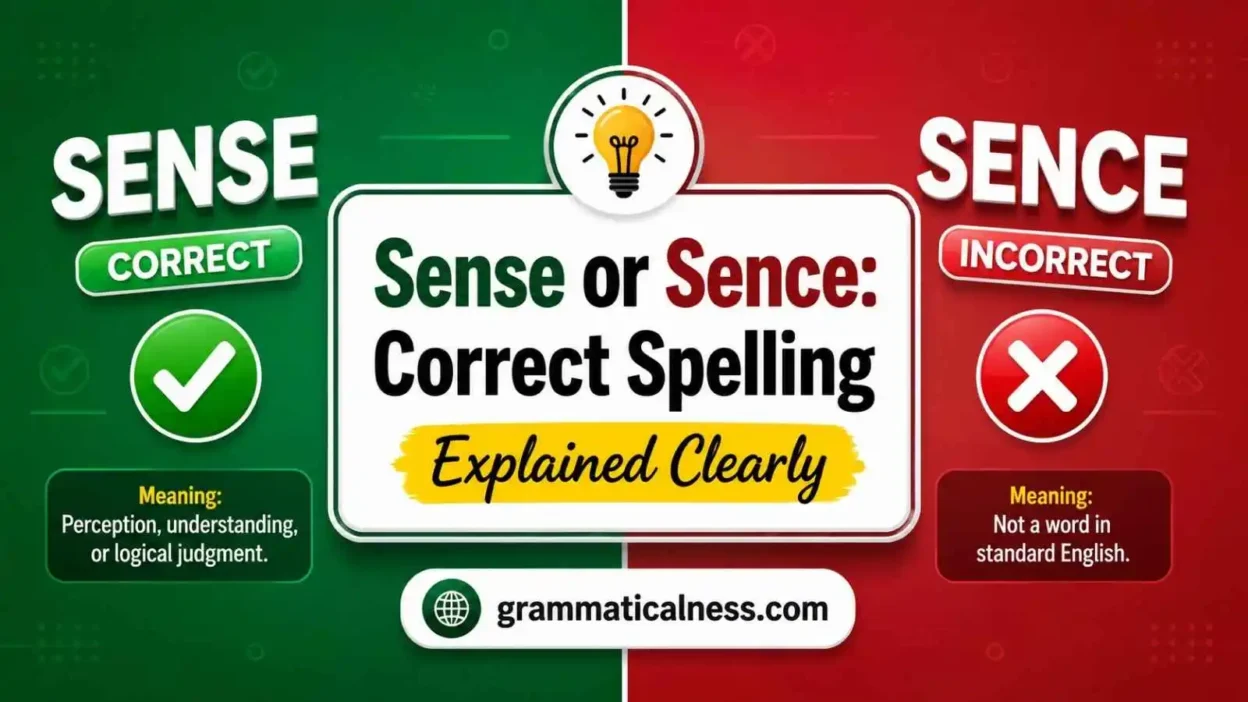
“Sense” is correct.
“Sence” is not a real word in standard English.
Use sense every time. If you write sence, it’s considered a spelling mistake.
Why People Confuse Them
The confusion mainly comes from pronunciation. Both sense and sence would sound the same: “sens.”
English spelling doesn’t always match pronunciation neatly. Words like since, fence, and science make things even trickier. As a result, people sometimes assume “sence” follows the same pattern—but it doesn’t.
Key Differences At A Glance
| Feature | sense | sence |
|---|---|---|
| Valid English word | Yes | No |
| Meaning | Multiple meanings | None |
| Used in writing | Always correct | Always incorrect |
| Dictionary entry | Yes | No |
Meaning and Usage Difference
Sense is a real and flexible word in English. It can be a noun or a verb.
As a noun, it often refers to:
- One of the five senses (sight, smell, touch, taste, hearing)
- A feeling or awareness
- Logic or good judgment
As a verb, it means:
- To notice or detect something
Sence, on the other hand, has no meaning. It’s simply a misspelling of sense.
Tone, Context, and Formality
Sense works in every setting—formal, informal, academic, and casual. It’s a standard word used in everyday conversation and professional writing.
Sence has no acceptable tone or context. Using it in any situation—emails, essays, or texts—will be seen as an error.
Which One Should You Use?
Always use sense.
Here’s a simple rule:
If you mean understanding, feeling, logic, or perception → use sense.
There is no situation where sence is correct.
When One Choice Sounds Wrong
Even if sence might “look right” to you, it should always feel wrong in polished writing.
Examples:
- ❌ That makes no sence
- ✅ That makes no sense
- ❌ I had a strange sence about it
- ✅ I had a strange sense about it
If you see sence, treat it as a red flag.
Common Mistakes (and Quick Fixes)
| Context | Best Choice | Why |
|---|---|---|
| Expressing logic | sense | Correct noun form |
| Talking about feelings | sense | Standard usage |
| Typing quickly | sense | Avoid typo |
| Unsure spelling | sense | Only correct option |
Quick fix tip:
If you type “sence,” just replace the “c” with an “s” → sense.
Everyday Examples
- That explanation makes perfect sense.
- I had a sense that something was off.
- She has a great sense of humor.
- He could sense the tension in the room.
- Use your common sense before deciding.
Incorrect examples:
- ❌ That makes no sence
- ❌ I feel a strange sence
Dictionary-Style Word Details
Verb
- sense: To notice, detect, or become aware of something
- Example: She could sense the mood changing.
- sence: Not used as a verb in standard English
Noun
- sense: A feeling, awareness, meaning, or one of the five senses
- sence: Not a valid noun
Synonyms
- sense: feeling, awareness, perception, understanding
- sence: No synonyms (not a real word)
Example Sentences
- sense: This plan makes a lot of sense.
- sense: I sensed danger immediately.
- sence: Not used in correct sentences
Word History
- sense: Comes from Latin roots related to perception and feeling
- sence: No historical origin as a standard English word
Phrases Containing
- sense: common sense, sense of humor, make sense, sixth sense
- sence: Not used in any standard phrases
FAQs
No. Sence is always a spelling mistake. The correct form is sense.
Because both sound the same when spoken. English spelling isn’t always phonetic, so people sometimes guess the wrong letter.
Sense can mean understanding, awareness, feeling, or one of the five physical senses like sight and hearing.
Yes. As a verb, sense means to notice or detect something.
Example: I could sense something was wrong.
It works in both. You can use sense in casual conversation, professional writing, and academic work.
Think of “common sense.” You’ve probably seen that phrase many times—notice it always uses sense, never sence.
Yes. Words like since, fence, and science look similar, which can make sense harder to spell correctly.
It will be seen as a spelling error and may affect clarity or credibility, especially in formal writing.
Yes. Examples include:
make sense
common sense
sense of humor
sixth sense
Slow down when typing and double-check the word. If in doubt, remember: sense is the only correct spelling.
Conclusion
The difference between sense and sence is straightforward once you see it clearly. Sense is a real, useful word with multiple meanings and everyday use. Sence is simply a spelling mistake that shows up because of how the word sounds.
If you remember just one thing, make it this:
Use “sense” every time—no exceptions.
That one small habit will instantly make your writing cleaner and more confident.