
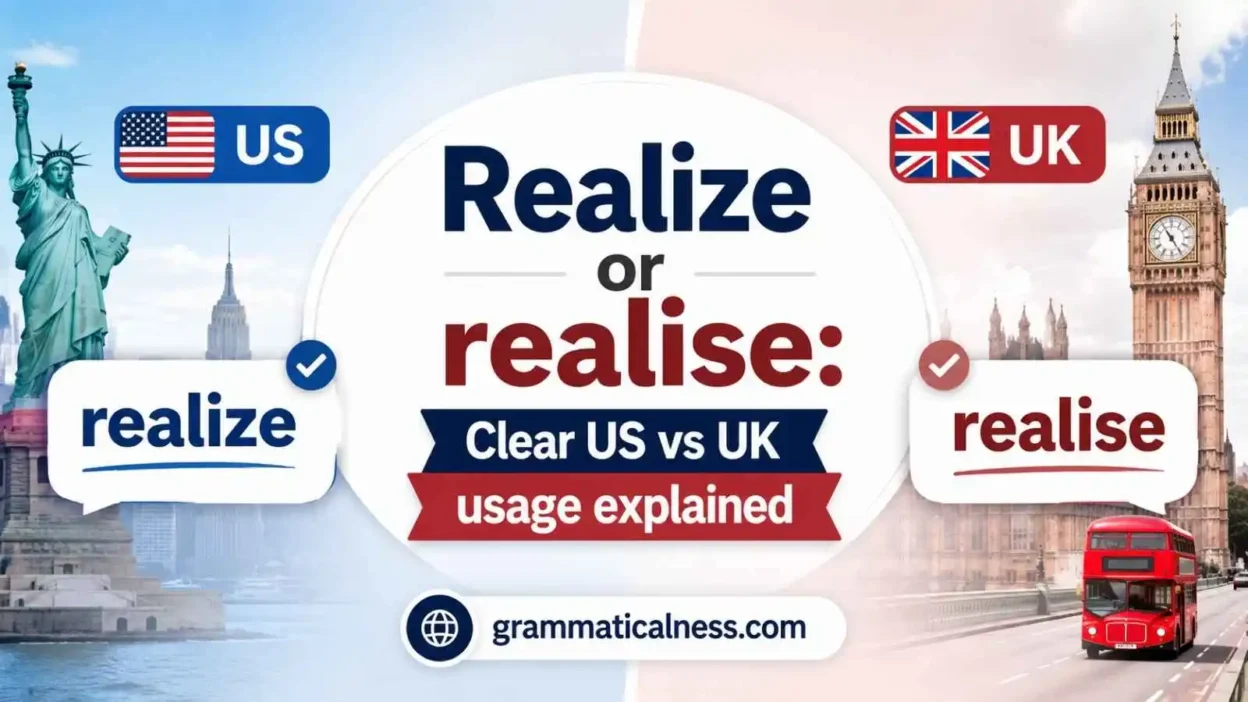
The confusion between realize or realise comes down to one main thing: regional spelling differences in English. Both words come from the same root and mean the same thing in modern usage. The difference is not about meaning but about where each spelling is preferred. If you’re writing for an American audience, the choice is simple. But if you’re reading or writing across regions, the spelling can change depending on the style being followed.
This guide breaks it down clearly so you always know which form to use and why it matters in real writing.
Quick Answer
Both spellings are correct, but usage depends on region:
- Realize → Standard in American English
- Realise → Standard in British English and other Commonwealth regions
In meaning, there is no difference. Both refer to becoming aware of something or making something real.
Why People Confuse Them
People get confused because English has two major spelling systems. One favors simplified endings, and the other preserves older forms. Since both versions appear in books, media, and online writing, readers often see both spellings in different contexts and assume there is a meaning difference when there is not.
Key Differences At A Glance
| Feature | Realize | Realise |
| Region | US English | UK English |
| Spelling system | Simplified ending | Traditional ending |
| Meaning | Become aware / make real | Become aware / make real |
| Usage in writing | Standard in US publications | Standard in UK publications |
Meaning and Usage Difference
There is no meaning difference between realize and realise. Both function as verbs meaning:
- To become aware of something
- To understand something clearly
- To make something real or effective (less common modern use)
The only real distinction is spelling preference by region. American English simplifies many words ending in “-ise” to “-ize,” while British English often keeps the “-ise” ending.
Tone, Context, and Formality
Both forms carry the same tone and formality level. Neither is more formal or informal than the other.
- In US academic, business, and media writing, realize is expected.
- In UK publications, realise is the standard.
Using the “wrong” regional spelling won’t change meaning, but it may look inconsistent in formal writing.
Which One Should You Use?
Choose based on your audience:
- Writing for the United States → use realize
- Writing for the UK, Australia, or similar regions → use realise
- Writing internationally → stay consistent within one style system
Consistency matters more than the choice itself.
When One Choice Sounds Wrong
Neither spelling sounds “wrong” in speech because pronunciation is identical. The only time it feels wrong is in writing when the spelling doesn’t match the expected regional style.
For example:
- A US newspaper using “realise” would look unusual
- A UK newspaper using “realize” would look inconsistent
Common Mistakes (and Quick Fixes)
A common mistake is mixing both spellings in the same document.
Wrong:
- I realize I should organise my notes carefully.
Mixed system issue:
- realize (US) + organise (UK)
Fix:
- I realize I should organize my notes carefully. (US style)
- I realise I should organise my notes carefully. (UK style)
Pick one system and stay consistent throughout your writing.
Everyday Examples
- I just realize how much time I wasted scrolling today.
- She didn’t realize the meeting was moved to Monday.
- I realise I forgot to send the email yesterday.
- They suddenly realise the project deadline is tomorrow.
Both forms work the same way in sentences.
Dictionary-Style Word Details
Verb
- Realize: To become aware of something or understand it clearly (US spelling)
- Realise: Same meaning, used in UK English
Noun
- Realize: Not commonly used as a noun in standard usage
- Realise: Not commonly used as a noun in standard usage
Synonyms
- Realize: understand, notice, recognize, become aware
- Realise: understand, notice, recognize, become aware
Closest plain alternatives are identical for both forms.
Example Sentences
- Realize: I didn’t realize the store closed early.
- Realise: I didn’t realise the store closed early.
Word History
Both spellings come from the same historical English root and developed different regional preferences over time. The difference is mainly a spelling tradition rather than a change in meaning.
Phrases Containing
- Realize: realize the truth, realize a dream, realize potential
- Realise: realise the truth, realise a dream, realise potential
FAQs
Is “realize” correct in the USA?
Yes. “Realize” is the standard American English spelling and is the one you should use in school, business, and everyday writing in the United States.
Is “realise” wrong?
No. “Realise” is not wrong. It is the standard spelling in British English, Australian English, and several other English varieties. It’s simply a regional difference.
Do “realize” and “realise” mean the same thing?
Yes. Both words have the same meaning:
- to become aware of something
- to understand something clearly
- to make something real or effective (less common)
The difference is only spelling, not meaning.
Why does English have two spellings for the same word?
English developed different spelling standards over time in different regions. American English simplified many words (like “realize”), while British English kept older spellings (like “realise”).
Which spelling should I use in exams or formal writing?
It depends on the style your school or organization follows:
- US-based writing → realize
- UK-based writing → realise
The most important rule is consistency.
Are both spellings pronounced the same way?
Yes. Both “realize” and “realise” are pronounced the same way in modern English. The difference is only in writing.
Can I mix “realize” and “realise” in the same document?
It’s not recommended. Mixing both forms makes writing look inconsistent. You should pick one spelling style and stick with it throughout.
Which spelling is more common worldwide?
Globally, usage depends on region:
- “Realize” is dominant in American English content
- “Realise” is common in British and Commonwealth English
Neither is universally “more correct.”
If you want, I can also give you a quick cheat sheet of -ize vs -ise words so you never get confused again.
Conclusion
The difference between realize or realise is simple: they mean the same thing, but belong to different spelling systems. If you’re writing in American English, use “realize.” If you’re following British English, use “realise.” The key is not choosing the “better” word, but using the right one consistently for your audience.