
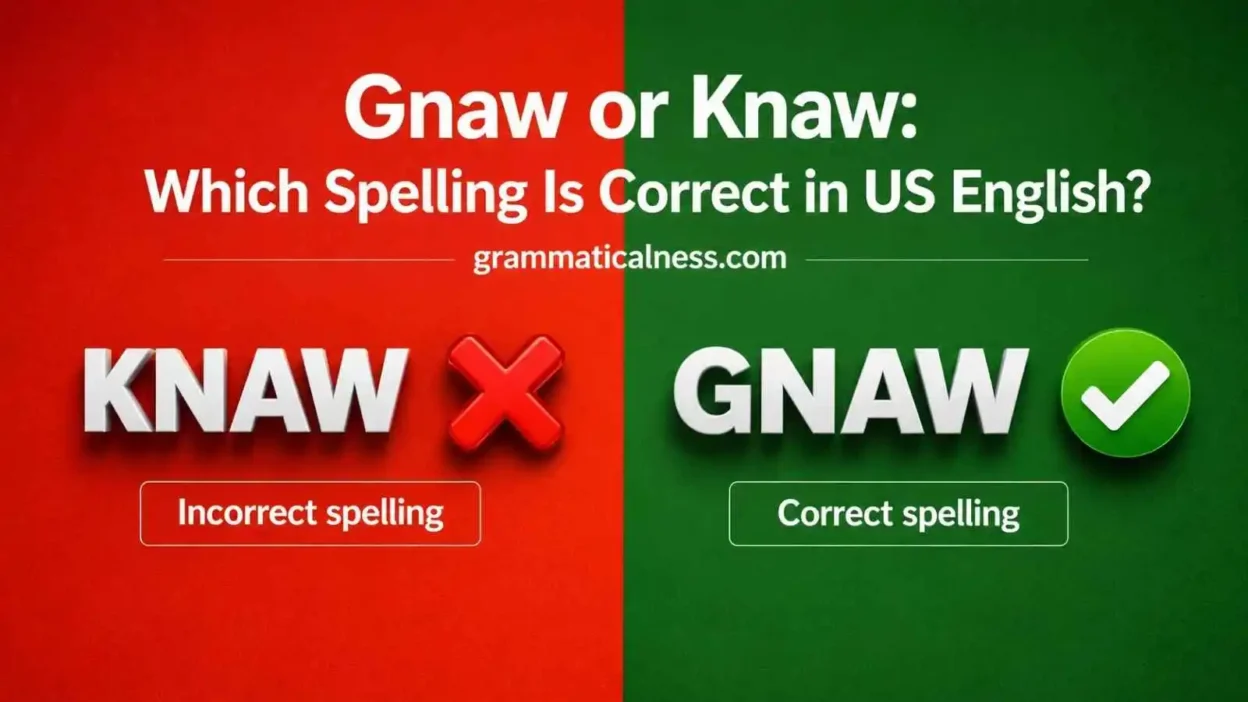
Many people hear the word gnaw and assume it should be spelled knaw. The confusion makes sense because the first letter in gnaw is silent.
Still, in modern US English, only one spelling is considered correct for the meaning “to chew,” “to wear away,” or “to bother persistently.”
Quick Answer
Gnaw is the correct spelling in standard American English.
Knaw is usually a spelling mistake when someone means gnaw.
| Context | Best Choice | Why |
| A dog chewing a bone | Gnaw | Standard dictionary spelling |
| Mice damaging wood | Gnaw | Accepted verb for repeated biting |
| Anxiety bothering someone | Gnaw | Standard figurative use |
| School or professional writing | Gnaw | Expected spelling |
| Sounding the word out by ear | Gnaw | The initial g is silent |
Why People Confuse Them
The biggest reason is pronunciation.
Gnaw is pronounced like “naw.” The g is silent. Because the spoken word starts with an n sound, many people guess the spelling and write knaw.
English has several words with silent opening letters, which makes this kind of mistake common.
Key Differences At A Glance
| Feature | gnaw | knaw |
| Standard US spelling | Yes | No |
| Means to chew repeatedly | Yes | No |
| Means to trouble or bother persistently | Yes | No |
| Found in major dictionaries | Yes | Not for this meaning |
| Appropriate in formal writing | Yes | No |
Meaning and Usage Difference
The real difference is simple.
Gnaw is a verb that means:
- to bite or chew repeatedly
- to wear away gradually
- to trouble or bother someone over time
Examples:
- The puppy gnawed on the chair leg.
- Salt water slowly gnawed at the shoreline.
- A feeling of guilt gnawed at him all week.
Knaw is not the standard spelling for those meanings in modern American English.
Pronunciation adds to the confusion because gnaw sounds like “naw,” not “g-naw.”
Tone, Context, and Formality
Gnaw works in every level of writing.
You can use it in:
- casual conversation
- school assignments
- journalism
- business writing
- fiction
Examples:
- The dog gnawed on the toy.
- Doubt continued to gnaw at her confidence.
Knaw generally looks like a spelling error in modern US writing. Most readers will assume it was typed by mistake.
Which One Should You Use?
Use gnaw whenever you mean:
- chewing repeatedly
- biting away at something
- gradual damage
- persistent emotional discomfort
Choose gnaw whether the meaning is literal or figurative.
Examples:
- Rats gnawed through the wiring.
- Hunger gnawed at him during the long drive.
- The question kept gnawing at her.
When One Choice Sounds Wrong
These sentences sound natural:
- The dog gnawed on a bone.
- Worry gnawed at him all night.
- Mice had gnawed a hole in the wall.
These look incorrect in standard US English:
- The dog knawed on a bone.
- Worry knawed at him all night.
- Mice knawed a hole in the wall.
Because readers expect gnaw, the spelling knaw immediately stands out.
Common Mistakes (and Quick Fixes)
Mistake: Writing knaw because it matches the sound.
Fix: Remember that gnaw begins with a silent g.
Mistake: Assuming gnaw only refers to animals.
Fix: It also describes emotional pressure or worry.
Example:
- Fear gnawed at him before the interview.
Mistake: Avoiding the word because the spelling feels unusual.
Fix: The silent g is normal and widely accepted.
Everyday Examples
- My dog spent an hour gnawing on a rubber toy.
- The squirrels gnawed through part of the fence.
- A small doubt kept gnawing at the back of her mind.
- Years of neglect had gnawed away at the old building.
- Hunger was starting to gnaw at the hikers.
Dictionary-Style Word Details
Verb
Gnaw: Commonly used as a verb meaning to chew repeatedly, wear away gradually, or trouble persistently.
Knaw: Not commonly used as a verb in standard US English for these meanings.
Noun
Gnaw: Not commonly used as a noun in standard US English.
Knaw: Not commonly used as a noun in standard US English.
Synonyms
Gnaw (literal meaning):
Closest plain alternatives:
- chew
- nibble
- bite
Gnaw (figurative meaning):
Closest plain alternatives:
- trouble
- bother
- plague
- worry
Knaw:
No standard synonym set for the meanings covered in this comparison because it is not the accepted spelling in modern US English.
Example Sentences
Gnaw:
- The puppy gnawed the corner of the box.
- Stress continued to gnaw at her.
- Beavers can gnaw through wood surprisingly fast.
Knaw:
- Knaw is generally treated as an incorrect spelling when gnaw is intended.
Word History
Gnaw: An old English word with a long recorded history. Earlier forms were pronounced differently, which helps explain the silent g seen today.
Knaw: Not the standard modern American spelling for the meanings discussed here. Historical spelling and dialect references exist in some sources, but they do not change standard US usage.
Phrases Containing
Gnaw:
- gnaw at someone’s mind
- gnaw at someone’s confidence
- gnaw away
- gnaw on a bone
Knaw:
No common modern US phrases for the meanings covered here.
FAQs
Is gnaw or knaw correct?
Gnaw is the correct spelling in standard American English. Knaw is generally considered a misspelling when someone means “to chew,” “to wear away,” or “to trouble persistently.”
Why do people spell gnaw as knaw?
People often write knaw because gnaw is pronounced like “naw.” Since the g is silent, the spelling can seem unexpected to those who have only heard the word spoken.
What does gnaw mean?
Gnaw usually means to bite or chew something repeatedly. It can also mean to gradually wear something away or to cause ongoing worry or discomfort.
Examples:
- The dog gnawed on a bone.
- Doubt gnawed at her confidence.
Is knaw a real word?
Knaw may appear in historical, dialectal, or misspelled forms in some sources, but it is not the standard spelling used in modern American English for the meanings discussed in this article.
How do you pronounce gnaw?
Gnaw is pronounced “naw” (/nɔː/ in many dictionaries). The initial g is silent.
Can gnaw be used figuratively?
Yes. In figurative use, gnaw describes a feeling, thought, or concern that continually bothers someone.
Examples:
- Anxiety gnawed at him all day.
- The unanswered question kept gnawing at her.
What is the past tense of gnaw?
The most common past tense and past participle form is gnawed.
Examples:
- The puppy gnawed the furniture.
- The wood had been gnawed by rodents.
Is gnaw formal or informal?
Gnaw is neutral and works in both formal and informal writing. You can use it in everyday conversation, academic writing, journalism, and professional documents.
What are some synonyms for gnaw?
Depending on the context, common alternatives include:
For chewing:
- chew
- bite
- nibble
For emotional discomfort:
- worry
- trouble
- plague
- bother
How can I remember the correct spelling?
A simple trick is to remember that gnaw starts with a silent g. Even though it sounds like “naw,” the standard spelling is always gnaw in modern US English.
Conclusion
If you are choosing between gnaw and knaw, the correct choice in modern US English is gnaw.
Use gnaw when talking about repeated chewing, gradual damage, or a feeling that keeps bothering someone. The spelling knaw usually appears because the silent g makes the word sound like “naw,” but it is not the standard spelling readers expect today.