
Many people mix up drier and dryer because the words look almost identical. In some situations, both are technically correct, but they are not always used the same way.
The short answer is simple:
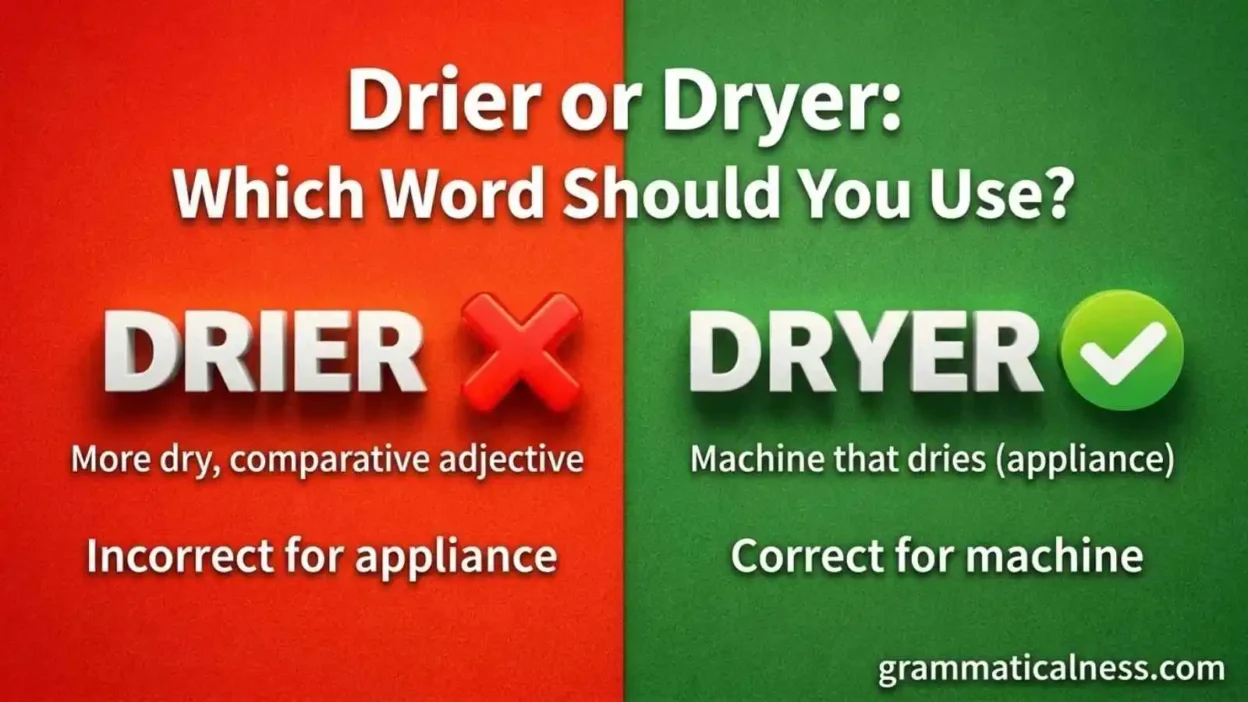
- Drier is usually an adjective meaning “more dry.”
- Dryer is most commonly a noun for a machine that dries things.
The confusion happens because dryer can also appear as an adjective in some contexts, especially in American English. Knowing the sentence structure usually makes the right choice obvious.
Quick Answer
Use drier when comparing how dry something is.
- “This towel feels drier than the other one.”
Use dryer when talking about a machine that dries clothes, hair, or other items.
- “The dryer stopped working.”
In some American writing, dryer may appear as an adjective meaning “less wet,” but drier is generally the safer and more widely accepted choice for comparisons.
Why People Confuse Them
The words come from the same root word: dry.
Adding -er to English words often creates:
- a comparison adjective (“smaller,” “faster”)
- or a noun describing a person or thing that performs an action (“teacher,” “washer”)
That creates overlap:
- drier = more dry
- dryer = a thing that dries
The pronunciation is also nearly identical in everyday speech, which makes the spelling confusion even more common.
Key Differences At A Glance
| Context | Best Choice | Why |
| Comparing dryness | drier | Standard comparative adjective |
| Talking about a laundry machine | dryer | Standard noun form |
| Talking about a hair tool | dryer | Refers to the device |
| Formal or edited writing | drier | More commonly preferred as adjective |
| Product names or casual usage | dryer | Sometimes used informally as adjective |
Meaning and Usage Difference
The biggest difference is grammatical function.
Drier
Drier is mainly the comparative form of the adjective dry.
It means:
- less wet
- containing less moisture
- more arid
Examples:
- “Arizona has a drier climate than Florida.”
- “Your hands look drier in winter.”
- “This paint feels drier now.”
Dryer
Dryer is primarily a noun.
It refers to:
- a clothes dryer
- a hair dryer
- a machine or device that removes moisture
Examples:
- “I left the towels in the dryer.”
- “Her hair dryer overheated.”
In some US writing, people also use dryer as an adjective:
- “The air feels dryer today.”
Still, many editors and dictionaries prefer drier for adjective use because it avoids confusion with the noun.
Pronunciation
Pronunciation usually does not help distinguish them because both are commonly pronounced almost the same way:
- “DRY-er”
That is one reason spelling mistakes happen so often.
Tone, Context, and Formality
Both words are standard English, but their roles differ.
Drier
- More common in edited and formal writing when used as an adjective
- Clearer in comparisons
- Often preferred in academic, weather, and professional writing
Dryer
- Standard noun in all situations
- Common in household language and product descriptions
- Occasionally used informally as an adjective in American English
Small comparison block:
- drier → comparative adjective
- dryer → noun, occasionally adjective
- drier → clearer in formal comparison sentences
- dryer → clearer when discussing appliances
Which One Should You Use?
Use drier if you can replace it with:
- “more dry”
- “less wet”
Example:
- “This season was drier than last year.”
Use dryer if you mean:
- a machine
- a drying device
Example:
- “The dryer is still running.”
If you are unsure during a comparison sentence, choose drier. It is usually the safer option in standard American English.
When One Choice Sounds Wrong
Some sentences become confusing when the wrong form is used.
Incorrect:
- “The laundry is in the drier.”
Why it sounds wrong:
- Readers expect the machine noun here.
Correct:
- “The laundry is in the dryer.”
Another example:
Less natural:
- “Today feels dryer than yesterday.”
More standard:
- “Today feels drier than yesterday.”
The second version is usually preferred in edited US writing.
Common Mistakes (and Quick Fixes)
Mistake 1: Using “dryer” for every situation
Incorrect:
- “My skin gets dryer in winter.”
Better:
- “My skin gets drier in winter.”
Quick fix:
If you are comparing moisture levels, use drier.
Mistake 2: Using “drier” for machines
Incorrect:
- “Put the sheets in the drier.”
Correct:
- “Put the sheets in the dryer.”
Quick fix:
Machines use dryer.
Mistake 3: Confusing speech with spelling
Because both words sound nearly the same, many people write the wrong one without noticing.
Quick fix:
Check whether the word describes:
- a comparison → drier
- a device → dryer
Everyday Examples
Here are realistic examples in modern American English.
Drier
- “This winter has been much drier than last year.”
- “I need a drier towel.”
- “The chicken turned out drier than expected.”
- “Nevada is generally drier than Oregon.”
Dryer
- “The dryer made a strange noise.”
- “Can you move the clothes to the dryer?”
- “She bought a new hair dryer.”
- “The dryer stopped mid-cycle.”
Dictionary-Style Word Details
Verb
Drier:
Not commonly used as a verb in standard US English.
Dryer:
Not commonly used as a verb in standard US English.
Noun
Drier:
Rare as a noun in modern standard American English.
Dryer:
A machine or device that removes moisture.
Examples:
- clothes dryer
- hair dryer
- hand dryer
Synonyms
Drier:
Closest plain alternatives:
- less wet
- more arid
- less moist
Possible opposites:
- wetter
- damper
Dryer:
Closest plain alternatives:
- drying machine
- drying appliance
Possible opposites do not clearly apply in normal usage.
Example Sentences
Drier:
- “The desert air became even drier overnight.”
- “These cookies taste drier than the first batch.”
Dryer:
- “The dryer needs a new heating element.”
- “He unplugged the hair dryer after using it.”
Word History
Drier:
Developed as the comparative form of the adjective “dry.”
Dryer:
Developed as a noun describing something that dries. Over time, it became strongly associated with household appliances.
The overlap between the two spellings has existed for a long time, which explains the ongoing confusion.
Phrases Containing
Drier:
- drier climate
- drier conditions
- drier skin
Dryer:
- clothes dryer
- hair dryer
- tumble dryer
- hand dryer
FAQs
Is “drier” or “dryer” more correct?
Both are correct, but they are used differently.
- Drier is usually the comparative adjective meaning “more dry.”
- Dryer is usually a noun for a machine that dries things.
Example:
- “This climate is drier.”
- “The dryer is broken.”
Can “dryer” be used as an adjective?
Yes, sometimes in American English. You may see sentences like:
- “The air feels dryer today.”
However, many editors and grammar references still prefer:
- “The air feels drier today.”
For comparison sentences, drier is usually the clearer choice.
Why do “drier” and “dryer” sound the same?
In everyday speech, both words are often pronounced almost identically:
- “DRY-er”
That is why people frequently confuse the spellings in writing.
Which word should I use for weather?
Use drier when comparing weather or climate.
Examples:
- “California is drier than Washington.”
- “We had drier conditions this summer.”
Is a hair dryer spelled with “y” or “ie”?
The correct spelling is:
- hair dryer
Because it refers to a device or machine, the noun form dryer is correct.
Is “tumble drier” correct?
In American English, people usually say:
- “dryer”
- or “clothes dryer”
“Tumble drier” is more common in British English, though Americans will still understand it.
Which is correct: “My skin is dryer” or “My skin is drier”?
The more standard and widely preferred version is:
- “My skin is drier.”
This is because the sentence compares dryness levels.
Can “drier” be used as a noun?
It is very uncommon in modern standard American English. Most noun uses related to machines or devices use dryer instead.
What is the easiest way to remember the difference?
A simple trick is:
- drier = “more dry”
- dryer = machine that dries
If you can replace the word with “more dry,” choose drier.
Conclusion
The difference between drier and dryer mostly comes down to grammar and context.
Use:
- drier for comparisons involving dryness
- dryer for machines and drying devices
Even though some American writers use dryer as an adjective, drier remains the clearer and more widely accepted choice in comparison sentences.
When in doubt:
- “more dry” → drier
- drying machine → dryer