
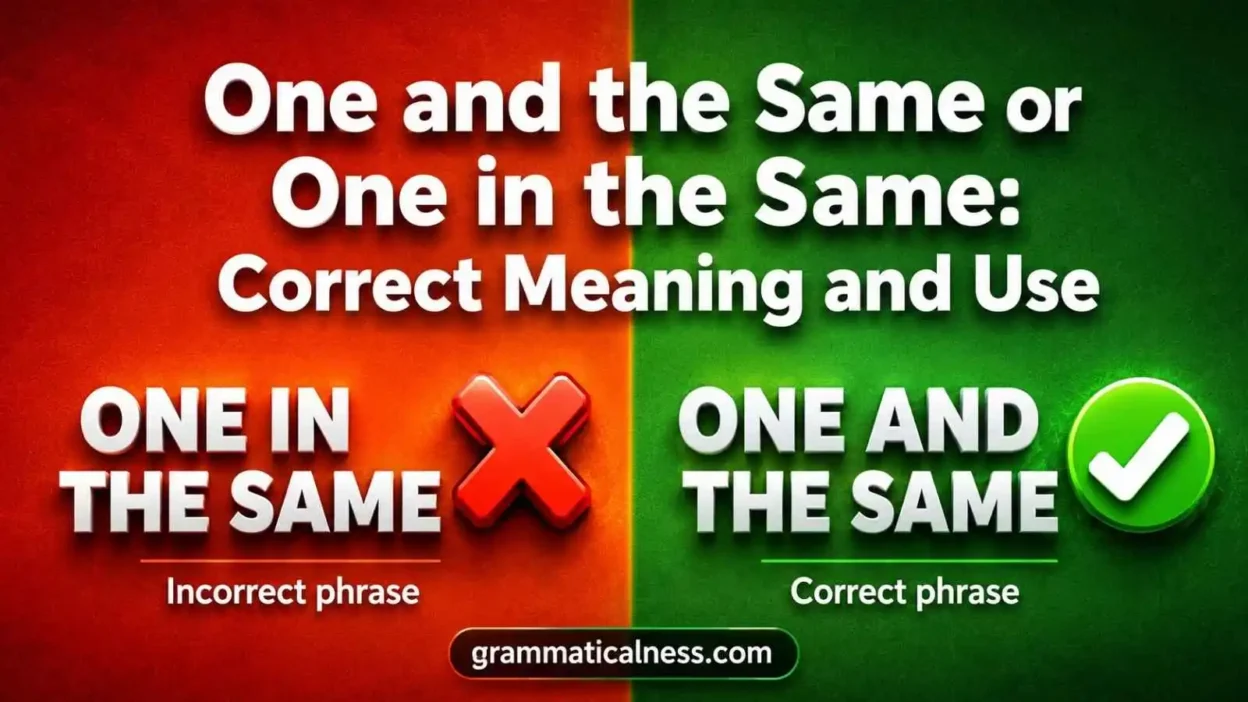
The choice between one and the same or one in the same causes confusion because the two phrases sound very similar in fast speech. In careful US English, however, the standard phrase is one and the same.
Use it when two people, things, roles, names, or ideas seem separate but are actually identical. For example, “The restaurant’s owner and chef are one and the same” means the owner and the chef are the same person.
The form “one in the same” is common, but it is not the standard idiom. It usually appears when someone writes the phrase the way it sounds instead of the way it is traditionally written.
Quick Answer
One and the same is the correct phrase in standard US English. It means two things or people are actually identical, not separate. One in the same is a common mistaken version and should be avoided in school, business, and edited writing.
Correct: The founder and CEO are one and the same.
Incorrect: The founder and CEO are one in the same.
Why People Confuse Them
People confuse these phrases mostly because of pronunciation. In normal speech, “and” can sound very weak. Many speakers say it quickly, almost like “n.” That soft sound can make “one and the same” sound close to “one in the same.”
The confusion is understandable, but writing has stricter expectations than casual speech. The idiom uses “and,” not “in,” because it joins two ideas: one and the same. It repeats the idea of sameness for emphasis.
So the mistake is not about meaning alone. It is about the fixed wording of the phrase. When you want the accepted expression, write “one and the same.”
Key Differences At A Glance
Here is the simple difference:
• One and the same: the standard idiom meaning identical or the same person or thing.
• One in the same: a common mistaken form, usually caused by sound confusion.
• Best choice for careful writing: one and the same.
• Main memory tip: use “and” because the phrase joins two matching ideas.
The phrase is not usually about one thing being inside another thing. That is why “in” feels wrong in this expression. You are not describing location. You are describing identity.
Meaning and Usage Difference
“One and the same” means that two things are not truly different. They may have different names, labels, jobs, or appearances, but they refer to the same person, object, idea, or result.
Examples:
The buyer and the account owner are one and the same.
Her private opinion and public statement were one and the same.
For this project, the deadline and launch date are one and the same.
“One in the same” does not work as the standard idiom because “in” suggests position or containment. It sounds as if one thing is inside another same thing, which is not the meaning people usually intend.
Tone, Context, and Formality
“One and the same” works in both casual and formal writing. You can use it in emails, essays, reports, articles, legal forms, and everyday conversation. It sounds clear, natural, and accepted.
“One in the same” may still be understood by readers because many people recognize the intended phrase. Still, it can look careless in polished writing. Teachers, editors, clients, and careful readers may notice it as an error.
This is not a US vs UK spelling issue. It is also not a style preference where either form works equally well. For standard US writing, choose “one and the same.”
Which One Should You Use?
| Context | Best Choice | Why |
| School essay | one and the same | It is the accepted idiom. |
| Business email | one and the same | It keeps the sentence professional. |
| Blog article | one and the same | It avoids a common phrase error. |
| Legal or official form | one and the same | It clearly means one person or thing, not two. |
| Casual text | one and the same | It is still the safer and clearer choice. |
| Dialogue showing a mistake | one in the same | Use only if the error is intentional. |
In almost every normal situation, “one and the same” is the right choice.
When One Choice Sounds Wrong
“One in the same” sounds wrong because “in” changes the logic of the phrase. The intended idea is identity, not location.
Wrong: Her coach and mentor are one in the same.
Correct: Her coach and mentor are one and the same.
Wrong: The two reports are one in the same.
Correct: The two reports are one and the same.
Wrong: His fear and anger were one in the same.
Correct: His fear and anger were one and the same.
If you can replace the phrase with “the same person” or “the same thing,” use “one and the same.”
Common Mistakes (and Quick Fixes)
A common mistake is typing “in” because that is what the phrase sounds like in speech.
Mistake: The author and narrator are one in the same.
Fix: The author and narrator are one and the same.
Another mistake is using the phrase when simple “the same” would sound better.
Wordy: Their goals are one and the same.
Simpler: Their goals are the same.
That does not make “one and the same” wrong. It simply means the phrase is best when you want emphasis. Use it when the identity may surprise the reader or when two labels need to be clearly connected.
Everyday Examples
The landlord and property manager are one and the same.
At that small company, the designer and customer support lead are one and the same.
My online username and business name are not one and the same.
For many fans, the actor and the character are almost one and the same.
In this case, the problem and the solution are one and the same.
The billing address and shipping address are one and the same.
Her personal values and work values are one and the same.
The two passwords should not be one and the same.
His public message and private belief were one and the same.
For the twins, their birthday celebration and graduation party were one and the same event.
Dictionary-Style Word Details
Verb
• one and the same: Not commonly used as a verb in standard US English. It is a fixed phrase.
• one in the same: Not commonly used as a verb in standard US English. It is usually a mistaken version of the phrase.
Example: You would not say, “They one-and-the-samed the issue.” That is not normal usage.
Noun
• one and the same: Not usually used as a noun by itself. It functions as a fixed phrase that describes identity.
• one in the same: Not usually used as a noun. It is best treated as a nonstandard wording, not a separate noun phrase with its own accepted meaning.
Example: In “The owner and chef are one and the same,” the phrase describes the subject after the verb “are.”
Synonyms
• one and the same: closest plain alternatives include identical, the same, the very same, the same person, and the same thing.
• one in the same: No exact standard synonym is needed because it is usually an error for “one and the same.”
Useful antonyms for the idea include different, separate, distinct, and unrelated.
Use “identical” when you want a shorter, more direct word. Use “one and the same” when you want to stress that two names or roles point to one identity.
Example Sentences
• one and the same: The account holder and applicant are one and the same.
• one and the same: To her, kindness and strength were one and the same.
• one and the same: The rumor and the official story were not one and the same.
• one in the same: This is commonly used by mistake when writers mean “one and the same.”
• one in the same: In careful writing, change it to “one and the same.”
Word History
• one and the same: This is an old fixed expression used to make “the same” more emphatic. The phrase has a long history, and trusted references connect it to older forms that expressed “one and the same” as a strong identity statement.
• one in the same: This appears to be a later misunderstanding based on sound. Because “and” can become weak in speech, some writers hear the phrase as “one in the same.”
The safest practical point is simple: the established idiom uses “and.”
Phrases Containing
• one and the same: “are one and the same,” “is one and the same,” “one and the same person,” “one and the same thing,” “one and the same issue.”
• one in the same: Commonly appears in mistaken versions such as “are one in the same” or “one in the same thing.” In standard writing, these should usually be corrected to “one and the same.”
FAQs
Is “one and the same” correct?
Yes. “One and the same” is the correct phrase in standard US English. It means two people, things, names, roles, or ideas are actually identical. For example, “The owner and manager are one and the same” means the owner and manager are the same person.
Is “one in the same” wrong?
Yes, in careful writing, “one in the same” is considered incorrect. It is a common mistake that happens because “and” can sound like “in” when people speak quickly. The standard phrase uses “and,” not “in.”
What does “one and the same” mean?
“One and the same” means that two things that may seem different are actually the same. It is often used when one person has two roles, one thing has two names, or two ideas point to the same result.
Can I use “one in the same” in casual writing?
It may be understood in casual writing, but it is still better to avoid it. Readers may see it as a mistake. If you want your writing to look clear and polished, use “one and the same.”
Why do people say “one in the same”?
People often say or write “one in the same” because of how the phrase sounds in speech. The word “and” can become very soft, almost like “n,” which makes the phrase easy to mishear.
What is a simple synonym for “one and the same”?
Simple alternatives include “the same,” “identical,” “the very same,” or “the same person.” For example, “The two accounts are one and the same” can also mean “The two accounts are the same.”
How do I remember the correct phrase?
Remember that the phrase joins two matching ideas, so it needs “and.” Write “one and the same,” not “one in the same.”
Conclusion
The correct choice is “one and the same.” Use it when two people, things, names, roles, or ideas are actually identical.
“One in the same” is a common mistaken form, but it is not the standard idiom. When you write for school, work, or publication, choose “and,” not “in.”
Easy memory tip: the phrase joins two matching ideas, so it needs “and.”
Yes. “One and the same” is the correct phrase in standard US English. It means two people, things, names, roles, or ideas are actually identical. For example, “The owner and manager are one and the same” means the owner and manager are the same person.
Yes, in careful writing, “one in the same” is considered incorrect. It is a common mistake that happens because “and” can sound like “in” when people speak quickly. The standard phrase uses “and,” not “in.”
“One and the same” means that two things that may seem different are actually the same. It is often used when one person has two roles, one thing has two names, or two ideas point to the same result.
It may be understood in casual writing, but it is still better to avoid it. Readers may see it as a mistake. If you want your writing to look clear and polished, use “one and the same.”
People often say or write “one in the same” because of how the phrase sounds in speech. The word “and” can become very soft, almost like “n,” which makes the phrase easy to mishear.
Simple alternatives include “the same,” “identical,” “the very same,” or “the same person.” For example, “The two accounts are one and the same” can also mean “The two accounts are the same.”
Remember that the phrase joins two matching ideas, so it needs “and.” Write “one and the same,” not “one in the same.”