
People often wonder whether the correct spelling is “smoky” or “smokey.” The confusion is understandable because both forms appear online, on menus, and in business names.
In standard American English, though, one form is clearly preferred in most writing.
Quick Answer
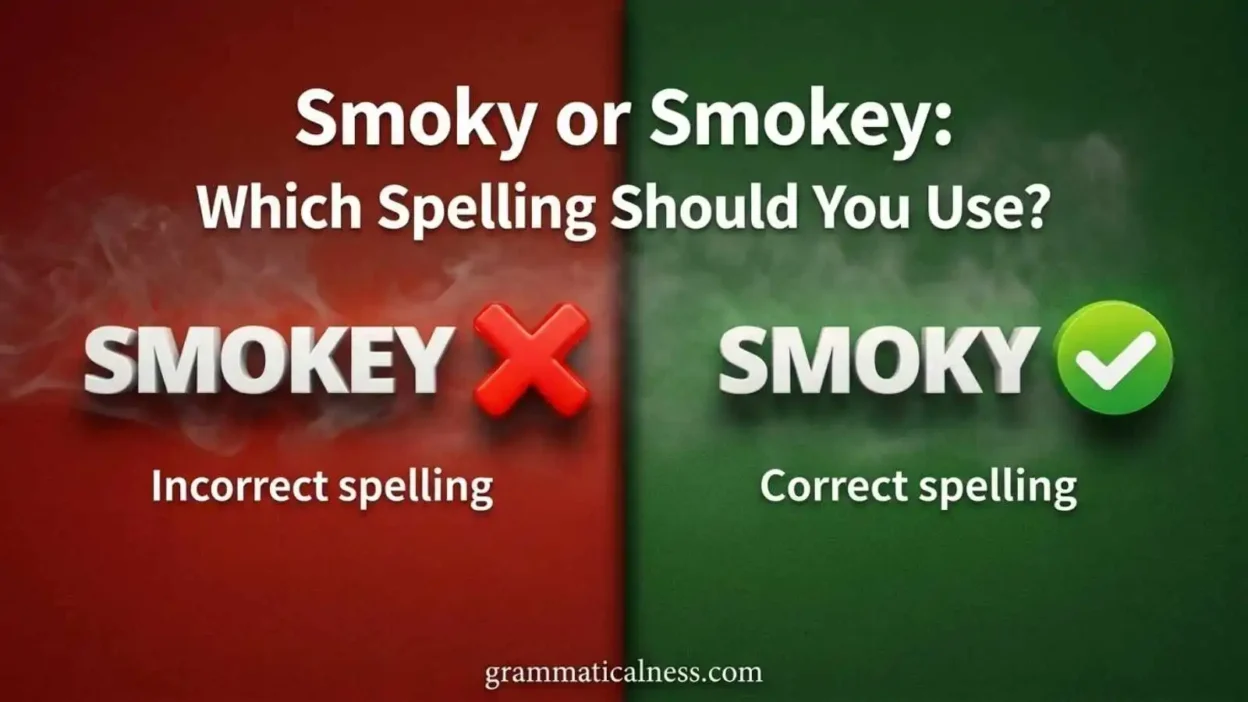
“Smoky” is the standard spelling in American English when describing smoke, smoke-like flavor, haze, color, or appearance.
“Smokey” is usually used as:
- a proper name
- a nickname
- a brand style choice
- part of a title or business name
For regular everyday writing, “smoky” is almost always the safer and more correct choice.
| Context | Best Choice | Why |
| Describing flavor | smoky | Standard adjective spelling |
| Describing air or haze | smoky | Accepted dictionary form |
| Makeup style | smoky | Standard usage in beauty writing |
| Restaurant brand name | smokey | Often a deliberate style choice |
| A nickname or character name | Smokey | Proper-name spelling |
Why People Confuse Them
The words sound almost identical in normal speech. Most Americans pronounce both as “SMOH-kee.”
People also see “smokey” in:
- BBQ restaurant names
- product labels
- song titles
- nicknames
- “Smokey Bear”
Because of that exposure, many assume both spellings are equally standard in all situations.
They are not.
Key Differences At A Glance
| Feature | smoky | smokey |
| Standard dictionary adjective | Yes | Usually no |
| Common in edited writing | Yes | Rare |
| Common in brand names | Sometimes | Very common |
| Used as a proper name | Rare | Yes |
| Preferred in school or business writing | Yes | No |
Meaning and Usage Difference
“Smoky” is the normal adjective form. It describes something connected to smoke or something that resembles smoke.
Examples:
- a smoky cabin
- smoky mountain air
- smoky whiskey
- smoky eye makeup
It can describe:
- smell
- flavor
- atmosphere
- color
- appearance
“Smokey” usually appears as a name or stylistic spelling instead of a standard adjective.
Examples:
- Smokey Robinson
- Smokey Bear
- Smokey’s BBQ Pit
In some informal settings, people use “smokey” as an alternative spelling for flavor descriptions. You may see phrases like:
- smokey ribs
- smokey sauce
Still, most American dictionaries and style guides prefer “smoky” in standard writing.
The pronunciation difference is usually minimal or nonexistent.
Tone, Context, and Formality
“Smoky” sounds polished, standard, and professional.
You would normally use it in:
- school papers
- restaurant reviews
- recipes
- journalism
- marketing copy
- business communication
“Smokey” feels more informal or branded.
It often appears in:
- restaurant names
- logos
- casual social media captions
- nicknames
That does not make “smokey” automatically wrong. It simply serves a different role most of the time.
Which One Should You Use?
Use “smoky” when you are writing normal descriptive English.
Examples:
- The kitchen had a smoky smell after dinner.
- This bourbon has a smoky finish.
- Her smoky eye makeup looked dramatic.
Use “Smokey” only when it is part of a proper name, title, or intentional branding.
Examples:
- We stopped at Smokey Joe’s Cafe.
- Smokey Bear became a famous wildfire mascot.
- I listened to Smokey Robinson on the drive home.
If you are unsure, choose “smoky.”
When One Choice Sounds Wrong
Some sentences immediately sound unnatural with the wrong spelling.
Incorrect:
- The apartment became smokey after the fire alarm went off.
Better:
- The apartment became smoky after the fire alarm went off.
Incorrect:
- I ordered the smoky burger from Smoky Mike’s BBQ.
Better:
- I ordered the smoky burger from Smokey Mike’s BBQ.
The adjective stays “smoky,” while the business name keeps its chosen spelling.
Common Mistakes (and Quick Fixes)
Mistake:
- “This candle smells smokey.”
Fix:
- “This candle smells smoky.”
Mistake:
- Treating “smokey” as the default adjective in formal writing.
Fix:
- Use “smoky” for standard descriptive use.
Mistake:
- Changing official names to match dictionary spelling.
Fix:
- Keep the original spelling in names and titles.
Examples:
- Smokey Robinson
- Smokey Bear
- Smokey’s Grill
Everyday Examples
Here are some realistic American English examples.
- The campfire left a smoky smell on our jackets.
- These wings have a rich smoky flavor.
- The city looked smoky after the wildfire nearby.
- She used dark shades to create a smoky eye look.
- We ate dinner at Smokey Dan’s Roadhouse.
- My uncle’s old dog was named Smokey.
- The bartender recommended a smoky Scotch whiskey.
- The concert playlist included several Smokey Robinson songs.
Dictionary-Style Word Details
Verb
smoky:
Not commonly used as a verb in standard American English.
smokey:
Not commonly used as a verb in standard American English.
Noun
smoky:
Rarely used as a noun. Primarily an adjective.
smokey:
Can function informally as a nickname or proper name.
Synonyms
smoky:
Closest plain alternatives:
- smoky-smelling
- hazy
- wood-fired
- smoke-filled
- charred
Possible opposites:
- fresh
- clear
- clean-smelling
smokey:
Usually not treated as a standard adjective synonym because it mainly appears in names or branding.
Example Sentences
smoky:
- The sauce had a deep smoky flavor.
- We drove through smoky mountain roads.
- Her apartment smelled smoky after the candles burned all night.
smokey:
- Smokey’s Barbecue opened a second location downtown.
- My grandfather called his gray cat Smokey.
- We watched an old Smokey Bear commercial online.
Word History
smoky:
This is the long-established standard adjective form related to smoke in English.
smokey:
This spelling developed mainly through names, nicknames, and branding styles. Clear historical rules separating the two are limited.
Phrases Containing
smoky:
- smoky flavor
- smoky eyes
- smoky air
- smoky finish
- smoky haze
smokey:
- Smokey Bear
- Smokey Robinson
- Smokey’s BBQ
FAQs
Is “smoky” or “smokey” correct?
“Smoky” is the standard and preferred spelling in American English when describing smoke, flavor, smell, haze, or appearance.
Examples:
- smoky flavor
- smoky air
- smoky eyes
“Smokey” is usually reserved for names, nicknames, or branding.
Why do some restaurants use “smokey”?
Many restaurants use “smokey” as a branding choice because it looks casual, rustic, or memorable. That does not make it the standard adjective spelling in formal writing.
Example:
- Smokey Joe’s BBQ
But:
- The ribs had a smoky flavor.
Is “smokey” considered wrong?
In standard edited writing, “smokey” is usually considered nonstandard when used as a regular adjective.
However, it is completely acceptable in:
- proper names
- nicknames
- titles
- brand names
Do “smoky” and “smokey” mean different things?
Usually, no. They generally point to the same smoke-related idea.
The main difference is usage:
- “smoky” = standard adjective
- “Smokey” = name or stylistic spelling
How do Americans usually spell it?
Most Americans use “smoky” in everyday writing, recipes, reviews, and descriptions.
Examples:
- smoky barbecue sauce
- smoky mountain air
- smoky whiskey
Are they pronounced differently?
Usually not. Most people pronounce both as:
- “SMOH-kee”
The spelling difference matters more in writing than in speech.
Is it “smoky flavor” or “smokey flavor”?
“Smoky flavor” is the standard and preferred form in American English.
While “smokey flavor” appears online and in branding, it is less accepted in formal or edited writing.
Why is it called “Smokey Bear” instead of “Smoky Bear”?
“Smokey Bear” is the official name of the famous wildfire prevention mascot. The spelling is part of the proper name and should not be changed.
Can I use “smokey” in casual writing?
You can, especially in informal posts or creative branding. Still, “smoky” will usually look more polished and grammatically standard.
Which spelling should I use if I’m unsure?
Use “smoky.” It is the safer and more widely accepted choice in American English.
Conclusion
For standard American English, “smoky” is the correct and preferred spelling in most situations.
Use it when describing:
- flavor
- smell
- haze
- color
- atmosphere
- makeup styles
“Smokey” usually belongs in names, nicknames, and branding.
If you are writing everyday descriptive English, “smoky” is almost always the better choice.