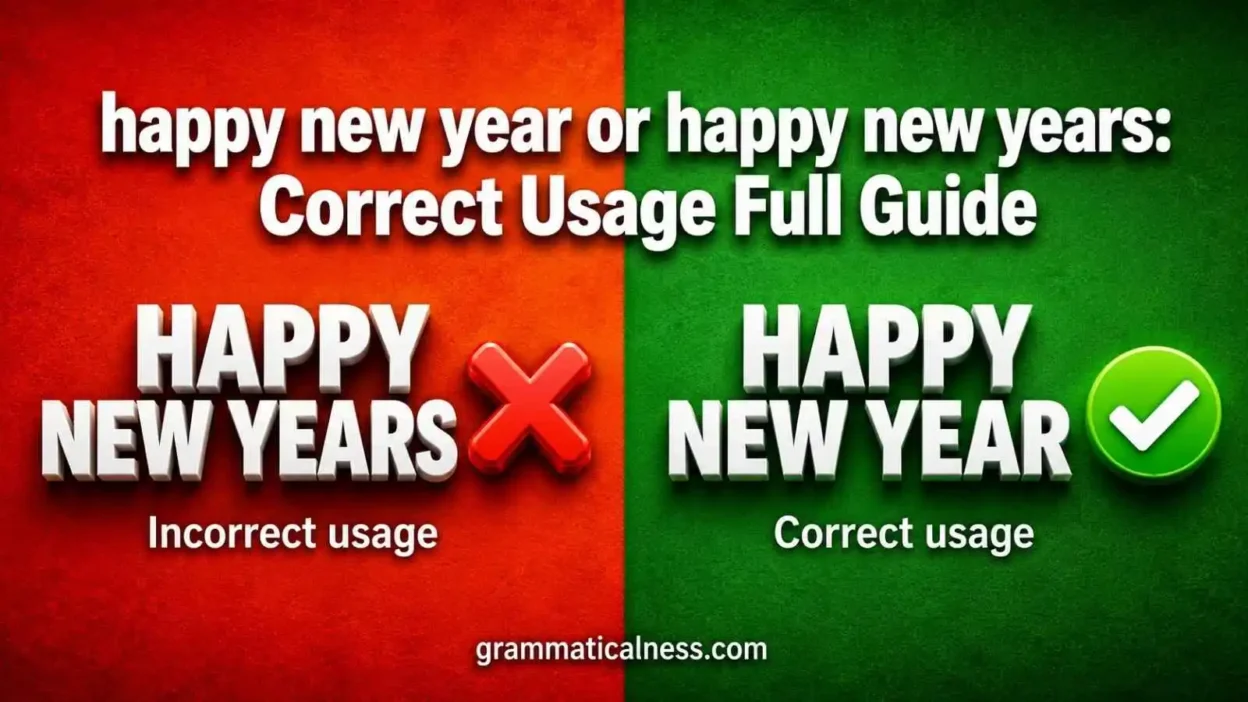
The correct standard greeting is Happy New Year, not Happy New Years.
Use Happy New Year when you are wishing someone well at the start of a new calendar year. The word year stays singular because you are greeting one new year, not several new years at once.
Happy New Years is a common mistake. People often write it because they are thinking of phrases like New Year’s Eve or New Year’s Day, but those are different structures.
Quick Answer
Write Happy New Year!
Do not write Happy New Years! in standard US English.
The simple rule is this: when the phrase is a greeting, use Year without an apostrophe and without an s.
Correct: Happy New Year, Mia!
Incorrect: Happy New Years, Mia!
Why People Confuse Them
This mistake is easy to understand. English has several New Year phrases that sound almost the same.
You may hear New Year’s Eve, New Year’s Day, and New Year’s resolutions. In those phrases, New Year’s is possessive. It points to something connected with the holiday or the start of the year.
But Happy New Year is different. It is a direct greeting. You are not naming the eve, the day, or a resolution. You are simply wishing someone a happy start to the year.
Another reason for the mistake is sound. In fast speech, Year and Year’s can sound close. That makes some people add an s when they write the phrase.
Key Differences At A Glance
| Context | Best Choice | Why |
|---|---|---|
| Greeting someone at midnight | Happy New Year | It is the standard greeting. |
| Writing a holiday card | Happy New Year | You are wishing one new year to be happy. |
| Posting a short caption | Happy New Year | The greeting does not need an s. |
| Referring to December 31 | Not happy new years | Use a different phrase, such as New Year’s Eve. |
| Referring to several years | new years | This is possible only when you truly mean multiple years. |
Meaning and Usage Difference
happy new year means “I hope the new year is happy for you.” In normal greeting form, it is written as Happy New Year!
happy new years suggests more than one new year. That meaning does not fit the usual holiday greeting because people are welcoming one new year at a time.
Compact comparison:
- happy new year: the standard greeting for the start of a year.
- happy new years: not standard as a greeting; it wrongly makes year plural.
This is not a pronunciation issue. The problem is written form and grammar. The standard phrase uses the singular noun year.
Tone, Context, and Formality
Happy New Year works in almost every setting. It is natural in texts, emails, greeting cards, workplace messages, school announcements, and social captions.
It can sound warm, polite, festive, or professional depending on the rest of the message.
Happy New Years sounds casual at best and incorrect in standard writing. A reader may still understand the meaning, but the phrase can look careless in a card, work email, flyer, or public message.
For polished writing, always use Happy New Year.
Which One Should You Use?
Use Happy New Year when greeting someone directly.
You can write it by itself:
Happy New Year!
You can add a name:
Happy New Year, Jordan!
You can include it in a longer sentence:
We wish you a happy New Year and a peaceful January.
In that longer sentence, happy is not capitalized unless it starts the sentence. The phrase still uses New Year because it refers to the holiday greeting.
Do not use Happy New Years unless you are quoting someone else’s mistake or discussing the phrase itself.
When One Choice Sounds Wrong
Happy New Years sounds wrong because the plural years does not match the meaning of the greeting.
You are not saying, “May several years be happy.” You are saying, “May this new year be happy.”
The phrase can also look like a confused version of New Year’s. But adding only s without an apostrophe does not make the holiday phrase correct.
Wrong: Happy New Years Eve!
Better: Happy New Year!
Different phrase: Happy New Year’s Eve!
That last phrase is correct only when you include Eve. It is not the same as the plain greeting.
Common Mistakes (and Quick Fixes)
Mistake: Happy New Years!
Fix: Happy New Year!
Mistake: Happy New Year’s!
Fix: Happy New Year!
Mistake: Wishing you a Happy New Year.
Fix: Wishing you a happy New Year.
Mistake: New Years resolution
Fix: New Year’s resolution
These mistakes come from mixing three different ideas: the greeting, the holiday, and things connected to the holiday. Keep the greeting simple: Happy New Year.
Everyday Examples
Happy New Year! I hope 2026 brings you peace and good news.
Happy New Year, everyone! Thanks for making this team a great place to work.
Wishing you a happy New Year and a strong start to January.
Happy New Year, Mom! Can’t wait to celebrate with you this weekend.
Our office will reopen after New Year’s Day. Happy New Year!
Happy New Year from all of us at Bright Oak Dental.
Each example uses Happy New Year for the greeting. When the sentence refers to a specific holiday name, such as New Year’s Day, the apostrophe belongs there.
Dictionary-Style Word Details
Verb
happy new year: Not commonly used as a verb in standard US English. It is a greeting phrase, not an action word.
happy new years: Not commonly used as a verb in standard US English. It is also not the standard greeting.
Noun
happy new year: The full phrase is not a noun. It works as a greeting. Inside the phrase, year is a singular noun.
happy new years: The full phrase is not a standard noun phrase for the greeting. Inside the phrase, years is plural, which is why it does not fit the usual greeting.
Synonyms
happy new year: Exact synonyms are limited because this is a fixed greeting. Closest plain alternatives include Have a wonderful new year, Best wishes for the new year, and Wishing you a happy New Year.
happy new years: No exact standard synonym is needed because the phrase is not the recommended greeting. If this is what you meant, use Happy New Year instead.
Clear antonyms do not really fit either phrase because holiday greetings do not have normal opposite terms.
Example Sentences
happy new year: Happy New Year! I hope this year is kind to you.
happy new year: We wished our neighbors a happy New Year before heading home.
happy new years: Happy New Years! is not the standard form for the greeting.
happy new years: If you mean the greeting, change it to Happy New Year!
Word History
happy new year: The phrase is built from happy, meaning full of joy or good wishes, and new year, meaning the year that is beginning. It has become a fixed holiday greeting.
happy new years: This form likely comes from confusion with related holiday phrases that use New Year’s, such as New Year’s Eve and New Year’s Day. There is no need to treat it as a separate standard greeting.
Phrases Containing
happy new year: Happy New Year!, Happy New Year, everyone!, wishing you a happy New Year, have a happy New Year.
happy new years: Not recommended in standard greeting phrases. Use Happy New Year for the greeting. Use New Year’s only in phrases like New Year’s Eve, New Year’s Day, and New Year’s resolution.
FAQs
The correct greeting is Happy New Year. Use it when you are wishing someone well at the start of a new year. Happy New Years is usually incorrect as a greeting.
Happy New Year is correct because the greeting refers to one new year ahead. You are wishing someone a happy year, not several years at once.
Happy New Years is not correct as the standard greeting. However, New Years can be correct when it means more than one New Year holiday, such as: We spent three New Years in New York.
Yes. In the greeting Happy New Year, the holiday phrase is usually capitalized. In a general sentence, you can write new year in lowercase, as in: I want to travel more in the new year.
The correct form is New Year’s Eve. The apostrophe shows that the evening is connected to the New Year holiday.
The correct form is New Year’s Day. Use the apostrophe because the day belongs to, or is associated with, the New Year holiday.
Happy New Year’s is not the standard greeting by itself. Write Happy New Year. Use New Year’s only before another word, such as New Year’s Eve, New Year’s Day, or New Year’s party.
A simple and correct message is: Happy New Year! Wishing you health, happiness, and success in the year ahead.
Happy New Year works in both formal and informal writing. You can use it in texts, greeting cards, work emails, business posts, and personal messages.
Conclusion
Use Happy New Year as the standard greeting.
Happy New Years usually looks wrong because the greeting points to one new year, not several. The form with an s only works in rare sentences about multiple New Year holidays, such as We spent two New Years in New York.
For cards, texts, emails, signs, and social posts, the safest choice is simple:
Happy New Year!