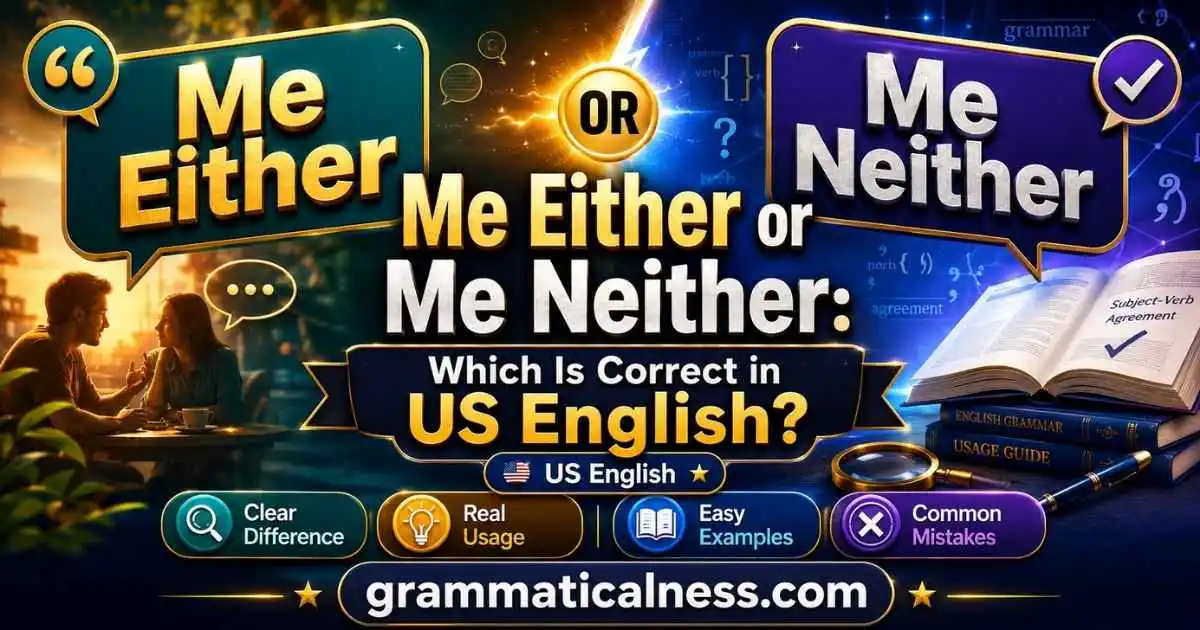
When someone makes a negative statement, should you reply “me either” or “me neither”?
For most speakers who want a safe, widely accepted choice, me neither is the better standalone response.
You may still hear me either in casual conversation, especially from some American speakers. People usually understand it to mean the same thing. However, its acceptance is less consistent, so it is not the best default for careful English.
The important difference comes down to how either and neither normally work with negative meaning.
Quick Answer
Use me neither as a casual standalone reply when you agree with a negative statement.
“I don’t like waking up at 5 a.m.”
“Me neither.”
Me either is also heard in informal speech and usually communicates the same idea, but many speakers and usage references consider it nonstandard or less suitable for careful English.
The safest pattern is simple: use me neither in casual conversation. In more formal or complete English, use a full construction such as Neither do I or I don’t either. Cambridge specifically records me neither as an informal spoken response and places either naturally inside an existing negative construction.
Why People Confuse Them
The confusion makes sense because both expressions can be heard after negative statements.
Consider:
“I can’t sleep on airplanes.”
A second speaker may say “Me neither.” Another speaker might casually say “Me either.” In conversation, both responses are likely to be understood as “I can’t sleep on airplanes either.”
The grammatical patterns behind them are different, though.
Neither already carries negative meaning. That makes me neither a natural shortened negative-agreement response.
Either, when it means “also” or “too,” normally appears with another negative element:
I can’t sleep on airplanes either.
That pattern may help explain why some speakers shorten a negative sentence to me either. However, the shortened standalone form does not have an explicit negative word supporting either.
Key Differences At A Glance
| Context | Best Choice | Why |
| Casual reply to “I don’t like it.” | Me neither | Established informal negative-agreement response |
| Careful or formal communication | Neither do I / I don’t either | Uses a complete grammatical structure |
| Standalone “Me either” | Usually avoid in careful English | Heard informally, but acceptance varies |
| Full sentence with an explicit negative | Either can be correct | Example: “They didn’t invite me either.” |
| Positive statement | Neither phrase | These expressions are used for negative agreement |
The central distinction is not that either is always wrong and neither is always right. The surrounding sentence matters.
Meaning and Usage Difference
Me neither means that the negative statement just made also applies to the speaker.
“I haven’t seen that movie.”
“Me neither.”
The response means, in effect, that the second person has not seen it either.
Me either is used by some speakers with the same intended meaning:
“I haven’t seen that movie.”
“Me either.”
Although listeners usually understand this response, it is less universally accepted as a standard standalone expression.
A useful distinction is:
- Me neither: conventional informal negative-agreement response.
- Me either: informal variant heard in speech; safer to avoid in careful writing.
- Either in a full negative sentence: fully normal, as in “I haven’t seen it either.”
Dictionaries consistently recognize adverbial either in negative sentences, while Cambridge explicitly gives me neither as a common informal spoken response. Context, and Formality
Both compared expressions sound conversational rather than formal.
Me neither works naturally in everyday dialogue, text conversations, casual comments, and informal personal writing.
“I’m not ready for Monday.”
“Me neither.”
Me either can sound natural to speakers who regularly use or hear it. To others, however, it may sound nonstandard or grammatically incomplete.
Because reactions vary, me neither is the safer choice when you do not know your audience.
For school assignments, professional documents, reports, or other formal contexts, a complete sentence is usually stronger than either short expression.
Which One Should You Use?
Choose me neither when you need a quick, natural reply to someone else’s negative statement.
For example:
“I don’t understand this new parking system.”
“Me neither.”
Use greater care with me either. It may work naturally within some speakers’ everyday dialect, but it is not as broadly accepted as a standalone standard response.
Do not confuse that with sentences where either follows a clear negative:
I don’t understand the system either.
In that sentence, either is completely natural because don’t already makes the statement negative. This use of either after a negative is directly documented in major dictionaries. One Choice Sounds Wrong
Me neither can sound wrong when there is no negative idea to agree with.
For example:
“I really enjoyed the concert.”
“Me neither.”
That response does not logically express simple agreement because the first statement is positive.
Me either also sounds risky as a standalone response in careful English:
“I can’t find my keys.”
“Me either.”
The intended meaning is clear, but me neither is the safer conventional response.
However, this sentence is different:
They couldn’t find me either.
Here, the exact words me either appear together, but they are not functioning as the standalone response being compared in this guide. Couldn’t supplies the negative context that allows either to mean “also.”
Common Mistakes (and Quick Fixes)
A common mistake is assuming that either must always be wrong whenever the idea is negative.
That is not true.
Incorrect reasoning: Never use either with a negative idea.
Better rule: Either commonly means “also” after an explicit negative.
I don’t want dessert either.
Another mistake is placing neither after an ordinary negative verb:
I don’t want dessert neither.
In standard edited English, that creates an unwanted double-negative structure. Use:
I don’t want dessert either.
Or restructure the statement with neither:
Neither do I.
Finally, do not assume that because me either is heard in conversation, every audience will consider it equally suitable. Spoken usage and careful written usage do not always follow exactly the same preferences.
Everyday Examples
At work
Maya: “I haven’t received the updated schedule.”
Jordan: “Me neither.”
Talking about food
Chris: “I don’t like extremely spicy wings.”
Alex: “Me neither.”
After a long commute
Sam: “I can’t stand sitting in traffic for an hour.”
Riley: “Me neither.”
Using either correctly in a full sentence
Taylor: “I haven’t heard back from the landlord.”
Morgan: “I haven’t either.”
Another full negative sentence
The first restaurant wasn’t open, and the second one wasn’t open either.
Casual regional or personal usage
“I don’t know the answer.”
“Me either.”
The final example is understandable in informal conversation, but me neither is the safer broadly accepted standalone choice.
Dictionary-Style Word Details
Verb
Me either: Not used as a verb. The expression contains the pronoun me and either, which serves an adverb-like agreement role in the intended informal construction.
Me neither: Not used as a verb. The phrase is an elliptical conversational response rather than a verb form.
Noun
Me either: This expression is not a noun. In this phrase, me functions as a first-person singular pronoun.
Me neither: Here, me also functions as a pronoun, while the full expression serves as a short conversational response. The full expression works as a short response showing agreement with a negative statement. Neither phrase should be labeled as a noun simply because it can stand alone as a reply.
Synonyms
Neither expression has a perfect one-word synonym.
Me either — closest plain alternatives for its intended meaning:
- I don’t either.
- Neither do I.
- Me neither.
For careful English, the first two alternatives remove the controversy surrounding standalone me either.
Me neither — closest plain alternatives:
- Neither do I.
- I don’t either.
The exact auxiliary verb changes with the original statement. For example, a statement with can’t may take a response built with can rather than do.
Example Sentences
Me either:
“I don’t remember his name.” “Me either.”
This is understandable informal usage, but me neither is safer in standard conversational English.
The same two words can also appear in a different, fully regular structure:
They didn’t call me either.
Me neither:
“I’ve never tried skiing.” “Me neither.”
“I can’t stay late tonight.” “Me neither.”
These examples use me neither as a short negative-agreement response.
Word History
Me either: The individual words have long histories in English, but the standalone conversational combination should not be assigned a precise first-use date without firm historical evidence. Its modern use is best understood as an informal negative-agreement expression associated with the regular pattern of using either after a negative.
Me neither: Its component words are also much older than the modern conversational formula. A precise origin date for the complete expression is not necessary for understanding current usage.
The important modern distinction is usage, not a claimed historical date.
Phrases Containing
Me either: The exact sequence can occur naturally inside a larger negative sentence:
They didn’t invite me either.
Here, either is supported by didn’t. This is grammatically different from using “Me either” alone as a response.
Me neither: Commonly appears as the complete short response:
“I don’t want to leave yet.”
“Me neither.”
It may also take conversational additions:
Me neither, honestly.
There is no need to invent longer fixed expressions for either form.
FAQs
Is “me either” or “me neither” correct?
Me neither is the safer and more widely accepted reply to a negative statement. Me either is heard in casual speech, but it is less suitable for careful or formal English.
What does “me neither” mean?
Me neither means that a negative statement also applies to you.
Example:
“I don’t like crowded places.”
“Me neither.”
Is “me either” grammatically correct?
Me either is common in some informal conversations and is usually understood. However, many speakers prefer me neither, neither do I, or I don’t either in standard English.
Can I say “I don’t either”?
Yes. I don’t either is a standard way to agree with a negative statement.
Example:
“I don’t watch that show.”
“I don’t either.”
Is “me neither” formal?
No. Me neither is mainly an informal conversational expression. In formal writing, a complete construction such as neither do I is usually a better choice.
What is the easiest rule to remember?
Use me neither as a short reply to a negative statement. Use either when the sentence already contains a negative, as in “I don’t like it either.”
Conclusion
When choosing between me either or me neither, use me neither as the safer standalone response to a negative statement.
“I don’t like cold weather.”
“Me neither.”
Me either is heard in informal speech and usually communicates the same intended idea, but its acceptance varies. Therefore, it is better not to rely on it in careful or formal English.
The most useful distinction is this: neither can carry the negative meaning in the short response, while either normally works naturally when a negative is already present, as in “I don’t either.”
That distinction helps explain both why me neither is the safer reply and why either itself is not incorrect in negative sentences.
Me neither is the safer and more widely accepted reply to a negative statement. Me either is heard in casual speech, but it is less suitable for careful or formal English.
Me neither means that a negative statement also applies to you.
Example:
“I don’t like crowded places.”
“Me neither.”
Me either is common in some informal conversations and is usually understood. However, many speakers prefer me neither, neither do I, or I don’t either in standard English.
Yes. I don’t either is a standard way to agree with a negative statement.
Example:
“I don’t watch that show.”
“I don’t either.”
No. Me neither is mainly an informal conversational expression. In formal writing, a complete construction such as neither do I is usually a better choice.
No. Me neither is mainly an informal conversational expression. In formal writing, a complete construction such as neither do I is usually a better choice.