

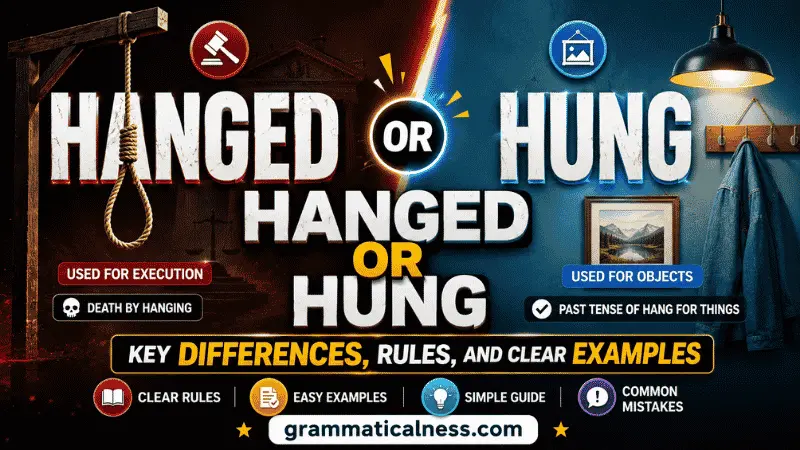
Both hanged and hung can serve as past forms of hang. However, they usually describe different situations.
Use hanged when hanging causes a person’s death. For example, a historical account may say that authorities hanged a prisoner.
In contrast, use hung for nearly every other meaning. You can hang a picture, coat, curtain, sign, or light. You can also hang out with friends, hang up the phone, or hang from a safety harness.
Therefore, the meaning of the action determines the correct form. Once you identify whether the sentence describes death or ordinary suspension, the choice becomes much easier.
Quick Answer
Use hanged when a person dies by hanging.
Use hung for displaying, attaching, or suspending something. Also use hung in common expressions such as hung out, hung up, and hung jury.
- Hanged: The authorities hanged the convicted prisoner.
- Hung: Elena hung the photograph above her desk.
As a simple rule, choose hanged for death and hung for everything else.
Why People Confuse Them
People often confuse these words because hang has two accepted past forms. Most verbs use only one past tense, so this unusual pattern can feel inconsistent.
Many writers learn the rule “people are hanged, but objects are hung.” Although that saying helps beginners, it does not explain every situation.
For example, a stage crew may hang an actor from a secure harness. Similarly, rescuers may hang a worker from a cable during an emergency exercise. In both cases, the person remains alive, so hung fits the meaning.
Therefore, focus on the result of the action rather than the type of subject.
Key Differences At A Glance
- Hanged describes death caused by hanging.
- Hung describes ordinary suspension, display, attachment, or position.
- Hanged often appears in historical, legal, or serious contexts.
- Hung appears in everyday speech and writing.
- Hanged rhymes with banged.
- Hung rhymes with young.
- Both words can work as the simple past or past participle of hang.
Meaning and Usage Difference
Hanged refers specifically to death by hanging. Writers commonly use it when discussing executions, historical punishments, murders, or suicides.
For example:
- The government hanged the prisoner at dawn.
- The court ordered that officials hang the convicted man.
- The report stated that the attackers had hanged the victim.
By comparison, hung covers the ordinary meanings of hang. It can describe placing an object above the ground, attaching something to a surface, or suspending a person safely.
For example:
- We hung the curtains yesterday.
- Marcus hung his coat near the door.
- The crew hung the performer from a safety cable.
In addition, phrasal verbs almost always use hung. You hung out with friends, hung up the phone, or hung on during a difficult moment.
For authoritative guidance, see Merriam-Webster’s “Hanged vs. Hung” usage guide, which explains that hung applies in most situations, while hanged is generally preferred for execution by hanging.
Tone, Context, and Formality
Hanged carries a serious and often disturbing meaning because it refers to death. As a result, writers usually use it in historical accounts, court reports, crime stories, and discussions of capital punishment.
Hung, on the other hand, usually sounds neutral. People use it when discussing decorating, clothing, signs, equipment, social activities, or body position.
Sometimes writers use hung when describing death by hanging. Readers may still understand the sentence. Nevertheless, hanged provides greater clarity in careful American English.
Therefore, use hanged when you need to make the fatal meaning unmistakable.
Which One Should You Use?
| Context | Best Choice | Why |
| Placing a picture on a wall | hung | The action involves display |
| Putting a coat on a hook | hung | The action involves attachment |
| Suspending a person from a harness | hung | The person remains alive |
| Causing death by hanging | hanged | The action results in death |
| Spending time with friends | hung | The correct phrase is hung out |
| Ending a phone call | hung | The correct phrase is hung up |
| Describing a jury that cannot agree | hung | The standard expression is hung jury |
First, ask whether the action caused death. If it did, choose hanged. Otherwise, choose hung.
When One Choice Sounds Wrong
Some sentences sound strange because the writer chooses the death-related form for an ordinary action.
For example, “The museum hanged three paintings” suggests the wrong meaning. Instead, write, “The museum hung three paintings.”
Similarly, “We hanged out after class” does not work. The phrasal verb hang out always forms its past tense as hung out.
A sentence such as “The actor hanged upside down during the stunt” also creates confusion. Because the actor survived, write, “The actor hung upside down during the stunt.”
However, the sentence “The executioner hung the prisoner” may still appear in informal writing. Although readers may understand it, hanged communicates the intended meaning more precisely.
Common Mistakes (and Quick Fixes)
Mistake: Using hanged whenever the sentence mentions a person.
Fix: Use hung when someone remains alive during the suspension.
Mistake: Writing hanged out.
Fix: Always write hung out.
Mistake: Writing hanged up the phone.
Fix: Use hung up the phone.
Mistake: Using hung in a formal description of an execution.
Fix: Choose hanged to make the fatal meaning clear.
Mistake: Writing hunged.
Fix: English does not use hunged as a standard past form.
Mistake: Assuming the subject alone determines the choice.
Fix: Instead, consider whether the action caused death.
Everyday Examples
- Nina hung a calendar beside her desk.
- We hung string lights across the backyard.
- Tyler hung his backpack on the chair.
- The workers hung a sign above the entrance.
- The director hung the actor from a secure harness.
- I hung out with my cousins on Saturday.
- She hung up before I finished speaking.
- The jury remained hung after several hours.
- The king hanged the rebel for treason.
- The authorities hanged the convicted criminal.
- The historian wrote that the army had hanged several prisoners.
- The court refused to let officials hang the defendant without another hearing.
These examples show the main pattern clearly. Hung covers everyday meanings, while hanged identifies death by hanging.
Dictionary-Style Word Details
Verb
Hanged: The simple-past and past-participle form of hang when the action causes death.
Example: The regime hanged its political opponents.
Hung: The simple-past and past-participle form of hang for attachment, suspension, display, position, and common expressions.
Example: Riley hung the painting above the fireplace.
Noun
Hanged: Standard American English does not commonly use hanged as a noun.
Hung: Standard American English does not commonly use hung as a noun in this comparison. However, it can function as an adjective in phrases such as hung jury.
Synonyms
Hanged: The closest plain alternatives include executed by hanging and put to death by hanging. However, no single substitute works naturally in every sentence.
Hung: Depending on the context, alternatives include suspended, displayed, mounted, attached, and draped.
Because hung has several meanings, it does not have one universal opposite.
Example Sentences
Hanged: The military hanged the spy after the trial.
Hung: Leah hung the new curtains before the guests arrived.
Hanged: The account claims that the rulers hanged several captives.
Hung: The technician hung the cables from the ceiling.
Word History
Hanged: English preserved this form mainly for death by hanging. Over time, writers increasingly connected it with executions and other fatal acts.
Hung: English developed this irregular form for the broader meanings of hang. Today, it covers nearly every use that does not specifically involve death.
Although actual usage sometimes overlaps, the modern distinction helps writers communicate more clearly.
Phrases Containing
Hanged:
- hanged by the neck
- be hanged
- the Hanged Man
- I’ll be hanged
Hung:
- hung out
- hung up
- hung over
- hung on
- hung in the balance
- hung jury
- hung from the ceiling
FAQs
Both forms are correct, but they express different meanings. Use hanged when hanging causes a person’s death. In contrast, use hung for ordinary suspension, attachment, display, position, and expressions such as hung out, hung up, and hung on.
Yes, hung can describe a person who remains alive while suspended. For example, a stunt coordinator may hang a performer from a harness. However, choose hanged when the sentence specifically states that hanging caused the person’s death.
Write hanged himself when the phrase means that the person died by hanging. This form communicates the fatal result clearly. Use hung himself only for a nonfatal physical position, although you may need extra details to prevent misunderstanding.
The correct form is hung out. The phrase hang out means spending relaxed time with people or staying in a place casually. Because it does not involve death, it always follows the ordinary past-tense pattern and becomes hung out.
Use hung up. You can say someone hung up the phone, hung up a coat, or became hung up on a small problem. These meanings involve ending, attaching, or becoming mentally stuck, so the death-related form does not apply.
They sometimes overlap in informal or historical writing, especially in sentences about death. Nevertheless, careful writers usually keep the distinction. Choose hanged for death by hanging and hung for every ordinary, figurative, or nonfatal use of the verb.
Conclusion
Use hanged when hanging causes death. In every other context, use hung.
Therefore, authorities may hang a prisoner and later report that they hanged him. Meanwhile, a homeowner hangs a picture and later says that she hung it on the wall.
Remember this final rule: people who die are hanged; people and things that remain suspended are hung.