

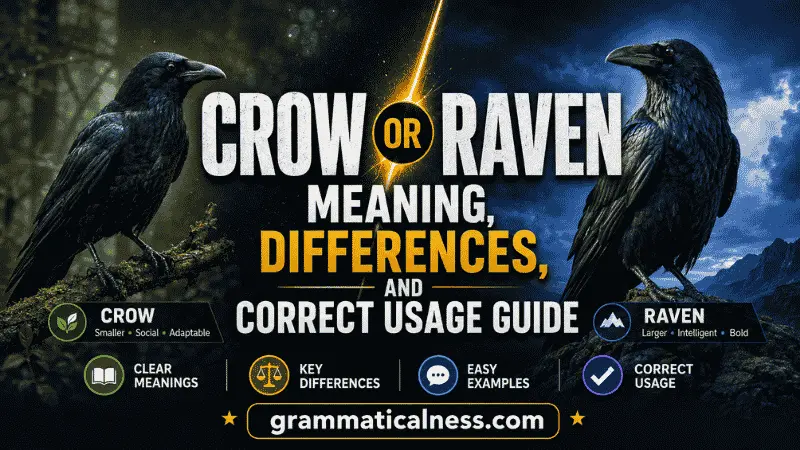
Crow and raven are both correct words, but they do not normally name the same bird. In North American everyday use, crow often refers to the American Crow, while raven often refers to the Common Raven.
The two birds can look alike because both are large, dark members of the same bird family. Still, their size, bill, throat feathers, tail shape, voice, and flight style differ. Their words also have separate verb meanings.
This guide explains how to choose crow or raven accurately in descriptions, stories, schoolwork, and everyday conversation.
Quick Answer
Use crow for a crow and raven for a raven. The terms are not interchangeable when you are identifying a particular bird.
A typical American Crow is smaller, has a slimmer bill, a smoother throat, a fan-shaped tail, and a sharper caw. A Common Raven is larger, has a heavier bill, shaggy throat feathers, a tapered tail, and a deeper croak.
Because distance can make size hard to judge, use more than one clue before choosing the word.
Why People Confuse Them
Crows and ravens share several visible traits. Both can appear entirely black, both have strong bills, and both belong to the corvid family. Many crow and raven species also belong to the genus Corvus.
Their common names do not create a perfectly strict scientific boundary across every species. In general, birds called ravens are larger and heavier than birds called crows, but field identification still depends on the species and location.
Movies and stories add another source of confusion. Writers sometimes choose raven because it sounds darker or more dramatic, even when the pictured bird looks more like a crow.
Key Differences At A Glance
| Feature | crow | raven |
| Typical US reference | American Crow | Common Raven |
| Overall build | Smaller and slimmer | Larger and heavier |
| Bill and throat | Slimmer bill; smoother throat | Thick bill; shaggy throat feathers |
| Tail in flight | Rounded or fan-shaped | Tapered or wedge-shaped |
| Common call | Sharper caw | Deeper croak |
| Flight | More steady flapping | More gliding and soaring |
These are practical clues, not absolute rules for every species worldwide.
Meaning and Usage Difference
As nouns, crow and raven name related but different kinds of birds. In a sentence such as “A crow landed on the fence,” the word identifies the bird as a crow. Replacing it with raven changes the identification.
For a typical North American comparison, people usually mean the American Crow and the Common Raven. The raven is generally larger, with a more massive bill and shaggy feathers around the throat. In flight, its tail often narrows toward the center. The crow usually looks more compact and shows a rounded or fan-shaped tail.
The words also differ outside bird names. Crow can be a verb meaning to boast or speak proudly. Raven can be a rare literary verb meaning to devour greedily or plunder.
Raven can also appear before a noun as a literary color description. In raven hair, for example, it means deep, glossy black rather than referring directly to a bird.
For additional visual identification tips, explore this Cornell Lab guide on how to tell crows and ravens apart.
Tone, Context, and Formality
As bird nouns, crow and raven are neutral words. Either one fits casual, academic, scientific, and descriptive writing when it names the correct bird.
Raven often carries a darker or more poetic feeling because of its use in literature and expressions such as raven hair. That association affects tone, but it does not change the bird’s identity.
The verb crow, meaning “boast,” is often informal and may sound critical. The verb raven is uncommon in modern conversation and usually sounds literary or old-fashioned.
Which One Should You Use?
| Context | Best Choice | Why |
| A smaller black bird giving repeated caws | crow | The size and call support a crow identification |
| A very large black bird with a deep croak and wedge-shaped tail | raven | The build, voice, and tail support a raven identification |
| The official name American Crow | crow | Crow is part of the species name |
| The official name Common Raven | raven | Raven is part of the species name |
| You cannot identify the bird confidently | crow or raven | This wording keeps the uncertainty honest |
| Someone boasts after winning | crow | Crow has an established verb sense meaning “boast” |
| A literary passage describes greedy devouring | raven | Raven can serve as a rare literary verb |
For field descriptions, combine voice, tail, bill, throat, flight, and location. Do not rely on color alone because both birds can look black.
When One Choice Sounds Wrong
Using raven for every large black bird sounds inaccurate. A crow seen nearby may look surprisingly large, especially without another object for scale.
Using crow for a bird already identified as a Common Raven is also incorrect. The birds are related, but the names are not casual substitutes.
The verb senses cannot be exchanged either:
- Correct: The winner began to crow about the score.
- Wrong: The winner began to raven about the score.
- Correct but literary: The hungry animals ravened over the food.
- Wrong: The hungry animals crowed over the food, unless they were boasting.
Common Mistakes (and Quick Fixes)
- Mistake: Choosing raven only because the sentence has a mysterious mood.
Fix: Identify the bird first, then choose the noun. - Mistake: Using size as the only test.
Fix: Check the voice, tail, bill, throat feathers, and flight pattern too. - Mistake: Assuming crow is a broad name for every raven.
Fix: Treat the terms as separate bird names in normal writing. - Mistake: Treating capitalization as a universal grammar rule.
Fix: Many birding references write American Crow and Common Raven, but publications may follow different house styles. - Mistake: Saying a crow “crows” because of its name.
Fix: Crows commonly caw; roosters crow.
Everyday Examples
- A crow carried a walnut onto the quiet street.
- We heard several crows calling from the trees behind the school.
- A raven soared above the canyon without flapping for several seconds.
- The ranger identified the heavy-billed bird as a Common Raven.
- From that distance, I could not tell whether the bird was a crow or raven.
- Maya refused to crow about her victory.
- The novel described a raven with shaggy throat feathers.
- The photographer waited for the raven to spread its wedge-shaped tail.
Dictionary-Style Word Details
Verb
Crow: To make a rooster-like cry; also, to boast or express triumph.
Example: He crowed about finishing first.
Raven: A rare or literary verb meaning to devour greedily, prey, or plunder.
Example: The creatures ravened over the remains.
Noun
Crow: A common name for various medium-to-large corvid birds. It can also mean a rooster’s cry or a cry of triumph.
Raven: A common name for several large-bodied corvid birds, especially the Common Raven in much North American usage.
Synonyms
Neither bird noun has an exact everyday synonym that preserves the same identification.
Crow: Closest plain alternatives include crow species or the broader term corvid.
Raven: Closest plain alternatives include raven species or the broader term corvid.
The broader description black bird is not exact, and blackbird names a different kind of bird. Clear antonyms do not apply.
Example Sentences
Crow: A crow watched us from the telephone wire.
Crow: Do not crow about the result before the final count.
Raven: A raven crossed the valley on long, steady wings.
Raven: The old tale describes wolves ravening after food.
Word History
Crow: The word comes from an Old English form and is generally connected with an imitation of the bird’s harsh call.
Raven: The noun comes from an Old English Germanic word for the bird. The separate verb is connected with ideas of greed, prey, and plunder.
The two words have long histories, but their modern bird meanings should not be treated as exact synonyms.
Phrases Containing
Crow: as the crow flies, eat crow, crow about something, crow’s feet.
Raven: Common Raven, raven hair, raven-black, ravening appetite.
In raven hair and raven-black, the word describes a deep, glossy black color rather than identifying a bird.
FAQs
No. In ordinary use, they name different birds, though both belong to the same broader family and many belong to Corvus. Use the word matching the bird. When identification is uncertain, write “a crow or raven” rather than guessing.
Listen and check the tail in flight. An American Crow often gives a sharper caw and shows a fan-shaped tail. A Common Raven usually gives a deeper croak and has a tapered tail. Use several clues together.
No. Distance can distort size, and several crow or raven species may occur in one region. Check the bill, throat feathers, tail shape, flight style, voice, location, and nearby birds carefully before choosing the name.
Use lowercase for general references, such as “a crow” or “a raven.” Many birding references capitalize standardized names such as American Crow and Common Raven. However, capitalization conventions can vary, so follow your publication’s established house style.
Yes, but their meanings differ. To crow can mean to make a rooster-like sound or boast proudly. To raven is rare and literary, meaning to devour greedily or plunder. These senses do not name the birds’ usual calls.
Sometimes, especially in literature and phrases such as raven hair or raven-black. That tone does not make raven the right label for every black bird. In factual writing, choose the word from the bird’s identity, not the mood.
Conclusion
Crow and raven are both standard words, but they usually identify different birds. Choose crow for a crow and raven for a raven.
In North America, a crow is generally smaller, smoother-throated, fan-tailed, and more likely to give a sharp caw. A raven is generally larger, heavier-billed, shaggy-throated, wedge-tailed, and more likely to give a deep croak.
When the view is unclear, use several clues or write “a crow or raven” until the identification is certain.